How Many Attempts for JEE Advanced Are Permitted? The Official Rules Explained
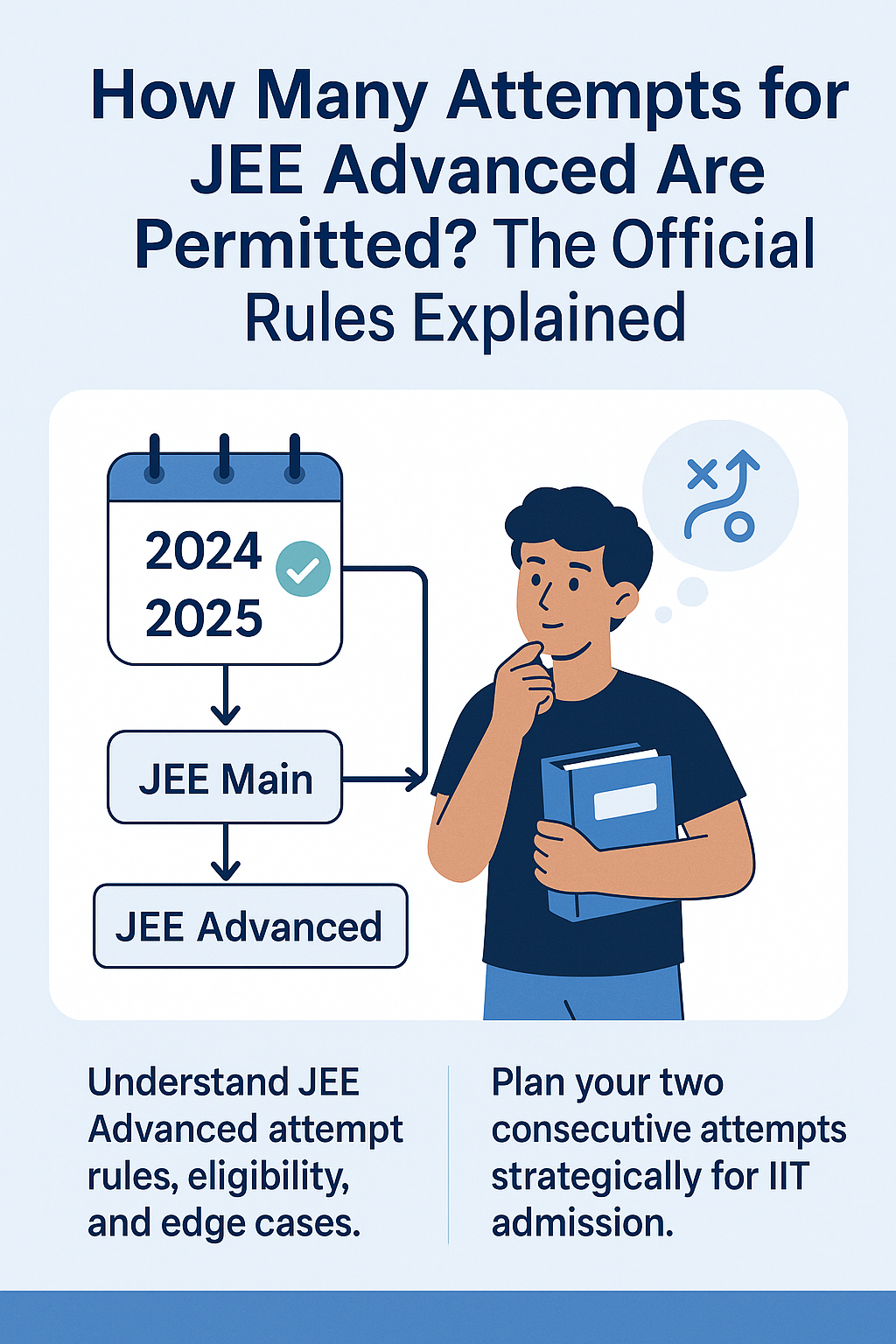
The Joint Entrance Examination (JEE) Advanced is one of the most competitive engineering entrance exams in India, determining admission to the prestigious Indian Institutes of Technology (IITs). Students often have many questions about eligibility, particularly regarding the number of attempts allowed. Misunderstanding the rules can lead to confusion, missed opportunities, or even disqualification. In this article, we explain the official rules, common edge cases, and the nuances that students must understand to avoid surprises.
The Basic Rule: Two Consecutive Years
The most fundamental rule regarding attempts is straightforward: a candidate can attempt JEE Advanced a maximum of two consecutive years. This means that a student who clears the JEE Main exam in a given year and becomes eligible for JEE Advanced can appear for the exam that year and, if needed, the following year as well. After two consecutive years, candidates become ineligible, regardless of their performance.
It is important to note the term “consecutive years.” This implies that students must utilize their eligibility in back-to-back years; skipping a year in between does not extend the window for attempts. For instance, if a student qualifies for JEE Advanced in 2024 but decides not to appear, they cannot reattempt in 2026 unless they requalify through JEE Main, subject to other eligibility conditions.
Age and Year of Passing Criteria
The number of attempts is linked to the year of passing the Class 12 (or equivalent) exam. The official rules specify that students must have passed their Class 12 examination in either the year of the current JEE Advanced attempt or the previous year. For example, for JEE Advanced 2026, eligible candidates must have passed Class 12 in 2025 or 2026.
This rule ensures that students are fresh or recent graduates, aligning with the two consecutive attempts framework. Students who passed Class 12 earlier than the previous year are automatically ineligible, even if they have never attempted JEE Advanced before.
If you are preparing for Class 12, explore AllRounder.ai courses here.
Nationality and Residency Considerations
While the exam is primarily designed for Indian nationals, foreign nationals and Persons of Indian Origin (PIO) / Non-Resident Indians (NRI) also have eligibility criteria that include the same two-year attempt rule. However, some IITs provide supernumerary seats for foreign candidates. These candidates must also adhere to the “two consecutive years” policy, ensuring fairness across all student categories.
Exceptions and Special Cases
1. Reappearing Students
A common question arises for students who reappear for Class 12 exams. Suppose a student passed Class 12 in 2024 but chose to reappear in 2025 to improve marks. In this scenario, the attempt eligibility is reset based on the latest passing year, i.e., 2025. The student can now attempt JEE Advanced in 2025 and 2026.
2. Improvement Exam Candidates
Students who appear for improvement exams also fall under a similar rule. If a student reappears for a single subject to enhance their board score, their eligibility for JEE Advanced is counted from the original passing year, not the improvement exam year. This subtle distinction is crucial, as misunderstanding it can lead to ineligibility or disqualification.
3. Candidates with Drop Years
Some students take a drop year to prepare better for the exam. The two-year consecutive attempt rule applies only if the student qualifies through JEE Main. A dropper cannot attempt JEE Advanced without requalifying through JEE Main, even if they were previously eligible.
4. Reserved Category Candidates
The attempt limit is uniform across all categories, including General, OBC-NCL, SC, ST, and EWS. There is no relaxation in the number of attempts for reserved category students. However, they may have relaxed qualifying marks in JEE Main, making it easier to qualify for JEE Advanced, but once qualified, the two-year attempt rule is the same for all.
Why the Two-Year Rule Exists
The rule is designed to maintain the academic relevance and fairness of the exam. JEE Advanced tests concepts from Class 11 and 12, and appearing too many years after graduation may disadvantage students whose knowledge is not fresh. Additionally, it ensures that the IIT admissions process remains streamlined, giving priority to students in the immediate academic cycle.
Consequences of Misunderstanding Attempt Rules
Students sometimes assume that failing once resets their eligibility, or that they can attempt multiple times over several years. Such misunderstandings can have serious consequences:
- Disqualification: A candidate attempting the exam in violation of the rules will be disqualified.
- Wasted Effort: Students may invest months in preparation only to realize they are not eligible to sit for the exam.
- Missed Opportunities: Failure to understand eligibility may result in missing the chance to attempt JEE Advanced within the legal window.
Key Takeaways for Students and Parents
1. Check Your Passing Year Carefully
Always verify the Class 12 passing year on your board certificate. The IITs strictly cross-check this information, and eligibility is non-negotiable.
2. Plan Your Attempts Strategically
The two-year window requires careful planning. Students should attempt the exam in the year they qualify and use the second attempt judiciously only if necessary. Over-preparing for the first year while ignoring mock tests can backfire.
3. Use Mock Tests Wisely
Mock tests and previous year papers are essential tools, especially when planning two attempts. They help identify strengths and weaknesses, allowing candidates to maximize their score within the limited attempts. Try interactive mock tests at AllRounder.ai.
4. Maintain Academic Balance
Students should not compromise board exam performance for JEE Advanced preparation. Since eligibility depends on recent Class 12 results, maintaining a strong academic record is essential to secure the first attempt.
5. Seek Professional Guidance
Parents and students should consult counsellors, coaching institutes, or official IIT announcements to ensure all eligibility criteria are met. Even minor oversights in understanding the rules can result in disqualification.
Frequently Asked Questions (FAQs)
Can a student attempt JEE Advanced without qualifying through JEE Main?
No. Qualification through JEE Main is mandatory for every attempt of JEE Advanced. Eligibility is not automatic.
If I fail JEE Advanced in my first attempt, can I skip the next year and attempt the year after?
No. The two-year consecutive attempt rule does not allow skipping a year. Candidates must attempt in consecutive years.
Do reserved category students get extra attempts?
No. The limit of two consecutive years applies to all categories. However, they may have relaxed JEE Main qualifying criteria.
Can a foreign student attempt JEE Advanced more than twice?
No. The same rule applies to all candidates, including foreign nationals.
Does reappearing for Class 12 reset eligibility?
Yes, but only if the student officially appears in all subjects again and passes. Single-subject improvements typically do not reset the attempt count.
Conclusion
Understanding how many attempts are permitted for JEE Advanced is critical for every aspirant. The two consecutive years rule ensures fairness, academic relevance, and streamlines the IIT admission process. Students must carefully consider their Class 12 passing year, plan attempts strategically, and use mock tests to maximize their performance.
Misunderstandings about eligibility can lead to disqualification or missed opportunities, so it is essential to consult official sources and plan wisely. Parents and mentors play a crucial role in guiding students through the process, helping them understand rules, and ensuring preparation is balanced and effective.
By being fully aware of the rules and planning accordingly, aspirants can focus on consistent preparation, strategic planning, and confidence-building, making the most of their permitted attempts. JEE Advanced is a test not only of knowledge but also of strategy, planning, and execution. Understanding your eligibility is the first step toward excelling in one of India’s most prestigious exams.
Explore more study support and smart tools at AllRounder.ai.