
Enrol to start learning
Reading is open to everyone. Enrolling is free, and it is what unlocks the audio lessons, practice tests and progress tracking.
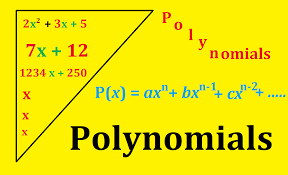
4. Polynomials
Learn about 4. Polynomials and discover its key concepts through interactive lessons and practical exercises.
Sections
This section provides an overview of polynomials, defining them and explaining their components.
This section outlines the various types of polynomials based on their degree and number of terms.
The degree of a polynomial is defined as the highest power of the variable with a non-zero coefficient, which helps classify the polynomial and its behavior.
This section covers the methods to add and subtract polynomials, focusing on combining like terms and the importance of arranging them in descending order for clarity.
This section focuses on the multiplication of polynomials using various methods, emphasizing the distributive property and polynomial identities.
This section introduces the division of polynomials, focusing on the methods of long division and synthetic division, highlighting their application in solving polynomial equations.
The Remainder Theorem states that the remainder of the division of a polynomial by a linear divisor can be determined by evaluating the polynomial at a specific value.
The Factor Theorem states that if a polynomial evaluates to zero at a certain value, then x minus that value is a factor of the polynomial.
Factorisation of polynomials involves breaking down polynomials into simpler components, making it easier to solve equations and understand polynomial behavior.
The zeros of a polynomial are the values of x for which the polynomial equals zero, which are vital for solving equations and graphing.
This section discusses how to graph polynomials on the Cartesian plane, focusing on the shapes of their graphs and significant features such as zeros, end behavior, and turning points.
Master the fundamentals of 4. Polynomials
Apply learned concepts in practical scenarios
Successfully complete all chapter exercises
Practice Exercises
Total Questions
4
Estimated Time
8 min
Passing Score
70%
Instructions
- Read each question carefully
- You can use hints if you need help
- Complete all questions before submitting