
Enrol to start learning
Reading is open to everyone. Enrolling is free, and it is what unlocks the audio lessons, practice tests and progress tracking.
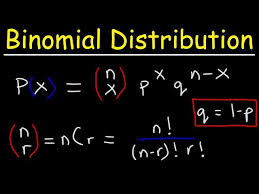
5. Binomial Distribution
Learn about 5. Binomial Distribution and discover its key concepts through interactive lessons and practical exercises.
Sections
The binomial distribution describes the number of successes in a fixed number of independent trials with two possible outcomes.
This section outlines the essential conditions that must be met for a random variable to follow a binomial distribution.
This section introduces the notation used in binomial distributions, explaining the relevant variables and symbols.
The Binomial Probability Formula calculates the probability of achieving exactly k successes in n independent Bernoulli trials with a constant probability of success.
This section explains the derivation of the binomial probability formula by considering the number of ways to choose successes and the probability of a specific outcome.
This section outlines the key properties of the binomial distribution, including mean, variance, and standard deviation.
Cumulative probabilities assess the likelihood of achieving a specific number of successes in binomial experiments.
This section presents worked examples for understanding the binomial distribution, demonstrating specific scenarios and calculations.
This section explains how to approximate the binomial distribution with a normal distribution when the number of trials, 𝑛, is large and the probability of success, 𝑝, is not close to 0 or 1.
This section presents an IB-style problem involving the binomial distribution, specifically related to a multiple-choice quiz scenario.
This section outlines scenarios where the binomial distribution is not applicable, including non-independent trials, varying probabilities, sampling methods, and multiple outcomes.
This section provides essential strategies for effectively approaching IB exams involving binomial distributions.
Master the fundamentals of 5. Binomial Distribution
Apply learned concepts in practical scenarios
Successfully complete all chapter exercises
Practice Exercises
Total Questions
3
Estimated Time
6 min
Passing Score
70%
Instructions
- Read each question carefully
- You can use hints if you need help
- Complete all questions before submitting