
AllRounder.ai

Enrol to start learning

Reading is open to everyone. Enrolling is free, and it is what unlocks the audio lessons, practice tests and progress tracking.
Enrol free
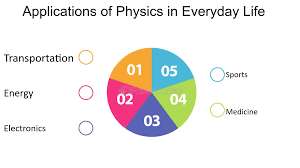
Physics in The Real World (Applications)

Physics in The Real World (Applications)

Learn about Physics in The Real World (Applications) and discover its key concepts through interactive lessons and practical exercises.

Sections

Mechanics in Daily Life

Mechanics is fundamental in our daily lives, influencing transportation, the design of machines, and our overall understanding of motion and forces.

1 Section Overview

Start current section content and materials

1.1 Transportation

This section explores the principles of mechanics and how they apply to transportation technologies such as cars, bicycles, and airplanes.

1.2 Machines and Levers

This section discusses the importance of simple machines, such as levers, in making work easier and more efficient.

Energy and Power in Technology

This section explores the crucial role of energy and power in various technological applications, highlighting electricity generation, solar energy, and battery technology.

2 Section Overview

Start current section content and materials

2.1 Electricity Generation

Electricity generation involves converting mechanical energy into electrical energy using various methods and technologies.

2.2 Solar Energy

Solar energy is the harnessing of sunlight for electricity generation using photovoltaic cells, playing a crucial role in renewable energy innovations.

2.3 Batteries

Batteries store chemical energy and convert it into electrical energy, forming the backbone of modern portable technology.

Waves and Sound

This section delves into waves and sound, exploring their applications in communication, medical technology, and audio systems.

3 Section Overview

Start current section content and materials

3.1 Communication

This section introduces the essential role of communication in physics applications, primarily through waves and sound.

3.2 Sound Waves

This section delves into sound waves, explaining their properties, applications in communication and medicine, and their significance in technology.

Optics and Light

This section explores the field of optics, focusing on the behavior of light and its applications in various technologies.

4 Section Overview

Start current section content and materials

4.1 Lenses in Eyewear

This section explores the role of lenses in eyewear, focusing on how concave and convex lenses function based on principles of optics.

4.2 Fiber Optic Communication

Fiber optic communication utilizes light to transmit data over distances, relying on the principle of total internal reflection.

4.3 Medical Imaging

Medical imaging utilizes principles of optics and electromagnetic radiation to create detailed images of the human body, facilitating diagnosis and treatment.

Thermodynamics in Real-World Applications

Thermodynamics explains the principles of heat, work, and energy transfer, which are essential in everyday technologies like refrigerators, engines, and environmental processes.

5 Section Overview

Start current section content and materials

5.1 Refrigerators and Air Conditioners

This section focuses on how refrigerators and air conditioners work based on the principles of thermodynamics, emphasizing heat transfer and the refrigeration cycle.

5.2 Engines and Combustion

This section discusses the principles of engines and combustion, focusing on thermodynamics and how heat energy is converted into mechanical work.

5.3 Global Warming

Global warming refers to the increase in Earth's average surface temperature due to greenhouse gas emissions, primarily from human activities.

Electromagnetism in Technology

Electromagnetism plays a crucial role in modern technology by enabling the operation of devices such as electric motors, transformers, and magnetic levitation trains.

6 Section Overview

Start current section content and materials

6.1 Electric Motors

Electric motors convert electrical energy into mechanical motion, utilizing electromagnetism principles in various applications.

6.2 Transformers

Transformers are crucial components in electrical power distribution, operating based on Faraday's Law of Induction to adjust voltage levels.

6.3 Magnetic Levitation

Magnetic levitation technology relies on magnetic fields to lift and propel objects, notably trains, enhancing speed and efficiency.

Nuclear Physics and Its Applications

Nuclear physics explores atomic nuclei and their applications, including energy generation and medical treatments.

7 Section Overview

Start current section content and materials

7.1 Nuclear Power

Nuclear power utilizes the process of nuclear fission to generate electricity, highlighting its advantages and potential risks.

7.2 Medical Treatments

This section discusses the application of nuclear physics in medical treatments, particularly radiation therapy and diagnostic imaging.

7.3 Nuclear Weapons

Nuclear weapons utilize the principles of nuclear fission and fusion, presenting significant implications for global security.

Physics in Environmental Science

Physics significantly contributes to environmental science by modeling climate systems, promoting sustainable energy, and controlling pollution.

8 Section Overview

Start current section content and materials

8.1 Climate Modeling

Climate modeling involves the application of physics to understand and predict climate systems and the impact of human activity on the Earth's atmosphere.

8.2 Sustainable Energy

Sustainable energy relies on clean sources such as wind, solar, and hydroelectric power to reduce environmental impact.

8.3 Pollution Control

Pollution control technologies employ physics principles to reduce environmental pollution and protect ecosystems.

Learning Objectives

  • Master the fundamentals of Physics in The Real World (Applications)

  • Apply learned concepts in practical scenarios

  • Successfully complete all chapter exercises

Practice Exercises

Total Questions

2

Estimated Time

4 min

Passing Score

70%

Instructions

  • Read each question carefully
  • You can use hints if you need help
  • Complete all questions before submitting