
AllRounder.ai

Enrol to start learning

Reading is open to everyone. Enrolling is free, and it is what unlocks the audio lessons, practice tests and progress tracking.
Enrol free
4. Atomic Structure

4. Atomic Structure

Learn about 4. Atomic Structure and discover its key concepts through interactive lessons and practical exercises.

Sections

Atomic Structure

Atoms are the basic building blocks of matter, comprising subatomic particles like protons, neutrons, and electrons, with a complex structure governed by historical atomic theory.

4 Section Overview

Start current section content and materials

4.1 Introduction

This section introduces the concept of atoms as the fundamental building blocks of matter and outlines significant developments in atomic theory.

4.2 What is an Atom?

An atom is the smallest particle of an element that retains its chemical properties.

4.3 Historical Development of Atomic Theory

This section outlines the key milestones in the development of atomic theory, from ancient philosophical ideas to modern scientific discoveries.

4.3.1 Democritus (400 BC)

Democritus, a Greek philosopher, introduced the concept of atoms as indivisible particles constituting matter.

4.3.2 John Dalton (1803) – Dalton’s Atomic Theory

Dalton’s Atomic Theory introduced the fundamental concept of atoms as the basic building blocks of matter, with specific postulates defining the nature of atoms and their interactions.

4.4 Discovery of Subatomic Particles

This section discusses the discovery of subatomic particles: electrons, protons, and neutrons, highlighting their properties and significance in understanding atomic structure.

4.4.1 Electron

The electron is a subatomic particle with a negative charge, discovered by J.J. Thomson in 1897, and plays a crucial role in the structure of atoms.

4.4.2 Proton

The proton is a positively charged subatomic particle discovered by Ernest Rutherford, playing a crucial role in defining the identity and mass of an atom.

4.4.3 Neutron

Neutrons are neutral subatomic particles discovered by James Chadwick in 1932.

4.5 Structure of an Atom

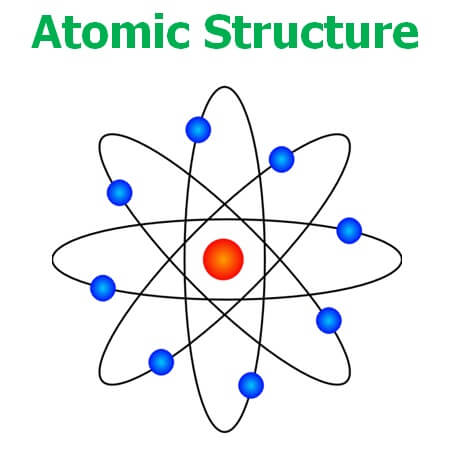
The structure of an atom involves a central nucleus containing protons and neutrons, with electrons orbiting in defined energy levels.

4.5.1 Nucleus

The nucleus is the central part of an atom, containing protons and neutrons, and plays a vital role in defining the atom's identity.

4.5.2 Electron Shells (Orbits)

Electron shells are the specific regions around an atom's nucleus where electrons are likely to be found.

4.6 Bohr’s Model of the Atom (1913)

Bohr’s model describes how electrons travel in fixed orbits around the nucleus and explains energy transitions in these electron shells.

4.7 Atomic Number and Mass Number

Atomic number is the number of protons in an atom and determines its identity, while the mass number is the sum of protons and neutrons in the nucleus.

4.7.1 Atomic Number (Z)

The atomic number (Z) refers to the number of protons in an atom, defining the identity of the element.

4.7.2 Mass Number (A)

The mass number of an atom is the total count of protons and neutrons, which determines its identity and properties.

4.8 Representation of an Atom

This section explains the representation of an atom using its atomic and mass numbers, as well as the significance of how atoms are denoted.

4.9 Distribution of Electrons – Electronic Configuration

This section explains how electrons are distributed in an atom, detailing the electronic configuration and the maximum number of electrons that can occupy each shell.

4.10 Valency

Valency refers to the combining capacity of an atom, determined by the number of electrons in its outermost shell.

4.10.1 Octet Rule

The octet rule states that atoms tend to gain, lose, or share electrons to have a full outer shell of eight electrons, leading to chemical stability.

4.10.2 Rules to Find Valency

This section details the concept of valency, focusing on the rules to determine the combining capacity of an atom based on its valence electrons.

4.11 Isotopes and Isobars

This section discusses isotopes and isobars, explaining their definitions and differences.

4.11.1 Isotopes

Isotopes are variants of the same element with the same atomic number but different mass numbers.

4.11.2 Isobars

Isobars are atoms of different elements that have the same mass number but different atomic numbers.

4.12 Summary

Atoms are the foundational building blocks of matter, composed of subatomic particles with distinct properties.

Learning Objectives

  • Master the fundamentals of 4. Atomic Structure

  • Apply learned concepts in practical scenarios

  • Successfully complete all chapter exercises

Practice Exercises

Total Questions

4

Estimated Time

8 min

Passing Score

70%

Instructions

  • Read each question carefully
  • You can use hints if you need help
  • Complete all questions before submitting