
Enrol to start learning
Reading is open to everyone. Enrolling is free, and it is what unlocks the audio lessons, practice tests and progress tracking.
Chapter 4 : Geometry
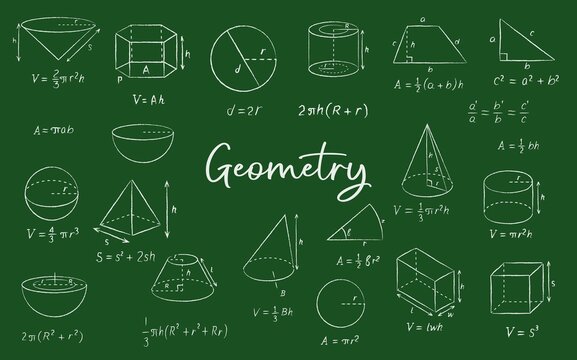
The chapter on Geometry provides a comprehensive exploration of plane figures, solid shapes, symmetry, geometric constructions, and theorems. It covers the properties of various polygons, characteristics of 3D shapes, and the significance of symmetry in both nature and design. Additionally, it features real-world applications and historical insights on geometric constructs, emphasizing their mathematical precision and artistic elements.
Sections
Plane geometry involves the study of flat shapes, including polygons and their properties.
Solid geometry focuses on three-dimensional shapes, their properties, and measurements, including Euler's formula.
This section covers the essential components of circles, including the center, radius, diameter, and circumference, alongside real-world applications.
This section covers the fundamental concepts of symmetry, including types such as line and rotational symmetry, and provides practical activities to explore these concepts.
This section covers basic geometric constructions, including perpendicular bisectors and angle bisectors using a compass.
This section encapsulates the core concepts of geometry, including plane figures, solid shapes, symmetry, geometric constructions, and their practical applications.
This section highlights various activities designed to enhance students' understanding of geometric concepts through practical application.
This section provides intriguing geometric facts and insights, emphasizing the fascinating relationship between geometry and the real world.
Plane figures include polygons and their properties, such as the number of sides and angles.
Solid shapes are defined by their three-dimensional characteristics including vertices, edges, and faces.
Symmetry plays a critical role in design, with examples ranging from nature to man-made structures.
Geometric constructions serve as foundational tools in creating accurate drawings and designs.
Polygon Properties
Understanding various polygons, their sides, angles, and diagonals.
Euler's Formula
A formula that relates the number of faces (F), vertices (V), and edges (E) of polyhedrons: F + V - E = 2.
Types of Symmetry
Distinguishing between line symmetry, where folded halves match, and rotational symmetry, where an object matches itself after rotation.
Geometric Constructions
Various methods to create specific angles and shapes using tools like a compass and straightedge.