
AllRounder.ai

Enrol to start learning

Reading is open to everyone. Enrolling is free, and it is what unlocks the audio lessons, practice tests and progress tracking.
Enrol free
3. Magnetic Effect of Current and Magnetism

3. Magnetic Effect of Current and Magnetism

Learn about 3. Magnetic Effect of Current and Magnetism and discover its key concepts through interactive lessons and practical exercises.

Sections

Magnetic Effect of Current and Magnetism

This section explores how electric currents create magnetic fields and the fundamental principles of magnetism.

3 Section Overview

Start current section content and materials

3.1 Introduction

This section introduces the interrelationship between electricity and magnetism, exploring how electric currents generate magnetic fields and vice versa.

3.2 Key Concepts

This section covers the fundamental principles of electromagnetism, including the relationship between electric currents and magnetic fields.

3.2.1 Oersted's Experiment

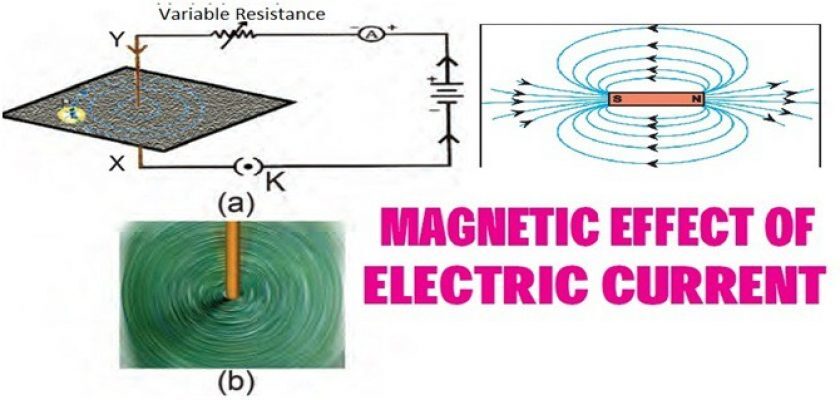
Oersted's Experiment demonstrated that electric currents create magnetic fields, a foundational concept in electromagnetism.

3.2.2 Biot–Savart Law

The Biot–Savart Law quantifies the magnetic field generated by an electric current through a small current element.

3.2.3 Magnetic Field Due to a Long Straight Wire

This section explains how a long straight wire carrying current produces a magnetic field in its vicinity, including the mathematical formula governing this phenomenon.

3.2.4 Magnetic Field on the Axis of a Circular Coil

This section details the calculation of the magnetic field produced on the axis of a circular coil and its significance.

3.2.5 Ampere’s Circuital Law

Ampere’s Circuital Law relates the integrated magnetic field around a closed loop to the current passing through the loop.

3.2.6 Magnetic Field Inside a Solenoid

This section covers how a solenoid produces a uniform magnetic field when an electric current passes through it.

3.2.7 Force on a Moving Charge in Magnetic Field (Lorentz Force)

The Lorentz force describes the impact of a magnetic field on a charge in motion, essential for understanding the behavior of charged particles within magnetic fields.

3.2.8 Motion of a Charged Particle in a Magnetic Field

This section discusses the behavior of charged particles when they move through a magnetic field, detailing their circular motion and the mathematical relationships governing their motion.

3.2.9 Force on a Current-Carrying Conductor in Magnetic Field

A current-carrying conductor experiences a force when placed in a magnetic field, a principle critical for understanding electric motors.

3.2.10 Torque on a Current Loop in Magnetic Field

This section discusses how a current loop experiences torque when placed in a magnetic field, quantified by the formula τ = nIA B sin θ.

3.2.11 Magnetic Dipole and Magnetic Dipole Moment

This section focuses on the concept of magnetic dipoles and their associated magnetic moment, key components in understanding magnetism.

3.2.12 Magnetism and Gauss's Law

Magnetism governs the behavior of magnetic fields and their interactions with electric currents, encapsulated by principles such as Gauss's law.

3.2.13 Earth’s Magnetism

Earth's magnetism is likened to a giant bar magnet, affecting navigation through its magnetic field.

3.2.14 Types of Magnetic Materials

This section discusses the different types of magnetic materials based on their magnetic permeability, including diamagnetic, paramagnetic, and ferromagnetic materials.

3.3 Important Definitions

This section defines key terms related to the magnetic effect of current, helping students understand core concepts critical to electromagnetism.

3.4 Summary

This section provides a comprehensive overview of the key concepts related to the magnetic effect of current and magnetic fields.

Learning Objectives

  • Master the fundamentals of 3. Magnetic Effect of Current and Magnetism

  • Apply learned concepts in practical scenarios

  • Successfully complete all chapter exercises

Practice Exercises

Total Questions

2

Estimated Time

4 min

Passing Score

70%

Instructions

  • Read each question carefully
  • You can use hints if you need help
  • Complete all questions before submitting