
Homologous Structures
Interactive Audio Lesson
Listen to a student-teacher conversation explaining the topic in a relatable way.
Introduction to Homologous Structures
🔒 Unlock Audio Lesson
Sign up and enroll to listen to this audio lesson

Today, we're going to discuss homologous structures. Can anyone tell me what they think that term means?

Does it mean similar parts in different organisms?
Exactly! Homologous structures are features in different species that share a common ancestry. They do not necessarily perform the same function, which is fascinating!

Can you give us an example of that?
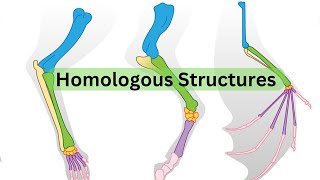
Sure! The pentadactyl limb is a perfect example. It’s found in humans, whales, bats, and many other vertebrates. Although they serve different purposes, they share a similar bone structure. Remember, 'common ancestry means similar anatomy'—that’s a good key point!
Examples of Homologous Structures
🔒 Unlock Audio Lesson
Sign up and enroll to listen to this audio lesson

Now, let’s discuss some specific examples of homologous structures. What might be some other examples beyond the pentadactyl limb?

What about the forelimbs of primates and rodents? They look a bit similar.
Great observation! The forelimbs of primates are indeed similar to those of rodents, even though they function differently. This similarity further supports the idea of a common ancestor.

So, does that mean species can evolve from a common ancestor and still look quite different?
Absolutely right! That’s the essence of evolution—species adapt to their environments while retaining traces of their common ancestry. Let's remember that: 'different functions, common forms'.
Significance of Homologous Structures
🔒 Unlock Audio Lesson
Sign up and enroll to listen to this audio lesson
Why do we study homologous structures? What do they tell us about evolution?
They probably show us how species are related?
Exactly! They provide evidence for common ancestry and help us understand evolutionary pathways. They illustrate how species evolve differently but from similar origins.
If they can look so different, can we have a situation where structures become more similar?
Good question! That’s called convergent evolution, where unrelated species develop similar traits due to similar environments. But we’re focusing on homology today, which highlights distinct evolutionary paths.
So homologous structures show us that diversity can arise from a common ancestor?
Exactly! Good summary: 'homologous = diversity from common ancestry'. Let’s keep that in mind.
Introduction & Overview
Read summaries of the section's main ideas at different levels of detail.
Quick Overview
Standard
Homologous structures are anatomical features in different species, similar due to shared evolutionary history, indicating common ancestry despite varied functions. The pentadactyl limb exemplifies this, showing that diverse species evolved from a common ancestor.
Detailed
Homologous Structures
Homologous structures are anatomical features found in different species that share a common evolutionary origin. Despite serving different functions in the organisms, their similarities highlight the concept of common ancestry. A classic example of homologous structures is the pentadactyl limb, characterized by a five-digit configuration found in various vertebrates like humans, bats, and whales. Each of these limbs has adapted to meet different environmental demands—grasping for humans, flying for bats, and swimming for whales—all while retaining the underlying structural similarities inherited from a common ancestor. The study of homologous structures offers compelling evidence for the theory of evolution, illustrating how species diversify over time from shared lineage.
Youtube Videos
![Evolution and Speciation [IB Biology SL/HL]](https://img.youtube.com/vi/0hf5Wq3aEE8/mqdefault.jpg)
![Cell Structure and Function [IB Biology SL/HL]](https://img.youtube.com/vi/8aQe0_OoaEA/mqdefault.jpg)
![NEW 2025 EXAM - IB Biology A4.1 - Evolution & Speciation [SL/HL] - Interactive Lecture](https://img.youtube.com/vi/6XX_wlAHeU4/mqdefault.jpg)
Audio Book
Dive deep into the subject with an immersive audiobook experience.
Definition of Homologous Structures
Chapter 1 of 2
🔒 Unlock Audio Chapter
Sign up and enroll to access the full audio experience
Chapter Content
Structures in different species that are similar due to common ancestry.
Detailed Explanation
Homologous structures are anatomical features in different species that have a similar underlying structure because they evolved from a common ancestor. This means that even though the functions of these structures might differ, their fundamental design is alike. Understanding this concept is crucial in studying evolution because it highlights how diverse life forms can adapt differently to their environments while still sharing a common lineage.
Examples & Analogies
Think of homologous structures like a family resemblance. Just as siblings might have different hairstyles or wear different clothes, they share certain facial features inherited from their parents. Similarly, species may develop different traits but still have a shared evolutionary background.
Evidence of Homologous Structures
Chapter 2 of 2
🔒 Unlock Audio Chapter
Sign up and enroll to access the full audio experience
Chapter Content
The pentadactyl limb in vertebrates (e.g., human hands, bat wings, whale flippers) indicates a common evolutionary origin despite different functions.
Detailed Explanation
The pentadactyl limb is a prime example of homologous structures. This structure is characterized by five digits and can be found in various vertebrates, such as humans, bats, and whales. While the limbs serve different purposes—grasping for humans, flying for bats, and swimming for whales—the underlying bone structure remains remarkably similar. This similarity provides strong evidence that these species share a common ancestor that also had a similar limb structure.
Examples & Analogies
Imagine a toolkit. While each tool may have a different function—like a screwdriver or a hammer—they are all built to be held in a hand. Similarly, the limbs of different vertebrates may have evolved for diverse functions, but they originate from the same basic design, just like tools in a toolkit.
Key Concepts
-
Homologous Structures: Features in different species derived from a common ancestor, demonstrating common evolutionary origins.
-
Pentadactyl Limb: A specific example of homologous structures seen across various vertebrate species.
-
Common Ancestry: The idea that different species have evolved from shared ancestral forms.
Examples & Applications
The human arm, bat wing, and whale flipper showcase the pentadactyl limb structure.
The forelimbs of various mammals, such as elephants, seals, and cats, reveal homologous features acting in different environments.
Memory Aids
Interactive tools to help you remember key concepts
Rhymes
Homologous, oh so grand, structures shared across the land. Different roles but roots the same, evolution's ever-changing game.
Stories
Imagine a family tree where each branch grows differently in nature. A human arm, a bat's wing, and a whale's flipper: all siblings connected through a shared parent but choosing their own paths in life.
Memory Tools
H.A.R.D. - Homologous Anatomy Reflects Divergence. Remember, it's about structure from ancestry!
Acronyms
H.O.L.D. - Homologous Origin Leads to Diversity. Helps recall the connection between these structures and their evolution!
Flash Cards
Glossary
- Homologous Structures
Anatomical features in different species that are similar due to shared ancestry.
- Pentadactyl Limb
A limb structure characterized by five digits found in many vertebrates, illustrating homologous anatomy.
- Common Ancestry
The concept that different species share a common ancestor from which they evolved.
Reference links
Supplementary resources to enhance your learning experience.