
Atomic Number (Z) and Mass Number (A): Unique Identifiers for Atoms
Interactive Audio Lesson
Listen to a student-teacher conversation explaining the topic in a relatable way.
Atomic Number (Z)
🔒 Unlock Audio Lesson
Sign up and enroll to listen to this audio lesson

Today, let's begin our discussion with the atomic number, which is denoted as Z. Can anyone tell me what the atomic number represents?

Does it tell us how many protons are in an atom?
That's exactly right! The atomic number is crucial as it defines an element. For example, what element has an atomic number of 6?

That would be carbon!
Great job! Now, remember, the atomic number also tells us the number of electrons in a neutral atom. So, what can we remember about this?

If the atomic number is 6, there are 6 electrons in a neutral carbon atom too.
Exactly! To help us remember, we can use the acronym Z for 'Zest' since it gives each element its unique identity. Shall we visualize how these numbers fit into the periodic table?

Yes, looking at the table would definitely help!
Recap: The atomic number (Z) indicates the number of protons and electrons, giving each element its identity. Remember to associate zest with Z!
Mass Number (A)
🔒 Unlock Audio Lesson
Sign up and enroll to listen to this audio lesson

Next, let's explore the mass number, denoted as A. Who can define what mass number is?
Isn't mass number the total of protons and neutrons in the nucleus?
That's correct! The mass number helps us understand the isotope forms of an element. For example, carbon commonly exists as Carbon-12 with a mass number of 12. Can anyone tell me how we would calculate that?
By adding the number of protons and neutrons? Like if it's 6 protons and 6 neutrons for Carbon-12 then it's 12!
Exactly! Now, tell me, if I have Carbon-14, how many neutrons does it have?
It would have 8 neutrons because 14 minus 6 is 8!
Fantastic! Can anyone summarize the significance of mass number?
The mass number distinguishes between isotopes of the same element, which can have different physical properties.
Great summary! Remember: A for 'Amount' as in the total number of protons and neutrons is the mass number!
Understanding Isotopes
🔒 Unlock Audio Lesson
Sign up and enroll to listen to this audio lesson
Now, who can tell me what an isotope is?
Isotopes are atoms of the same element that have the same number of protons but different neutrons?
Exactly! So how does this affect their mass numbers?
They will have different mass numbers since they have different numbers of neutrons, even though the atomic number is the same.
Yes! Let's give an example. What might be a common isotope of hydrogen?
Protium has 1 proton and no neutrons, and then there's deuterium, which has 1 proton and 1 neutron!
Well done! Remember: Isotopes have the same Z, different A, and that's why they can behave similarly chemically but have different physical properties.
That makes sense! It's really interesting how these little differences can matter so much.
Exactly! To summarize: Isotopes differ in neutrons and mass number but share the same atomic number. Always remember the acronym Z for identity and A for amount!
Introduction & Overview
Read summaries of the section's main ideas at different levels of detail.
Quick Overview
Standard
In this section, we delve into atomic number (Z) and mass number (A) as unique identifiers for atoms, describing how the atomic number defines an element and the mass number gives information about its isotopes. Both numbers play crucial roles in understanding atomic structure and the periodic table.
Detailed
Atomic Number (Z) and Mass Number (A)
The atomic number (Z) represents the count of protons in an atom's nucleus, uniquely identifying each element. For instance, if an atom has 6 protons, it is carbon. The atomic number also determines the number of electrons in a neutral atom, ensuring charge balance. In contrast, the mass number (A) indicates the total number of protons and neutrons in an atom, providing insights into its isotopes. For example, a common carbon atom with 6 protons and 6 neutrons has a mass number of 12, referred to as Carbon-12. Isotopes differ in mass number but have the same atomic number, leading to diverse atomic forms and varying physical properties. Understanding these two numbers is key to navigating the periodic table and comprehending elemental behavior in chemical reactions.
Youtube Videos
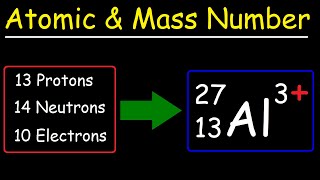


Audio Book
Dive deep into the subject with an immersive audiobook experience.
Atomic Number (Z)
Chapter 1 of 3
🔒 Unlock Audio Chapter
Sign up and enroll to access the full audio experience
Chapter Content
Atomic Number (Z):
- Definition: The atomic number (Z) is the direct count of the number of protons found within the nucleus of an atom.
- Significance: The atomic number is the most fundamental property of an element. It unequivocally identifies an element and defines its place on the Periodic Table. Every atom of a specific element (e.g., all carbon atoms) will always have the same atomic number (e.g., 6).
- Neutral Atoms: In a neutral atom, the number of positively charged protons is exactly balanced by an equal number of negatively charged electrons. Therefore, for a neutral atom: Number of Protons = Atomic Number (Z) = Number of Electrons.
- Example: Oxygen (O) has an atomic number of 8. This means every oxygen atom contains exactly 8 protons in its nucleus. In a neutral oxygen atom, there will also be 8 electrons orbiting the nucleus.
Detailed Explanation
The atomic number, denoted as Z, indicates the number of protons in an atom's nucleus, which is fundamental to defining the type of element. For instance, if an atom has an atomic number of 8, it is always oxygen. In a neutral atom, the number of protons equals the number of electrons, which ensures electrical balance. Therefore, for every proton that gives a positive charge, there is an electron that provides a negative charge, leading to a stable atom.
Examples & Analogies
Think of the atomic number as a house number on a street. Just as each house has a unique number that distinguishes it from others, each element has a unique atomic number that identifies it. So, when you see the number 8 on a mailbox (representing oxygen), you know exactly what house it is!
Mass Number (A)
Chapter 2 of 3
🔒 Unlock Audio Chapter
Sign up and enroll to access the full audio experience
Chapter Content
Mass Number (A):
- Definition: The mass number (A) represents the total count of protons and neutrons within the nucleus of a specific atom. It is essentially the total number of "heavy" subatomic particles in the nucleus. (Electrons are so light that their contribution to the overall atomic mass is typically ignored when calculating the mass number).
- Calculation: The relationship between mass number, atomic number, and neutrons is straightforward: Mass Number (A) = Number of Protons (Z) + Number of Neutrons.
- Finding Number of Neutrons: This relationship can be rearranged to calculate the number of neutrons if the mass number and atomic number are known: Number of Neutrons = Mass Number (A) - Atomic Number (Z).
- Significance: The mass number provides information about a specific isotope of an element. While the atomic number defines the element, the mass number distinguishes between different versions of that element.
- Example:
- Consider a common atom of carbon. Its atomic number (Z) is 6, meaning it has 6 protons. If this particular carbon atom also has 6 neutrons, then its mass number (A) would be 6 + 6 = 12. We would refer to this as Carbon-12.
- Another form of carbon, Carbon-14, also has 6 protons (because it's still carbon), but it has a mass number of 14. This means it has 14 - 6 = 8 neutrons.
Detailed Explanation
The mass number (A) provides insight into the total number of protons and neutrons in an atom's nucleus. Understanding mass number allows for the identification of different isotopes. For example, carbon, with an atomic number of 6, can exist as different isotopes like Carbon-12 (6 protons + 6 neutrons) and Carbon-14 (6 protons + 8 neutrons). This differentiation is essential in understanding the behavior and stability of different atomic forms of the same element.
Examples & Analogies
You can think of the mass number as the total number of people living in a house, which includes family members (protons) and pets (neutrons). Just as you would have to count both to know how many beings are in the house, the mass number counts both protons and neutrons to give a complete picture of the atom. For Carbon-12, it's like knowing there are 6 family members (protons) and 6 pets (neutrons) in the house.
Isotopes Introduction
Chapter 3 of 3
🔒 Unlock Audio Chapter
Sign up and enroll to access the full audio experience
Chapter Content
Isotopes (Brief Introduction):
- Definition: Isotopes are atoms of the same element that have the same number of protons (and thus the same atomic number) but a different number of neutrons. Because their number of neutrons differs, isotopes of the same element will also have different mass numbers.
- Key Idea: Since the number of protons determines the element's identity, isotopes are simply different "versions" or forms of the same element.
- Chemical Properties: Isotopes of an element exhibit nearly identical chemical properties. This is because chemical behavior is primarily determined by the number and arrangement of electrons, which in a neutral atom is governed by the number of protons (atomic number). As isotopes of the same element have the same number of protons, they also have the same number of electrons (in their neutral state) and thus react in very similar ways.
- Physical Properties: However, isotopes can have slightly different physical properties, such as density, melting point, and boiling point, due to their differences in mass. The heavier isotope will typically be denser.
- Notation: Isotopes are commonly represented by writing the element symbol with the mass number as a superscript and the atomic number as a subscript (e.g., 612 C for Carbon-12, 614 C for Carbon-14). Often, for simplicity, only the mass number is shown after the element name (e.g., Carbon-12, Carbon-14).
- Example: Hydrogen Isotopes:
- Protium (11 H): The most common isotope of hydrogen. It has 1 proton and 0 neutrons (Mass Number = 1).
- Deuterium (12 H): Also known as "heavy hydrogen." It has 1 proton and 1 neutron (Mass Number = 2).
- Tritium (13 H): A radioactive isotope. It has 1 proton and 2 neutrons (Mass Number = 3). All three are hydrogen because they all have 1 proton.
Detailed Explanation
Isotopes are distinct forms of the same element with varying neutron counts. Even though they share the same number of protons, which defines their elemental identity, their differing neutron numbers lead to variations in mass. For instance, hydrogen has isotopes called Protium, Deuterium, and Tritium, which demonstrate this concept clearly. The heavier the isotope, the more neutrons it possesses, affecting its physical properties without significantly altering its chemical behavior.
Examples & Analogies
Think of isotopes like different editions of a book series. All editions convey the same story (they're all still hydrogen), but they may differ slightly in cover illustrations, page sizes, or even chapter structures (the varying number of neutrons). While these differences may change some aspects of how the book feels, the main story (its chemical properties) remains largely the same.
Key Concepts
-
Atomic Number (Z): Defines an element by indicating the number of protons in the nucleus.
-
Mass Number (A): Indicates the total count of protons and neutrons, providing insight into isotopes.
-
Isotopes: Atoms with the same atomic number but different mass numbers due to differing neutron counts.
Examples & Applications
Carbon-12 (6 protons, 6 neutrons) has a mass number of 12.
Carbon-14 (6 protons, 8 neutrons) is an isotope of Carbon-12, differing only in neutron count.
Memory Aids
Interactive tools to help you remember key concepts
Rhymes
Z is for zing, it's how atoms sing, count the protons, that's the thing!
Stories
Imagine a team of atoms. Each one has a badge (the atomic number) that says how many protons they are. Some have extra members (neutrons) that make their teams different. That's how isotopes form!
Memory Tools
Z = Protons, A = Protons + Neutrons. Remember: Z for zero ambiguity about identity!
Acronyms
PEN
Protons = Atomic number
Electrons = Neutral atoms
Neutrons affect Mass.
Flash Cards
Glossary
- Atomic Number (Z)
The number of protons in the nucleus of an atom, uniquely identifying an element.
- Mass Number (A)
The total number of protons and neutrons in the nucleus of an atom.
- Isotope
Atoms of the same element that have the same number of protons but different numbers of neutrons.
- Neutrons
Subatomic particles found in the nucleus that carry no electrical charge.
- Protons
Subatomic particles found in the nucleus that carry a positive charge.
Reference links
Supplementary resources to enhance your learning experience.