
Enrol to start learning
Reading is open to everyone. Enrolling is free, and it is what unlocks the audio lessons, practice tests and progress tracking.
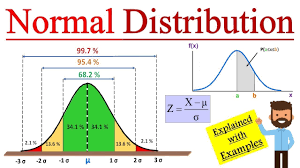
4. Normal Distribution
Learn about 4. Normal Distribution and discover its key concepts through interactive lessons and practical exercises.
Sections
The Normal Distribution is a crucial concept in statistics, characterized by its bell shape and defined by its mean and standard deviation.
The properties of the normal distribution highlight its symmetric nature, relationship between mean, median, and mode, and the empirical rule governing data distribution.
This section covers the concept of the standard normal distribution, its properties, and how to apply it in calculating probabilities.
The standardization process transforms raw normal random variables into standard normal variables using mean and standard deviation to compute probabilities.
This section explores how to compute probabilities using the normal distribution, focusing on tail probabilities, ranges, and percentiles.
This section introduces the concepts of percentiles and quantiles, essential for understanding data distribution.
This section provides concrete examples illustrating the application of the normal distribution to solve probability problems.
This section discusses the diverse applications of the Normal Distribution in real-world scenarios as well as its limitations in modeling certain types of data.
The summary table provides a concise overview of key concepts related to the Normal Distribution, including its notation, properties, and applications.
Master the fundamentals of 4. Normal Distribution
Apply learned concepts in practical scenarios
Successfully complete all chapter exercises
Practice Exercises
Total Questions
1
Estimated Time
2 min
Passing Score
70%
Instructions
- Read each question carefully
- You can use hints if you need help
- Complete all questions before submitting