
AllRounder.ai

Enrol to start learning

Reading is open to everyone. Enrolling is free, and it is what unlocks the audio lessons, practice tests and progress tracking.
Enrol free
2. Probability

2. Probability

Learn about 2. Probability and discover its key concepts through interactive lessons and practical exercises.

Sections

Introduction

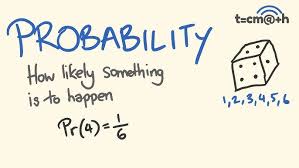
This section introduces the basics of probability, including its importance in quantifying uncertainty and predicting outcomes.![image-59ab4c21-e78f-4b55-a0c9-3673803c751b.png](https://allrounder.s3.ap-south-1.amazonaws.com/content/683094eac37f34d602459066/06f113e3-96b9-4430-8464-8b0715ae6230/b0055388-2a7f-4213-8097-a7b8d1b3a98e/image-59ab4c21-e78f-4b55-a0c9-3673803c751b.png =400x400)

1 Section Overview

Start current section content and materials

Key Concepts & Vocabulary

This section introduces foundational probability concepts such as experiments, outcomes, events, and probability itself.

2 Section Overview

Start current section content and materials

2.1 Experiment / Trial

An experiment or trial involves a process with uncertain outcomes, which forms the basis for understanding probability.

2.2 Outcome

This section discusses outcomes in probability, explaining their significance and relation to events and sample spaces.

2.3 Sample Space (S)

The sample space represents the complete set of all possible outcomes for a given experiment, forming the foundation of probability theory.

2.4 Event

This section introduces the concept of events in probability, explaining their relationship to the sample space and how they can be analyzed in terms of likelihood.

2.5 Probability (P)

This section introduces the fundamental concepts of probability, its types, rules, and applications, highlighting its importance in quantifying uncertainty.

Defining Probability

This section provides a comprehensive overview of probability, covering theoretical, empirical, and subjective approaches, along with essential properties and key concepts.

3 Section Overview

Start current section content and materials

3.1 Classical (Theoretical) Probability

Classical probability deals with the likelihoods of events occurring in situations with equally likely outcomes.

3.2 Empirical (Experimental) Probability

Empirical probability is determined through observation and experimentation rather than theoretical calculations.

3.3 Subjective Probability

Subjective probability is based on personal judgment and experience rather than strict calculation.

Properties of Probability

This section focuses on the key properties of probability, including fundamental rules and concepts that quantify the likelihood of events in various scenarios.

4 Section Overview

Start current section content and materials

Venn Diagrams

Venn diagrams are visual tools that illustrate relationships between different events, showing their intersections, unions, and complements within a probability context.

5 Section Overview

Start current section content and materials

Worked Example

This section presents a worked example demonstrating how to calculate probabilities using a simple die roll.

6 Section Overview

Start current section content and materials

Conditional Probability

This section focuses on conditional probability, exploring how the probability of an event is influenced by the occurrence of another event.

7 Section Overview

Start current section content and materials

Independent Events

Independent events are those whose occurrence does not affect each other's probabilities.

8 Section Overview

Start current section content and materials

Mutually Exclusive vs Independent

This section explores the differences between mutually exclusive events and independent events in probability theory.

9 Section Overview

Start current section content and materials

Bayes’ Theorem (Introductory)

Bayes’ Theorem provides a way to update the probability of an event based on new evidence, allowing for more informed decision-making.

10 Section Overview

Start current section content and materials

Probability Distributions (Discrete)

This section covers discrete probability distributions, explaining how probabilities are assigned to specific outcomes and introducing key concepts such as expected value and variance.

11 Section Overview

Start current section content and materials

Binomial Probability (Basic Intro)

This section introduces the concept of binomial probability, focusing on calculating the likelihood of achieving a specific number of successes in independent trials.

12 Section Overview

Start current section content and materials

Common Pitfalls

This section highlights common misconceptions and mistakes related to probability.

13 Section Overview

Start current section content and materials

Exercises (Examples)

This section presents exercises related to probability concepts, including card drawing, coin tossing, and traffic light scenarios.

14 Section Overview

Start current section content and materials

14.1 Exercise 1

This section introduces basic probability concepts through various exercises related to classical and empirical probability.

14.2 Exercise 2

Exercise 2 focuses on practical applications of probability concepts through engaging problems.

14.3 Exercise 3

This section presents exercises that apply the concepts of probability learned in the chapter, reinforcing the understanding through practical scenarios.

Summary

This section covers the essential concepts of probability, highlighting how to measure uncertainty and predict outcomes of random events.

15 Section Overview

Start current section content and materials

Learning Objectives

  • Master the fundamentals of 2. Probability

  • Apply learned concepts in practical scenarios

  • Successfully complete all chapter exercises

Practice Exercises

Total Questions

3

Estimated Time

6 min

Passing Score

70%

Instructions

  • Read each question carefully
  • You can use hints if you need help
  • Complete all questions before submitting