
Pneumatic and Hydraulic Actuators
Interactive Audio Lesson
Listen to a student-teacher conversation explaining the topic in a relatable way.
Overview of Pneumatic Actuators
🔒 Unlock Audio Lesson
Sign up and enroll to listen to this audio lesson

Today, we will learn about pneumatic actuators. Can anyone tell me what a pneumatic actuator is?

Isn't it a device that uses air to create movement?
Exactly! Pneumatic actuators use compressed air to produce linear or rotary motion. They are critical in applications like robotics and manufacturing. What types of pneumatic actuators can you name?

There's the double-acting and single-acting cylinder, right?

And I think there are rotary actuators too!
Great job! These actuators are valued for their fast response and ease of maintenance. A mnemonic to remember their advantages could be 'Fast and Easy'. What are some limitations?

They can't produce as much force as hydraulic systems can.
Correct! The compressibility of air can also affect precision. Let's summarize: Pneumatic actuators are fast and easy to maintain but have limited force and precision.
Overview of Hydraulic Actuators
🔒 Unlock Audio Lesson
Sign up and enroll to listen to this audio lesson

Now, let’s dive into hydraulic actuators. What energy source does a hydraulic actuator require?
It uses pressurized hydraulic fluid, right?
Exactly! This fluid generates linear or rotary motion. Can anyone suggest types of hydraulic actuators?
Hydraulic cylinders and motors?
Spot on! Hydraulic actuators find applications in heavy machinery as they provide high force and precise control. What are some limitations they face?
They can leak and require a lot of maintenance.
They are also heavier than pneumatic systems, right?
That's correct! The trade-offs between pneumatic and hydraulic actuators illustrate the need to choose based on application requirements. Remember—hydraulic systems are strong but require diligence in maintenance.
Applications and Comparisons
🔒 Unlock Audio Lesson
Sign up and enroll to listen to this audio lesson
Let’s talk about where we find these actuators in real-world applications. Can you think of some places where pneumatic actuators are used?
In manufacturing automation, like conveyor belts?
And robots, like those used in assembly lines!
Exactly! Now, what about hydraulic actuators?
They are used in heavy machinery like excavators.
Also in aircraft, for landing gear systems!
Great examples! So how would you summarize the advantage of hydraulic systems over pneumatic in applications demanding force?
Hydraulic systems can lift heavier loads and provide more precise movements.
Exactly! Whether choosing pneumatic or hydraulic actuators, consider the application’s needs carefully. Let’s review: pneumatic for speed, hydraulic for force.
Introduction & Overview
Read summaries of the section's main ideas at different levels of detail.
Quick Overview
Standard
This section discusses pneumatic and hydraulic actuators, outlining their working principles, types, applications, advantages, and limitations. Understanding these actuators is vital for mechanical engineers involved in automation and robotics.
Detailed
Actuators play a crucial role in industrial automation and robotics by converting energy into mechanical motion. This section focuses on pneumatic actuators, which operate using compressed air to create linear or rotary motion, featuring types such as cylinders and rotary actuators and applications that include manufacturing and robotics. Their advantages include fast response and simpler maintenance compared to hydraulic systems, despite their limitations in force output and precision due to air compressibility.
Hydraulic actuators, on the other hand, utilize pressurized hydraulic fluid to generate motion, with types including hydraulic cylinders and motors. They are used in heavy machinery and applications requiring high force and precise control, offering smooth movement but facing challenges such as leakage and maintenance. A comprehensive understanding of these actuators is essential for designing effective automated systems that optimize speed, precision, and reliability.
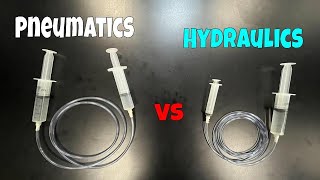
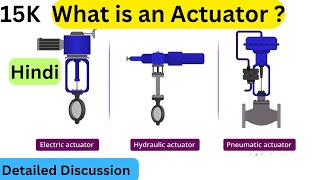
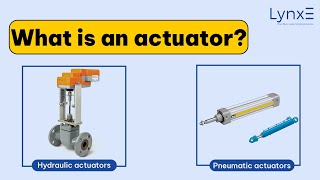
Youtube Videos
Audio Book
Dive deep into the subject with an immersive audiobook experience.
Pneumatic Actuators
Chapter 1 of 2
🔒 Unlock Audio Chapter
Sign up and enroll to access the full audio experience
Chapter Content
Pneumatic Actuators
Working Principle: Use compressed air to produce linear or rotary motion.
Types: Cylinders (double-acting, single-acting), rotary actuators.
Applications: Automation in manufacturing, robotics, clamping, positioning systems.
Advantages:
- Fast response and movement.
- Simpler maintenance compared to hydraulic systems.
Limitations: Less force output than hydraulic actuators; compressibility of air affects precision.
Detailed Explanation
Pneumatic actuators function by utilizing compressed air to create movement, either in a straight line (linear) or around a point (rotary). There are different types of pneumatic actuators, including double-acting and single-acting cylinders, as well as rotary actuators. They are widely used in various applications, especially in manufacturing and robotics, due to their ability to respond quickly and their relatively straightforward maintenance needs when compared to hydraulic systems. However, they do have limitations, such as producing less force than hydraulic actuators and the fact that the compressibility of air can affect the accuracy of movement.
Examples & Analogies
Imagine a balloon filled with air. When you release it, the air rushes out, propelling the balloon forward. This is similar to how pneumatic actuators work; they utilize air pressure to create motion. In a factory, these actuators might be responsible for moving parts from one location to another quickly, like how a conveyor belt operates, but faster.
Hydraulic Actuators
Chapter 2 of 2
🔒 Unlock Audio Chapter
Sign up and enroll to access the full audio experience
Chapter Content
Hydraulic Actuators
Working Principle: Use pressurized hydraulic fluid to generate motion.
Types: Hydraulic cylinders, motors.
Applications: Heavy machinery (excavators, presses), aircraft landing gear, industrial automation.
Advantages:
- High force and precise control.
- Smooth, steady movement.
Limitations: Prone to leakage; requires careful maintenance; heavier and larger than pneumatic systems.
Detailed Explanation
Hydraulic actuators utilize pressurized hydraulic fluid to create motion, which is typically more powerful than pneumatic systems. They come in forms such as hydraulic cylinders and motors. Hydraulic actuators are crucial in heavy machinery, like excavators and presses, because they can deliver a high amount of force with precision. One of the benefits is that they allow for smooth and steady movement. However, they come with challenges, such as the risk of leaks, which can lead to loss of pressure and require regular maintenance. Moreover, they tend to be bulkier and heavier compared to pneumatic systems.
Examples & Analogies
Think of a hydraulic jack used to lift a car. When you pump the jack, hydraulic fluid is compressed and provides the force needed to lift the heavy vehicle. This is similar to hydraulic actuators used in construction equipment, where immense force and control are required to move or lift heavy loads smoothly.
Key Concepts
-
Pneumatic Actuators: Use compressed air for movement.
-
Hydraulic Actuators: Use hydraulic fluid for movement, offering greater force.
-
Applications: Pneumatic for robotics, Hydraulic for heavy machinery.
-
Types: Include cylinders (single and double-acting) and rotary actuators.
Examples & Applications
Pneumatic actuators are often used in pick-and-place robots for speed and efficiency.
Hydraulic actuators are employed in construction equipment like backhoes capable of heavy lifting.
Memory Aids
Interactive tools to help you remember key concepts
Rhymes
Air flows quick, with speed it flicks, pneumatic moves, it fixes and picks.
Stories
Imagine a robot arm that swiftly grabs items using the power of air, while a construction crane, with its hydraulic strength, lifts heavy loads like they are feathers.
Memory Tools
Remember 'AHP' for Actuating with Hydraulic Power; strength is its might.
Acronyms
Use 'P.A.H.' to recall
Pneumatic Air
Hydraulic Force.
Flash Cards
Glossary
- Pneumatic Actuator
A device that uses compressed air to produce linear or rotary motion.
- Hydraulic Actuator
A device that uses pressurized hydraulic fluid to generate motion.
- DoubleActing Cylinder
A cylinder that can exert force in both directions, utilizing pressure on both sides.
- SingleActing Cylinder
A cylinder that exerts force in one direction, typically using a spring return.
- Rotary Actuator
An actuator that produces rotary motion, often driven by air or hydraulic fluid.
Reference links
Supplementary resources to enhance your learning experience.