
Introduction to OLED Technology
Interactive Audio Lesson
Listen to a student-teacher conversation explaining the topic in a relatable way.
Introduction to OLEDs
🔒 Unlock Audio Lesson
Sign up and enroll to listen to this audio lesson

Today, we are going to discuss Organic Light Emitting Diodes, or OLEDs. These are unique because they use organic materials to emit light. Can anyone tell me the difference between OLEDs and traditional LEDs?

Traditional LEDs use inorganic materials, right?
That's correct! OLEDs use organic compounds, primarily carbon-based materials. This leads to significant advantages, such as flexibility and high color vibrancy. Let's remember that with the acronym OLEDS - Organic Light Emitting Diodes with Superior features. Can anyone name some of the advantages?

Higher color accuracy and lower power consumption!
Exactly! And let's not forget about their ability to be used in flexible displays. This brings us to their structure. What do you think are the main components of an OLED?
Structure of an OLED
🔒 Unlock Audio Lesson
Sign up and enroll to listen to this audio lesson

An OLED consists of several layers, including a substrate, an anode, organic layers, and a cathode. Can anyone tell me what materials are typically used for the anode?

Isn’t it usually indium tin oxide, ITO?
Exactly! The anode injects holes into the organic layers. And what about the cathode, what material is commonly used for it?

Aluminum, right?
Yes! Great job! This structure allows for efficient light production. Now, let’s recap: remember the order – substrate, anode, organic layers, cathode. We can use the acronym 'S-A-O-C' to help us remember.
Working Principle of OLEDs
🔒 Unlock Audio Lesson
Sign up and enroll to listen to this audio lesson
Now that we know the components, let’s look at how OLEDs work. What happens when a voltage is applied to the device?
Electrons are injected from the cathode and holes from the anode into the organic material.
Correct! They recombine in the emissive layer to produce light. This process is called recombination. Can anyone tell me why OLEDs can produce different colors of light?
The color depends on the types of organic materials used in the emissive layer.
Right again! And to summarize, OLED technology capitalizes on the unique properties of organic compounds to create vibrant displays and lights. Remember this sequence: Injection ➡️ Recombination ➡️ Light Emission!
Advantages and Applications of OLEDs
🔒 Unlock Audio Lesson
Sign up and enroll to listen to this audio lesson
Let’s talk about the advantages of OLED technology. Can anyone list some benefits over traditional display technologies?
Higher contrast and more energy efficiency!
Absolutely! And OLEDs can be incredibly thin and flexible. This leads to amazing applications in smartphones and even transparent displays. Can anyone think of more applications?
How about in general lighting?
Exactly! OLEDs are used in various fields such as displays, lighting, and as emerging technologies cost-effective and energy-efficient! Remember the mnemonic 'S-F-L' for Displays, Flexibility, and Lighting!
Introduction & Overview
Read summaries of the section's main ideas at different levels of detail.
Quick Overview
Standard
Organic Light Emitting Diodes (OLEDs) represent a significant departure from traditional LED technology, leveraging organic materials for light emission to provide high efficiency, vibrant colors, and new possibilities in display and lighting applications. This section outlines the basic principles of OLED technology, including its structure, operation, and advantages over conventional displays.
Detailed
Detailed Summary
Organic Light Emitting Diodes (OLEDs) are advanced light-emitting diodes utilizing organic materials to generate light through electroluminescence. Unlike traditional LEDs that rely on inorganic semiconductors, OLEDs are constructed from organic compounds—primarily carbon-based molecules or polymers. When an electric current is applied, electrons move through the organic layers to recombine with holes, producing photons of light. The emitted light's color is determined by the specific materials in the organic layers.
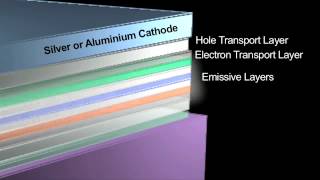
Key components of an OLED include a substrate, an anode, organic layers (comprising a hole transport layer, emissive layer, and electron transport layer), a cathode, and an encapsulation layer for protection against moisture. The advantages of OLEDs over traditional display technologies like LCDs include higher contrast ratios, improved color accuracy, lower power consumption, and the capability to be manufactured on flexible or transparent substrates, making them suitable for innovative applications in electronics, lighting, and emerging technologies.
Youtube Videos


Audio Book
Dive deep into the subject with an immersive audiobook experience.
What are OLEDs?
Chapter 1 of 3
🔒 Unlock Audio Chapter
Sign up and enroll to access the full audio experience
Chapter Content
Organic Light Emitting Diodes (OLEDs) are a type of light-emitting diode that uses organic compounds to emit light when an electric current is applied. Unlike traditional LEDs, which use inorganic semiconductor materials, OLEDs use organic materials that emit light through the process of electroluminescence.
Detailed Explanation
OLEDs are a special kind of light source made from organic materials, which can glow when electricity flows through them. This is different from regular LEDs, which are made from non-organic materials. OLEDs work by using a process called electroluminescence, where organic compounds lit up when they are powered. This technology is important because it offers new ways to create light and images.
Examples & Analogies
Think of OLEDs like lit-up jellybeans. When you press a jellybean (apply electricity), it lights up from the inside. Regular LEDs are like hard candies, they require a specific setup to glow and do not have the same softness and flexibility as jellybeans.
Structure of OLEDs
Chapter 2 of 3
🔒 Unlock Audio Chapter
Sign up and enroll to access the full audio experience
Chapter Content
In an OLED, organic materials (typically carbon-based molecules or polymers) are sandwiched between two electrodes (an anode and a cathode). When a voltage is applied, electrons are injected from the cathode and holes from the anode into the organic material, where they recombine to produce light. The color of the emitted light depends on the specific organic materials used in the device.
Detailed Explanation
Inside an OLED, there are layers of organic materials placed between two electrodes: the anode (positive side) and the cathode (negative side). When electricity is applied, electrons move from the cathode, and holes (missing electrons, acting as positive charges) move from the anode. These electrons and holes meet inside the organic materials, where they combine to create light. The type of organic material used will decide what color of light is produced, allowing for various colors in displays.
Examples & Analogies
Imagine making a sandwich: the organic materials are like the bread filling, the anode is one slice of bread, and the cathode is the other slice. When you apply a voltage, it's like squeezing the sandwich together, causing the filling (organic materials) to react and produce brightness, similar to how a tasty combination can create flavors.
Advantages of OLEDs
Chapter 3 of 3
🔒 Unlock Audio Chapter
Sign up and enroll to access the full audio experience
Chapter Content
OLEDs offer several advantages over traditional display technologies, such as LCDs (Liquid Crystal Displays) and LEDs (Light Emitting Diodes), including higher contrast ratios, better color accuracy, lower power consumption, and the ability to be made on flexible and transparent substrates.
Detailed Explanation
OLEDs have several benefits compared to older screen technologies like LCDs. First, they can produce much darker blacks and bright whites, which makes for a more vivid picture. They also show colors more accurately and use less electricity, making them energy efficient. Additionally, OLEDs can be made into thin sheets that bend or are see-through, opening new possibilities for designs in devices.
Examples & Analogies
Think of OLEDs like the difference between a standard window and a stained glass window. A regular window lets in a lot of light, but might distort colors; stained glass (like OLED) not only lets light through but also creates beautiful colors and patterns while using energy wisely.
Key Concepts
-
Electroluminescence: The process of light emission in OLEDs due to electric current.
-
Substrate: The physical layer that supports OLED construction.
-
Emissive Layer: The layer where light is produced within the OLED.
Examples & Applications
Smartphones utilize OLEDs for vibrant and energy-efficient displays.
OLED technology is used in modern TVs for better contrast ratios and picture quality.
Memory Aids
Interactive tools to help you remember key concepts
Rhymes
OLEDs glow bright, with colors in sight, they shine through the night with a flick of your light.
Stories
Imagine a tiny theater where organic actors play the roles of light and color, working together to create beautiful shows for all to see.
Memory Tools
Remember 'S-A-O-C' for remembering the OLED structure: Substrate, Anode, Organic layers, Cathode.
Acronyms
OLEDS - Organic Light Emitting Diodes with Superior features.
Flash Cards
Glossary
- OLED
Organic Light Emitting Diodes, a type of LED that emits light through organic compounds.
- Electroluminescence
The phenomenon where a material emits light in response to an electric current.
- Substrate
The base layer of an OLED, often made from glass, plastic, or metal.
- Anode
The positive electrode in an OLED that injects holes into the organic layers.
- Cathode
The negative electrode that injects electrons into the OLED.
- Emissive Layer
The layer in an OLED where electron-hole recombination occurs, producing light.
- Contrast Ratio
A measure of the difference between the darkest and lightest parts of an image.
Reference links
Supplementary resources to enhance your learning experience.