Why Multitasking Reduces Learning Efficiency
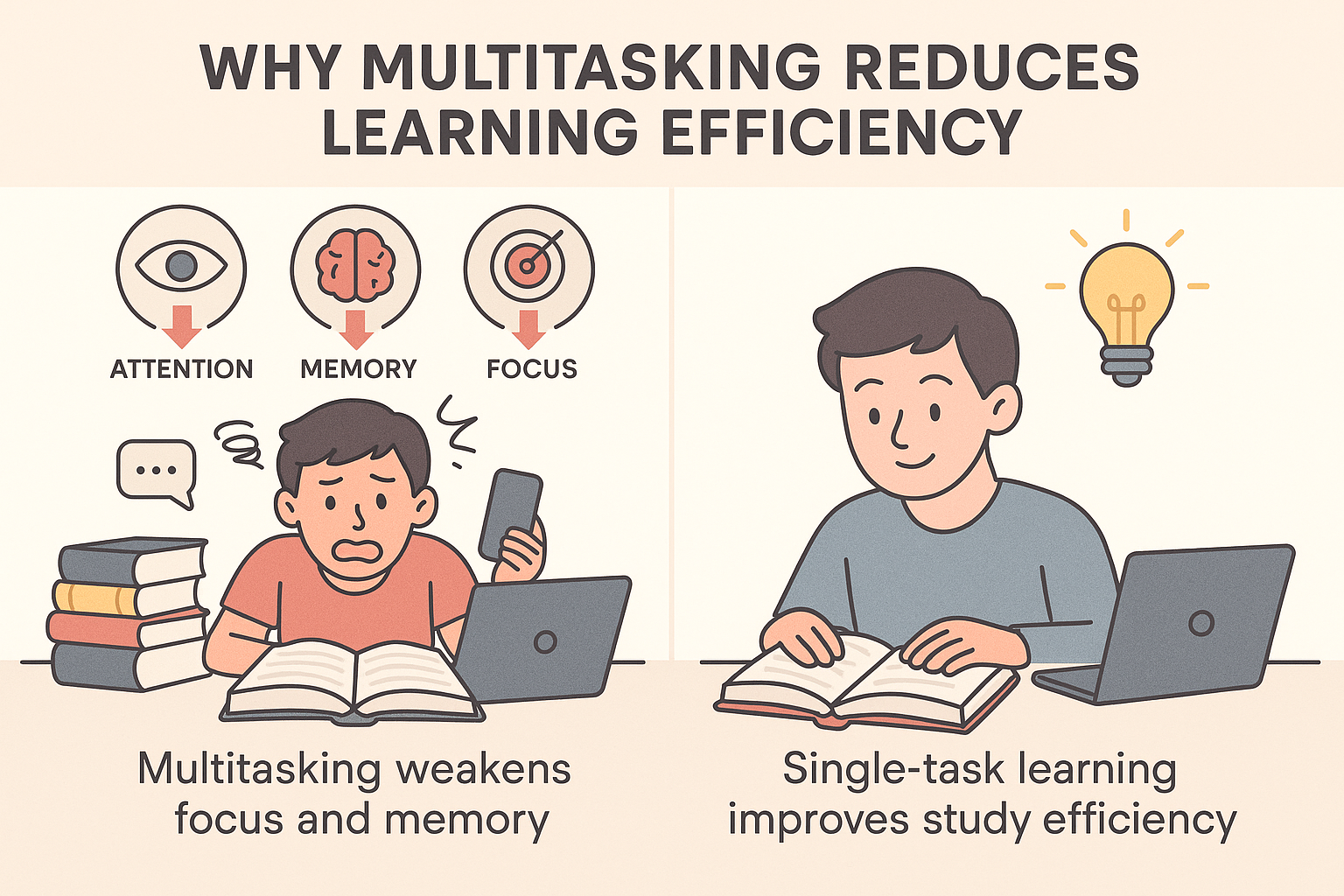
Many students believe multitasking helps them save time. They attempt homework while checking messages, listening to music, or switching between subjects. At first, this approach feels productive because several things appear to be happening at once. Over time, however, students notice slower progress, weaker understanding and rising frustration. Multitasking often creates the illusion of efficiency while quietly reducing learning quality.
Learning requires attention, memory and mental processing. When focus shifts between tasks, the brain struggles to store information properly. This affects students across all boards, including CBSE, ICSE and IB, where understanding and application matter more than speed. Understanding why multitasking fails is the first step toward improving study habits.
What Multitasking Really Does to the Brain
The brain does not perform multiple thinking tasks at the same time. Instead, it switches attention back and forth. Each switch uses mental energy and reduces processing depth. When students jump between studying, notifications and conversations, the brain resets repeatedly.
This constant switching interrupts memory formation. Information does not move into long-term storage, which leads to forgetting. Students may feel busy but remember little. This explains why multitasking often leads to repeated revision and confusion before exams.
Focused attention allows the brain to build connections. Multitasking breaks those connections before they strengthen.
Why Students Feel Multitasking Helps
Multitasking feels helpful because it creates a sense of control. Students feel they are handling many responsibilities at once. Digital devices make switching easy, which reinforces the habit.
Some students also fear missing out. They worry that stepping away from devices will disconnect them socially. Over time, this habit reduces study confidence and increases stress.
Understanding learning speed helps break this belief. Why some students learn faster and how you can too explains that faster learning comes from focus and strategy rather than doing many things at once.
How Multitasking Weakens Concept Clarity
Concepts require sustained attention. Subjects like mathematics, science and languages demand logical flow. Multitasking breaks this flow and causes gaps in understanding.
Students may complete homework without truly learning. Later, when concepts reappear in tests, confusion increases. This leads to anxiety and self-doubt.
Strong concept clarity builds confidence and reduces revision time. Single-task learning supports this clarity far better than multitasking.
The Impact on Memory and Retention
Memory works best when attention stays steady. Multitasking interrupts this process. The brain forgets earlier information when attention shifts too often.
This creates a cycle where students study more but remember less. Exams then feel overwhelming because nothing feels familiar.
Breaking this cycle requires slowing down and focusing on one task at a time.
Multitasking and Academic Stress
Multitasking increases mental fatigue. Students feel tired without completing meaningful work. This exhaustion lowers motivation and confidence.
Over time, stress builds. Students may feel incapable even when effort is high. This stress often spreads beyond academics into daily life.
Healthy routines help prevent this. Reduce school stress and build a healthy study routine highlights how structured habits protect mental well-being.
Why Focus Improves Learning Speed
Focused study may feel slower at first, but it saves time overall. Students understand concepts once instead of revisiting them repeatedly.
Focus reduces careless mistakes and strengthens recall. Learning feels calmer and more controlled.
Students who shift from multitasking to focused study often notice improvement within days.
How Multitasking Affects Different Age Groups
Younger students struggle more with multitasking because attention skills are still developing. Middle school students often imitate adult behaviour without understanding its impact.
Senior students face higher syllabus pressure. Multitasking increases burnout and lowers efficiency during critical years such as Grade 10, Grade 11 and Grade 12.
Focused habits built early protect students as academic demands rise.
Building Focus Through Single-Task Study Sessions
Single-task sessions involve working on one subject or concept at a time. Even short sessions become productive when distractions are removed.
Students can set clear goals such as revising one topic or solving a few problems. This builds satisfaction and progress.
Over time, focus strengthens naturally.
Why Breaks Matter More Than Multitasking
Many students multitask to avoid boredom. Breaks offer a better solution. Planned breaks refresh the brain without disrupting learning.
Short breaks support attention and memory. Why breaks are important for students and how to use them wisely explains how rest improves efficiency.
Breaks work best when separated from study time rather than mixed into it.
Helping Students Replace Multitasking With Better Habits
Habits change through small steps. Students can start by keeping devices away during study sessions or using timers for focused work.
Parents play a key role here. Encouragement and understanding matter more than strict rules. Build a positive parent learning relationship shows how support strengthens discipline.
Positive habits grow faster in calm environments.
Confidence Grows When Focus Improves
Focused learning builds confidence. Students feel prepared and capable. Confidence reduces avoidance and fear around studies.
Supportive guidance helps students trust their abilities. How to help children build confidence in their studies explains how confidence improves academic outcomes.
Confidence and focus reinforce each other.
Motivation Improves With Clear Progress
Multitasking hides progress. Focus reveals it. When students complete tasks fully, motivation increases.
Parents can support this through steady encouragement. How to help your child stay motivated throughout the school year highlights the value of consistent support.
Motivation thrives on visible success.
Understanding Individual Learning Styles
Some students need visual input, others need discussion or practice. Multitasking ignores these differences.
Understanding learning preferences helps students choose better strategies. Identify and nurture your child’s learning style explains how tailored approaches improve outcomes.
Single-task focus allows learning styles to work effectively.
Curiosity Thrives in Focused Learning
Curiosity fades when attention scatters. Focus gives space for questions and exploration.
Students learn deeper when curiosity guides attention. The role of curiosity in a child’s learning journey shows how curiosity strengthens understanding.
Focused learning protects curiosity.
Using Smart Tools Without Multitasking
Digital tools help learning when used with intention. Platforms like AllRounder.ai support focused study through structured lessons, practice and revision.
Students across Grade 8 and Grade 9 benefit from guided content that reduces the need for constant switching.
Tools work best when used one at a time.
Practising With Focus Builds Mastery
Practice strengthens learning only when attention stays present. Focused practice improves accuracy and confidence.
Using practice tests helps students apply knowledge and identify gaps without distraction.
Focused practice saves time and effort.
Gamified Learning Without Distraction
Games can support learning when used intentionally. Educational platforms offering learning games engage students without splitting attention.
Gamification works when it replaces distraction rather than adding to it. Clear boundaries keep learning productive.
Turning Study Time Into a Positive Habit
Multitasking often turns study into a struggle. Focused routines transform it into a stable habit.
How to turn study time into a positive daily habit for kids explains how consistency builds ease and confidence.
Habits protect learning quality.
Long-Term Benefits of Single-Task Learning
Students who avoid multitasking develop stronger attention, memory and self-control. These skills support lifelong learning.
They perform better in exams and handle academic pressure with confidence. Focus becomes a personal strength.
Single-task learning prepares students for both academic and personal success.