
Architecture of Microprocessors vs. Microcontrollers
Interactive Audio Lesson
Listen to a student-teacher conversation explaining the topic in a relatable way.
Introduction to Microprocessors
🔒 Unlock Audio Lesson
Sign up and enroll to listen to this audio lesson

Let's start by defining what a microprocessor is. A microprocessor is essentially the brain of a computer system, responsible for executing instructions and processing data.

So, is the microprocessor the same as a CPU?
Yes, that's correct! The terms are often used interchangeably. Microprocessors are designed to perform vast calculations, but they depend on external components like RAM for memory. Can anyone tell me why they might need external memory?

Because they don't have enough space on the chip itself?
Exactly! This setup allows more flexibility in developing powerful systems. Remember the acronym 'PIE' for microprocessor capabilities: Processing Power, Integrated Design, and External Dependencies.

What are some common applications for microprocessors?
Great question! Microprocessors are found in PCs, laptops, and other high-performance systems where calculation speed is critical. In summary, microprocessors are powerful and flexible but require external components.
Introduction to Microcontrollers
🔒 Unlock Audio Lesson
Sign up and enroll to listen to this audio lesson

Now, let's shift our focus to microcontrollers. A microcontroller integrates a CPU, memory, and peripherals into a single chip.
So, would this mean they are more compact than microprocessors?
Absolutely! Their integration means they are smaller and cheaper to use. Let's use the acronym 'CAPE' to remember their key features: Compact, All-in-one, Power-efficient, and Embedded functionality.

What kind of things do microcontrollers typically control?
Microcontrollers are commonly found in home appliances, medical devices, and IoT gadgets. They handle tasks like reading sensors and managing actuators. Much simpler tasks compared to microprocessors. Can anyone recall an example of a device that uses a microcontroller?
A washing machine!
Spot on! To sum up, microcontrollers are perfect for cost-effective and efficient applications, especially when specific tasks are needed.
Comparing Microprocessors and Microcontrollers
🔒 Unlock Audio Lesson
Sign up and enroll to listen to this audio lesson
Let's explore the key differences between microprocessors and microcontrollers!
I remember hearing that microprocessors are just 'brains.' What about microcontrollers?
Good memory! While microprocessors are focused on computation, microcontrollers are designed for control tasks. Think of microprocessors like a general-purpose server and microcontrollers as a specialized tool.
Could their application choice affect the design process?
Exactly! Choosing between them affects design decisions, from cost to complexity. Use the mnemonic 'PCC' for applications: Power, Complexity, and Cost considerations.
Could you give some example applications for both?
Certainly! Microprocessors power computers, and microcontrollers are found in appliances like microwaves. In summary, selecting between them hinges on performance requirements and cost factors. Do you all feel confident in identifying which to choose for a design?
Yes!
Introduction & Overview
Read summaries of the section's main ideas at different levels of detail.
Quick Overview
Standard
The section explores the distinct architectures of microprocessors and microcontrollers by examining their fundamental components, processing capabilities, memory configurations, and typical applications in embedded systems. The differences between these architectures significantly influence the design and performance of various electronic systems.
Detailed
Architecture of Microprocessors vs. Microcontrollers
In the realm of embedded systems, understanding the roles and architectures of microprocessors and microcontrollers is crucial for effective system design. This section covers the following key points:
Microprocessors
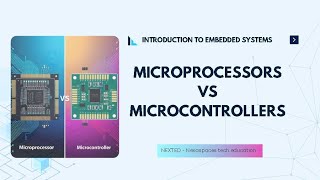
- Definition: A microprocessor is a central processing unit (CPU) on a single chip, primarily designed to perform arithmetic and logic operations. They are the ‘brains’ of computers and complex gadgets.
- Key Characteristics:
- High Processing Power: Microprocessors generally offer higher performance due to their ability to execute complex instructions.
- Memory Configuration: They rely on external memory (RAM and ROM) for data storage, requiring additional components to function.
- I/O Management: Microprocessors usually have a limited number of built-in I/O ports, necessitating external hardware for input and output operations.
- Applications: Commonly used in PCs, laptops, and high-performance servers where complex computations are required.
Microcontrollers
- Definition: A microcontroller, often referred to as an embedded controller, integrates a CPU, memory (both SRAM and ROM), and peripheral interfaces on a single chip.
- Key Characteristics:
- Integrated Components: Microcontrollers come with built-in memory and I/O ports, which allows for smaller size and cost-effectiveness.
- Power Efficiency: They are designed to perform specific tasks and often consume less power, making them suitable for battery-operated devices.
- Specialized Instructions: Microcontrollers can execute instructions tailored for control-oriented tasks, such as handling sensors and actuators.
- Applications: Widely used in consumer electronics, automotive systems, medical devices, and IoT applications.
Comparison Summary
- Processing Power: Microprocessors are suited for complex applications requiring extensive processing, while microcontrollers cater to more straightforward control functions.
- Cost and Complexity: Microcontrollers are generally cheaper and simpler due to their integrated design, making them ideal for mass-produced devices.
- Application Examples: Microprocessors power computers and complex systems, while microcontrollers control everyday appliances and devices like microwaves, washing machines, and smart home tech.
Understanding these architectural differences is essential for engineers and developers in selecting the appropriate unit for specific embedded system requirements.
Youtube Videos



Audio Book
Dive deep into the subject with an immersive audiobook experience.
Understanding Microprocessors
Chapter 1 of 3
🔒 Unlock Audio Chapter
Sign up and enroll to access the full audio experience
Chapter Content
Microprocessors are the main component of a computer system that performs calculations and processes data. They typically consist of the following key features:
- CPU (Central Processing Unit): Executes instructions and processes data.
- Memory: Temporary storage, primarily RAM (Random Access Memory) for active tasks and operations.
- I/O Ports: Interfaces for communicating with peripherals.
Microprocessors are designed primarily for general-purpose computing tasks, with a focus on speed and high power, making them suitable for PCs and servers.
Detailed Explanation
Microprocessors are integrated circuits that serve as the brain of computers and some embedded systems. They execute instructions, perform arithmetic calculations, and manage data flow. The CPU within a microprocessor is critical for carrying out tasks by executing a set of instruction sequences known as programs. They also interact with memory systems for short-term storage of data that is being used or processed.
In essence, microprocessors are versatile and powerful, but they also consume more power and require additional components such as external memory and I/O devices to function effectively. This makes them less suitable for low-power applications where efficiency is key.
Examples & Analogies
Think of a microprocessor as a highly skilled chef in a large restaurant kitchen. The chef (CPU) uses various tools and ingredients (memory and I/O ports) to create complex dishes. However, the chef works with a large team and many resources surrounding them, demonstrating how microprocessors need multiple components to work effectively.
Understanding Microcontrollers
Chapter 2 of 3
🔒 Unlock Audio Chapter
Sign up and enroll to access the full audio experience
Chapter Content
Microcontrollers, on the other hand, are compact integrated circuits designed to perform specific tasks in embedded systems and often include:
- CPU: Similar to microprocessors, but usually simpler and focused on control tasks.
- Memory: Often includes both RAM and non-volatile memory (like Flash) to store programs permanently.
- I/O Ports: Built-in connections for simple devices like sensors and actuators.
Microcontrollers are optimized for real-time control applications, are power-efficient, and are commonly used in consumer electronics, automotive systems, and Industrial control systems.
Detailed Explanation
Microcontrollers are designed for specific control-oriented applications rather than general-purpose computing. They integrate a CPU, memory, and I/O interfaces in one single chip, which reduces the need for external components. This makes them ideal for tasks that require real-time processing—such as controlling motors, reading sensor inputs, and managing data from devices.
Microcontrollers are often programmable to perform predefined operations efficiently. Their low power consumption makes them suitable for battery-operated devices and applications where power efficiency is essential.
Examples & Analogies
Imagine a microcontroller as a skilled technician who is always on-site, responsible for managing a specific piece of equipment (like the automation of a car's engine control). They have all the tools and instructions needed at their disposal, allowing them to efficiently execute precise tasks without needing to consult a larger team or rely on external resources frequently.
Key Differences between Microprocessors and Microcontrollers
Chapter 3 of 3
🔒 Unlock Audio Chapter
Sign up and enroll to access the full audio experience
Chapter Content
The primary differences between microprocessors and microcontrollers include:
- Complexity: Microprocessors handle complex tasks, while microcontrollers perform simple, dedicated tasks.
- Integration: Microcontrollers integrate several system components into one chip, while microprocessors usually connect to external components.
- Power Consumption: Microcontrollers are designed to be more power-efficient than microprocessors, making them favorable for mobile applications.
- Cost: Microcontrollers generally cost less than microprocessors due to their simpler architecture.
Detailed Explanation
Several key differences set microprocessors apart from microcontrollers. Microprocessors cater to complex computing tasks and often work in environments that require significant processing power. In contrast, microcontrollers are built with specific tasks in mind, typically integrating key elements like RAM, Flash memory, and various I/O ports within a single chip. This integration leads to lower power consumption, making microcontrollers ideal for portable and low-power devices.
Another notable difference is cost; since microcontrollers are less complex and integrate multiple functionalities, they tend to be cheaper compared to stand-alone microprocessors that require additional components.
Examples & Analogies
Let's say you're developing a complex video gaming system where intricate graphics and high-speed calculations are essential. This resembles using a microprocessor—for its power and capability. Now, think about a simple automated irrigation system. In this case, using a microcontroller is optimal as it requires only basic operations, such as turning pumps on/off based on soil moisture readings, making it both efficient and cost-effective.
Key Concepts
-
Microprocessor: The brain of computing systems, designed for complex processing.
-
Microcontroller: All-in-one chip designed for specific control applications.
-
Performance: Microprocessors offer high performance for general-purpose tasks.
-
Cost-effectiveness: Microcontrollers are typically cheaper and more compact.
-
Application usage: Microprocessors in desktops vs. microcontrollers in appliances.
Examples & Applications
Microprocessors power personal computers and complex computing tasks.
Microcontrollers are embedded in household devices like washing machines and microwave ovens.
Memory Aids
Interactive tools to help you remember key concepts
Rhymes
Processors are the brains, in computers they reign; Controllers do their duty, keeping devices all groovy.
Stories
Imagine building a robot at home. The microprocessor is like the robot's brain, making complex decisions, while the microcontroller is like its nervous system, performing specific actions and reactions.
Memory Tools
'MICE' to remember Microprocessor: Memory, Instruction, Computation, Execution.
Acronyms
'CAPS' to illustrate Microcontroller
Compact
All-in-one
Power-efficient
Specialized.
Flash Cards
Glossary
- Microprocessor
A component that executes arithmetic and logic operations, typically requiring external memory.
- Microcontroller
An integrated circuit that includes a CPU, memory, and peripheral interfaces on a single chip.
- CPU (Central Processing Unit)
The part of a computer that performs most of the processing inside a microprocessor.
- I/O Ports
Connections that allow a microprocessor or microcontroller to communicate with external devices.
- Embedded Systems
Dedicated computer systems designed to perform specific tasks within larger mechanical or electrical systems.
Reference links
Supplementary resources to enhance your learning experience.