
AllRounder.ai

Enrol to start learning

Reading is open to everyone. Enrolling is free, and it is what unlocks the audio lessons, practice tests and progress tracking.
Enrol free
1. Relations and Functions

1. Relations and Functions

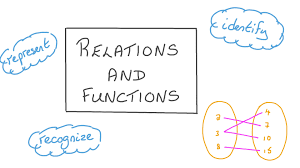
Relations and functions are foundational concepts in mathematics that describe the relationships between elements of different sets. The chapter covers various types of relations and functions, including their properties, classifications, and operations such as composition and inversion. Understanding these concepts is crucial for advanced studies in calculus, algebra, and real-world applications.

Sections

Relations

This section introduces the concept of relations as subsets of Cartesian products between two sets, along with types and properties of relations.

1 Section Overview

Start current section content and materials

1.1 Definition of a Relation

A relation is a subset of the Cartesian product of two sets, consisting of ordered pairs.

1.2 Types of Relations

This section discusses the different types of relations in mathematics, defining key concepts like reflexive, symmetric, transitive, anti-symmetric, and equivalence relations.

1.2.1 Reflexive Relation

A reflexive relation is defined as a relation where every element of a set is related to itself.

1.2.2 Symmetric Relation

A symmetric relation is defined as a relationship where if one ordered pair is included, the reverse pair must also be included.

1.2.3 Transitive Relation

A transitive relation is defined as one where if an element relates to a second element, and that second element relates to a third, then the first element must relate to the third.

1.2.4 Anti-symmetric Relation

The section defines anti-symmetric relations, discussing their properties and providing examples.

1.2.5 Equivalence Relation

An equivalence relation is a specific type of relation that is reflexive, symmetric, and transitive.

Functions

This section delves into the concept of functions in mathematics, highlighting their definitions, types, and key properties.

2 Section Overview

Start current section content and materials

2.1 Definition of a Function

This section defines functions as specific types of relations where each element from a domain corresponds to exactly one element in a co-domain.

2.2 Types of Functions

This section introduces the various types of functions, detailing definitions and examples of one-to-one, onto, and bijective functions.

2.2.1 One-to-One Function (Injective Function)

This section explores the definition and properties of one-to-one functions, also known as injective functions, emphasizing their significance in mathematics.

2.2.2 Onto Function (Surjective Function)

An onto function, or surjective function, is one where every element in the co-domain is mapped by at least one element from the domain.

2.2.3 One-to-One Correspondence (Bijective Function)

A bijective function is a special type of function that is both one-to-one (injective) and onto (surjective), ensuring a perfect pairing between the domain and co-domain elements.

2.3 Domain, Co-domain, and Range

This section provides an overview of the concepts of domain, co-domain, and range, essential for understanding functions in mathematics.

Composition of Functions

The composition of functions involves combining two functions where the output of one function becomes the input of another, thus creating a new function.

3 Section Overview

Start current section content and materials

3.1 Definition

This section defines key concepts of relations and functions in mathematics, exploring their definitions, types, and applications.

Inverse of a Function

The inverse of a function reverses the mapping of the original function, existing only for bijective functions.

4 Section Overview

Start current section content and materials

4.1 Definition

The section provides foundational definitions and concepts related to relations and functions, crucial for understanding complex mathematical structures.

Summary

This section summarizes key concepts of relations and functions, essential for understanding higher-level mathematics.

5 Section Overview

Start current section content and materials

Learning Objectives

  • Relations are subsets of the Cartesian product of two sets, with types including reflexive, symmetric, transitive, anti-symmetric, and equivalence relations.

  • Functions, a special type of relation, map each element from a domain to exactly one element in the co-domain, and can be classified as injective, surjective, and bijective.

  • The concepts of domain, co-domain, and range help describe function behavior, while composition and inverses of functions are important operations in function theory.

Key Concepts

Relation

A subset of the Cartesian product of two sets, consisting of ordered pairs.

Function

A special type of relation where each element in the domain is associated with exactly one element in the co-domain.

Injective Function

A function where different elements of the domain map to different elements in the co-domain.

Surjective Function

A function where every element of the co-domain is mapped to by at least one element from the domain.

Bijective Function

A function that is both injective and surjective.

Composition of Functions

The combination of two functions where the output of one function becomes the input of another.

Inverse of a Function

A function that reverses the operation of the original function, existing only if the function is bijective.