
Basic Concepts: Relations, Attributes, Tuples, Domains
Interactive Audio Lesson
Listen to a student-teacher conversation explaining the topic in a relatable way.
Understanding Relations
🔒 Unlock Audio Lesson
Sign up and enroll to listen to this audio lesson

Today, we’re going to discuss relations, which you can think of as tables in a database. Can anyone tell me what defines a relation?

Is it the rows and columns that make up the table?
Exactly! A relation is a two-dimensional table made up of columns, which we call attributes, and rows, which we call tuples. Can you think of an example of a table?

How about a class list with student names and IDs?
Great example! Remember, each table needs a unique name, like 'STUDENTS'. Now, since the order of rows and columns doesn’t matter, how does that affect data display?

It means we can list the students in any order, and it will still be the same table.
Exactly! That’s a critical aspect of relations. Let’s summarize: what do we mean by a relation? Any thoughts?

A relation is a table that consists of rows and columns, and it represents related data!
Attributes as Columns
🔒 Unlock Audio Lesson
Sign up and enroll to listen to this audio lesson

Now that we understand relations, let’s talk about attributes. What do you think an attribute represents in a table?
An attribute would be a specific characteristic, like a student's name or ID number.
Exactly! Each attribute represents a unique property of the entity the table describes. Can you give me an example of attributes in the STUDENTS table?
We could have attributes like StudentID, StudentName, and Major.
Perfect! And remember, every attribute must have a unique name, and it draws its values from a defined domain. What is a domain?
It's the set of all possible valid values for an attribute!
"Exactly! Domains are crucial for ensuring data integrity. Can someone summarize what we discussed today about attributes?
Tuples and Domains
🔒 Unlock Audio Lesson
Sign up and enroll to listen to this audio lesson
Let’s dive into tuples. Can anyone explain what a tuple is in the context of a relation?
A tuple is a single row in a table that contains all the information for a specific record.
Good! Each tuple is an ordered list of values corresponding to the table's attributes. How about we consider an example? What would a tuple look like in our STUDENTS table?
For example, it could be something like (101, 'Alice Smith', 'Computer Science').
Great! And just as the name indicates, the order of tuples themselves doesn’t matter. Now, who can tell me why domains are important?
Domains ensure that the data stored in attributes is valid, like restricting StudentID to unique integers.
Exactly right! Students, let’s summarize: what do we need to remember about tuples and domains?
Tuples are rows in a table, representing complete records, and domains set the rules for what values those attributes can have!
Introduction & Overview
Read summaries of the section's main ideas at different levels of detail.
Quick Overview
Standard
The section outlines the essential elements of the Relational Model, including the definitions and roles of relations (tables), attributes (columns), tuples (rows), and domains (possible values). It emphasizes the significance of each component in structuring and managing data within relational databases.
Detailed
Detailed Summary
The section provides a comprehensive overview of the fundamental components of the Relational Model, a framework for organizing data in relational databases. Here, the following key terms are defined:
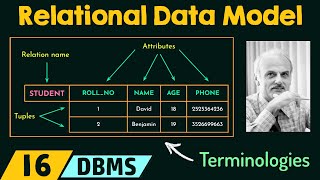
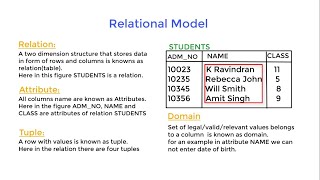
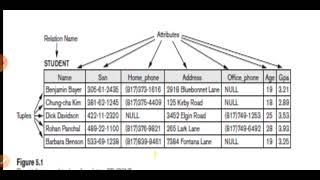
- Relation: Conceptually represented as a table, each relation consists of rows and columns, where each table has a unique name. The order of rows (tuples) and columns (attributes) is logically irrelevant, emphasizing the relational nature by linking different pieces of data together.
- Attribute: Each column in a table is identified as an attribute, which represents a specific property of the entity being described. All attributes must have unique names and draw their values from predefined domains.
- Tuple: A tuple reflects a single row within a relation, representing one complete record that includes values for each corresponding attribute. The structure of a tuple allows for clarity in data representation, but the order of the tuples does not affect the table's logical meaning.
- Domain: Each attribute has an associated domain, defining the permissible values and formats for that attribute, which helps maintain data integrity and consistency. The domain specifies the data types, such as integers, strings, or dates, and any associated constraints.
These concepts are vital for understanding how relational databases are structured and managed, facilitating efficient data retrieval and manipulation.
Youtube Videos


Audio Book
Dive deep into the subject with an immersive audiobook experience.
Introduction to the Relational Model
Chapter 1 of 5
🔒 Unlock Audio Chapter
Sign up and enroll to access the full audio experience
Chapter Content
Imagine you want to keep track of information, like details about students in a school. How would you organize it? Most people would instinctively draw a table, with columns for things like "Student ID," "Name," "Major," and rows for each individual student. This intuitive way of organizing data is precisely what the Relational Model is all about!
The Relational Model was created by Dr. Edgar F. Codd, a brilliant mathematician. He based it on ideas from mathematical set theory (which deals with collections of unique items) and logic. This mathematical foundation makes the relational model very consistent and powerful.
Detailed Explanation
The Relational Model provides a structured way to organize data in tables, which helps in easily managing and retrieving information. It is inspired by set theory, which emphasizes unique collections of items. Dr. Edgar F. Codd developed this model to provide a clear and mathematically sound framework for databases, making it simple to store and relate data efficiently.
Examples & Analogies
Think of organizing your library. Instead of having books scattered everywhere, you create a bookshelf with specific sections for different genres. Each book can be identified quickly, just like how data is organized in tables, making it easier to find and manage.
Definitions of Key Terms
Chapter 2 of 5
🔒 Unlock Audio Chapter
Sign up and enroll to access the full audio experience
Chapter Content
Let's break down the basic terms used in this model:
● Relation (Think: Table)
○ In simple terms, a relation is exactly what you imagine: a two-dimensional table.
○ Each table in your database will have a unique name (e.g., STUDENTS, COURSES, DEPARTMENTS).
○ A table is made up of rows and columns.
○ The term "relation" is used because it shows how different pieces of information are "related" to each other.
○ Important Point: The order of the rows (which we call "tuples") in a table doesn't logically matter.
● Attribute (Think: Column or Field)
○ Each named column in a table is called an attribute.
○ An attribute describes a specific characteristic or property of the thing (entity) that the table is about.
○ Example: In a STUDENT table, StudentID, StudentName, Major, and DateOfBirth would all be attributes.
● Tuple (Think: Row or Record)
○ A tuple is a single row in a table. It represents one complete record or one instance of the entity that the table is describing.
○ Example: If your STUDENT table has columns (StudentID, StudentName, Major, DateOfBirth), then a single tuple (row) might look like: (101, 'Alice Smith', 'Computer Science', '2004-03-15').
● Domain:
○ A domain is the complete collection of all possible valid values for an attribute.
Detailed Explanation
This section defines the core concepts of the Relational Model. A 'Relation' is a table that consists of 'Attributes' (columns) which define the properties of the information stored, and 'Tuples' (rows) that contain the actual data records. The 'Domain' specifies the acceptable values that an attribute can hold, ensuring data validity and integrity.
Examples & Analogies
Imagine a classroom register. Each student record (tuple) contains attributes such as ID, Name, and Major. The register (relation) lists these students, and the domain ensures that IDs are unique numeric values while names are string values. This structure helps keep track of students systematically.
Understanding Domains
Chapter 3 of 5
🔒 Unlock Audio Chapter
Sign up and enroll to access the full audio experience
Chapter Content
A domain is the complete collection of all possible valid values for an attribute. It sets the rules for what kind of data can be put into a column. This includes the data type (like numbers, text, dates) and sometimes specific formats or ranges.
Example:
- For StudentID, the domain might be "a 5-digit whole number (integer) that must be unique."
- For StudentName, the domain might be "text (string) up to 100 characters long."
Detailed Explanation
Domains define the constraints and characteristics of data that can be stored in each attribute of a table. By specifying the data type and any other limits, domains assist in maintaining data integrity. For example, a 'StudentID' must be a unique 5-digit number, preventing errors like entering letters or exceeding the length limit.
Examples & Analogies
Consider a form where you fill in your age. If the form specifies that your age must be a number between 0 and 150, that's a domain rule. If you try to enter 'abc' or '200', it wouldn't be allowed. Similarly, domains in databases ensure the right type of data is entered.
Relation Schema
Chapter 4 of 5
🔒 Unlock Audio Chapter
Sign up and enroll to access the full audio experience
Chapter Content
The schema of a relation (or relation schema) is essentially the blueprint or definition of a single table. It tells you the name of the table and the names of all its attributes (columns), along with the domains for each attribute. It defines the structure, but not the actual data.
Example: For our STUDENT table, its schema would be written as: STUDENT (StudentID, StudentName, Major, DateOfBirth).
Detailed Explanation
The relation schema serves as a description of the table's structure, outlining the name and types of data each column will hold without containing any actual records. This schema provides a framework that helps in designing and understanding the database, ensuring that the data follows expected formats.
Examples & Analogies
Think of a blueprint for a house. The blueprint won't show any furniture or people inside, but it defines where the rooms are, their sizes, and their functions. Similarly, a database schema outlines what tables exist, what attributes they have, and the types of values allowed!
Relational Database State
Chapter 5 of 5
🔒 Unlock Audio Chapter
Sign up and enroll to access the full audio experience
Chapter Content
While the schema describes what your tables look like, the relational database state (or instance) refers to the actual data (all the real tuples or rows) that are present in all the tables at a specific point in time. This state is dynamic; it changes as you add new students, update course information, or delete records.
Detailed Explanation
The relational database state is the snapshot of the current data stored in the database at a specific time. It reflects all records and their values based on the defined schemas. Unlike the schema, which is static and outlines the table's structure, the database state can change frequently as new data is entered or existing data is modified.
Examples & Analogies
Consider a dynamic scoreboard during a sports game. The scoreboard reflects the current score and game status at every moment. Similarly, the database state shows the current data in your tables, which can change as new players are added or scores are updated.
Key Concepts
-
Relation: A two-dimensional table.
-
Attribute: A named column within a relation.
-
Tuple: A row within a relation.
-
Domain: A set of permissible values for an attribute.
Examples & Applications
A STUDENTS table with attributes such as StudentID, StudentName, and Major.
A tuple representing a student record could look like (102, 'Bob Johnson', 'Mathematics').
Memory Aids
Interactive tools to help you remember key concepts
Rhymes
In a table where rows do meet, each tuple dances, neat and sweet.
Stories
Imagine a classroom with students (tuples) sitting in rows (relations), each showing their unique gifts (attributes) from a treasure box of possibilities (domains).
Memory Tools
RATD - Relation, Attribute, Tuple, Domain.
Acronyms
RATD (Rela)tion, (At)tribute, (Tu)ple, (Do)main.
Flash Cards
Glossary
- Relation
A two-dimensional table in a database that contains rows and columns.
- Attribute
A column in a relation that describes a particular characteristic of the entity.
- Tuple
A single row in a relation, representing one complete record of data.
- Domain
The complete set of valid values for a given attribute.
Reference links
Supplementary resources to enhance your learning experience.