
LED Emission Spectrum
Interactive Audio Lesson
Listen to a student-teacher conversation explaining the topic in a relatable way.
Introduction to LED Emission Spectrum
🔒 Unlock Audio Lesson
Sign up and enroll to listen to this audio lesson

Today, we'll explore how the emission spectrum of LEDs works. Can anyone tell me what determines the color of light an LED emits?

Is it the type of material used in the LED?
Exactly! The color, or wavelength, of light emitted is influenced by the semiconductor material's band gap. Let's discuss the materials—can anyone name a common LED material and the color it emits?

I think Gallium Arsenide is used for red light?
That's correct! GaAs is important for red and infrared LEDs. Remember—G-A-R: Gallium, Arsenide, Red. Let's keep going!
Semiconductor Materials
🔒 Unlock Audio Lesson
Sign up and enroll to listen to this audio lesson

Let's now discuss different semiconductor materials. What do you think is the role of the energy band gap?

Does it affect the color of the light emitted?
Exactly! A larger band gap means emitted light has higher energy, shorter wavelengths. Can anyone give me an example of a semiconductor that emits blue light?

Indium Gallium Nitride, or InGaN?
Right! We can think of it as 'I-G-N for Blue'. Now, what colors are associated with Gallium Phosphide?
Green and yellow, correct?
Correct! Keep in mind, GaP is key for those colors. Let's summarize what we learned about these materials.
Application of LED Colors
🔒 Unlock Audio Lesson
Sign up and enroll to listen to this audio lesson
Now that we know which materials emit which colors, how do you think this knowledge impacts our daily lives?
Well, they are used in all sorts of consumer electronics, right?
Absolutely! RGB lighting systems, displays, and many electronic gadgets utilize different LED colors. Can someone explain how this affects the design of a smartphone?
Different colors can provide notifications or make the display brighter?
Spot on! This is a practical application of understanding the emission spectrum. Remember—different applications utilize various colors based on their properties.
Introduction & Overview
Read summaries of the section's main ideas at different levels of detail.
Quick Overview
Standard
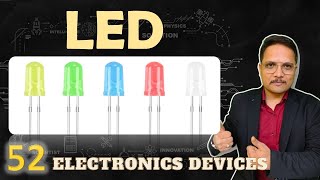
The emission spectrum of LEDs is directly related to the semiconductor materials utilized, including Gallium Arsenide (producing red and infrared light), Gallium Phosphide (green and yellow light), and Indium Gallium Nitride (blue and white light). The band gap of these materials dictates the color of the emitted light.
Detailed
LED Emission Spectrum
The LED emission spectrum is a crucial aspect of Light Emitting Diodes (LEDs), as it defines the color of light emitted. This spectrum is primarily dictated by the semiconductor materials used in their construction and the associated energy band gaps. The key points regarding LED emission spectra include:
- Gallium Arsenide (GaAs): Widely utilized for producing red and infrared LEDs. The larger the band gap, the more energy is released and the shorter the wavelength of light emitted.
- Gallium Phosphide (GaP): Employed to generate green and yellow LED light. GaP has an intermediate band gap, leading to the production of these visible wavelengths.
- Indium Gallium Nitride (InGaN): This semiconductor material is pivotal for producing blue and white LEDs, showcasing a higher band gap associated with blue light production.
Understanding the LED emission spectrum is essential in comprehending how the different colors of light are produced in various applications of LEDs, making this knowledge vital for advancements in lighting technology.
Youtube Videos



Audio Book
Dive deep into the subject with an immersive audiobook experience.
Color Determination
Chapter 1 of 2
🔒 Unlock Audio Chapter
Sign up and enroll to access the full audio experience
Chapter Content
The color (wavelength) of light emitted by an LED is determined by the semiconductor material used and its band gap.
Detailed Explanation
The emitted color of light from an LED is not random; it specifically depends on the type of semiconductor material from which the LED is made. Each semiconductor material has a unique 'band gap,' which influences the energy of the photons released when electrons recombine with holes. Higher energy photons correspond to shorter wavelengths (like blue light), while lower energy photons correspond to longer wavelengths (like red light).
Examples & Analogies
Think of the band gap like the height of a hill. If you need to roll a ball over the hill (to represent electrons moving across the band gap), a higher hill (larger band gap) means you need a stronger push (more energy) for the ball to reach the other side. The color of the light emitted is like the ball's speed; a taller hill gives a shorter wavelength (like blue) and a lower hill gives longer wavelengths (like red).
Common Semiconductor Materials
Chapter 2 of 2
🔒 Unlock Audio Chapter
Sign up and enroll to access the full audio experience
Chapter Content
The following materials are commonly used in LEDs to emit different colors of light:
● Gallium Arsenide (GaAs): Red and infrared LEDs.
● Gallium Phosphide (GaP): Green and yellow LEDs.
● Indium Gallium Nitride (InGaN): Blue and white LEDs.
Detailed Explanation
Different materials are specifically chosen for LED manufacturing based on the color of light they emit. For example, Gallium Arsenide (GaAs) is ideal for producing red and infrared light, which is essential for remote controls or night vision equipment. Gallium Phosphide (GaP) generates green and yellow light, commonly used in indicator lights. Indium Gallium Nitride (InGaN) is versatile for blue and white LEDs, crucial for modern lighting and display technologies.
Examples & Analogies
Imagine if you were to paint different rooms in your house different colors. The choice of paint color would determine how each room looks under the same light. Similarly, the type of semiconductor material used in LEDs determines the color of light emitted, allowing for various applications just like how different paint colors suit different moods and styles in your home.
Key Concepts
-
LED Emission Spectrum: The spectrum of colors emitted by LEDs, determined by the semiconductor material used.
-
Semiconductor Materials: Different materials like GaAs, GaP, and InGaN that contribute to the color of LED light.
-
Band Gap: A critical factor that influences the wavelength and energy of the light emitted by semiconductors.
Examples & Applications
Gallium Arsenide (GaAs) LEDs emit red and infrared light commonly used in remote controls.
Gallium Phosphide (GaP) LEDs are utilized in traffic lights for their green and yellow output.
Indium Gallium Nitride (InGaN) is used in smartphones for blue and white display backlights.
Memory Aids
Interactive tools to help you remember key concepts
Rhymes
GaAs for Red, GaP for Green, InGaN shines bright for the colors seen.
Stories
Imagine a colorful parade of LEDs: Red ones made of GaAs lead the way, while the green GaPs cheer, and the shiny blue InGaN brings up the rear!
Memory Tools
RGB - Remember Gallium Arsenide for Red, Gallium Phosphide for Green, Indium Gallium Nitride for Blue.
Acronyms
GAG
GaAs
GaP
InGaN - remember the materials for key LED colors.
Flash Cards
Glossary
- LED
Light Emitting Diode, a semiconductor device that emits light when an electrical current passes through.
- Electroluminescence
The phenomenon in which a material emits light in response to an electric current.
- Band Gap
The energy difference between the valence band and conduction band of a semiconductor material; affects the energy and wavelength of emitted light.
- Galium Arsenide (GaAs)
A semiconductor used in LEDs that emits red and infrared light.
- Gallium Phosphide (GaP)
A semiconductor used in LEDs that produces green and yellow light.
- Indium Gallium Nitride (InGaN)
A semiconductor material crucial for producing blue and white LEDs.
Reference links
Supplementary resources to enhance your learning experience.