
Distinction from General-Purpose Computing Systems
Interactive Audio Lesson
Listen to a student-teacher conversation explaining the topic in a relatable way.
Overview of Embedded Systems
🔒 Unlock Audio Lesson
Sign up and enroll to listen to this audio lesson

Today, let's start our exploration by defining embedded systems. An embedded system is a dedicated computer designed specifically to perform a limited set of functions, often with real-time constraints. How would you differentiate this from a general-purpose computer?

I think general-purpose computers can run various applications, while embedded systems are made for a specific task!
Absolutely correct! We can remember this with the mnemonic 'SPEC' – Specific tasks, Performance optimization, Embedded operation, and Constraints. Can anyone give an example of an embedded system?

What about the microcontroller in a washing machine?
Great example! Now, let’s delve deeper into the characteristics of embedded systems.
Real-Time Operation
🔒 Unlock Audio Lesson
Sign up and enroll to listen to this audio lesson

Real-time operation is vital for many embedded systems. Can anyone explain what 'real-time' means in this context?

I think it means that the system must respond to inputs within a guaranteed time frame.
Exactly! There are different types of real-time systems: hard, soft, and firm. For instance, flight control systems are hard real-time—missing a deadline could be catastrophic. Can anyone provide a soft real-time example?

How about a streaming service? It's important, but missing a buffer time doesn't cause failure.
Spot on! Let’s summarize: hard real-time systems have strict deadlines, while soft real-time systems allow some flexibility. Remember, 'hard is harsh; soft is chill.'
Hardware and Software Optimization
🔒 Unlock Audio Lesson
Sign up and enroll to listen to this audio lesson
Now let’s discuss the structuring of embedded systems. They are tightly integrated, meaning the hardware and software work together hand-in-hand. Why is this integration so crucial?
I assume it’s because they need to be power efficient and perform their limited tasks effectively.
Exactly! The 'less is more' philosophy applies here: fewer resources can lead to greater efficiency for specific tasks. This is unlike GPC, where the modularity allows upgrades. Can someone remember an advantage of having such integration?
Better performance and low power consumption?
Well said! Tighter integration indeed translates into optimized performance.
Operating Systems
🔒 Unlock Audio Lesson
Sign up and enroll to listen to this audio lesson
Let's talk operating systems. What types do we find in embedded systems?
I think they often use Real-Time Operating Systems (RTOS), right?
Exactly! RTOSes are designed for predictability. In contrast, general-purpose computers use more user-friendly systems. Can someone remind me of what sacrifices we have with embedded systems compared to GPCs in regards to OS?
They may lack flexibility since they’re designed for specific tasks.
Right again! You all are doing great!
Introduction & Overview
Read summaries of the section's main ideas at different levels of detail.
Quick Overview
Standard
This section explores the key distinctions between embedded systems and general-purpose computing systems, emphasizing the dedicated functionality, resource optimization, and operational constraints of embedded systems. It contrasts the specialized hardware and software design of embedded systems with the versatility and user-oriented nature of general-purpose computers.
Detailed
Distinction from General-Purpose Computing Systems
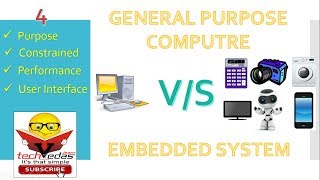
This section delves into the distinct characteristics that set embedded systems apart from general-purpose computing systems (GPCs). While GPCs like PCs and smartphones are designed for versatility, capable of running multiple applications and handling a range of tasks, embedded systems are purpose-built and optimized for specific applications.
Key Differences:
- Dedicated Functionality: Embedded systems are engineered for a single or limited tasks, exemplifying extreme optimization for performance and resource usage. For example, a washing machine controller is solely focused on managing wash cycles, contrasting sharply with a general-purpose computer which could run diverse applications.
- Real-time Operation: Many embedded systems operate under stringent real-time constraints where timely response to stimuli is crucial. There are categories like hard real-time systems (e.g., flight control systems) where missing a deadline can result in catastrophic failure, compared to soft real-time systems (e.g., multimedia streaming) where some flexibility exists.
- Structure and Performance Constraints: Embedded systems often have significant limitations in terms of processing power, memory, and energy efficiency. They utilize specialized hardware, tightly integrated with dedicated firmware that cannot be altered by the user, unlike the modular nature of GPCs that allow hardware upgrades and software installations.
- Operating Systems: Embedded systems frequently run on Real-Time Operating Systems (RTOS) or bare-metal setups prioritized for efficiency and deterministic behavior, in contrast to general-purpose operating systems (GPOS) which focus on user convenience and multitasking.
In summary, the stark differences lie in how embedded systems are uniquely designed for specific operational roles with stringent requirements, opposed to the adaptable, resource-rich environments that characterize general-purpose computing platforms.
Youtube Videos


Audio Book
Dive deep into the subject with an immersive audiobook experience.
Definition and Characteristics of General-Purpose Computers
Chapter 1 of 2
🔒 Unlock Audio Chapter
Sign up and enroll to access the full audio experience
Chapter Content
General-Purpose Computers (GPCs):
Examples include desktop PCs, laptops, servers, and even advanced smartphones.
- Flexibility: Designed to run a vast array of applications from different vendors.
- Rich User Interfaces: Primarily interactive, often with keyboards, mice, large displays.
- High Performance/Memory: Typically feature powerful multi-core processors, large amounts of RAM and storage, and active cooling.
- General-Purpose Operating Systems (GPOS): E.g., Windows, macOS, Linux, Android, iOS. These OSes prioritize multi-tasking, resource sharing, and user convenience over strict real-time guarantees.
- Hardware/Software Decoupling: Users can easily install/uninstall software, upgrade hardware components.
Detailed Explanation
General-Purpose Computers (GPCs) are designed to be versatile and capable of handling a wide range of tasks. They can run various applications, have extensive interaction capabilities through interfaces like keyboards and touchscreens, and come equipped with powerful hardware to manage multiple demanding tasks simultaneously. Operating systems like Windows or macOS focus on user convenience and multitasking, allowing users to run various applications at one time. Moreover, GPCs offer hardware flexibility, enabling users to upgrade components easily or change software as needed.
Examples & Analogies
Think of a GPC as a Swiss Army knife. It's equipped with various tools (applications) for different tasks. Just like how you can use a Swiss Army knife for cutting, screwing, or prying open, you can use a GPC to browse the web, play games, or edit videos.
Key Distinctions of Embedded Systems
Chapter 2 of 2
🔒 Unlock Audio Chapter
Sign up and enroll to access the full audio experience
Chapter Content
Embedded Systems:
- Dedicated Function: Optimized for one or a few tasks.
- Minimal/Specific UI: Often non-existent or task-specific.
- Resource Constraints: Operate under severe limitations of processing power, memory, and power.
- Real-time Operating Systems (RTOS) or Bare-metal: Prioritize determinism and predictability.
- Tight Hardware/Software Integration: Hardware and software are co-designed for optimal performance and efficiency, often inseparable.
Detailed Explanation
Embedded Systems are tailored to perform specific functions or tasks, unlike GPCs which can handle various applications. They usually operate with very limited user interfaces, sometimes consisting only of LEDs or buttons designed specifically for their dedicated tasks. Embedded systems function with constrained resources in terms of processing power, memory, and energy usage. They often employ Real-time Operating Systems (RTOS) to ensure they respond predictably to various inputs. Additionally, the integration of hardware and software in embedded systems is close and optimized for efficiency, often making the two inseparable in their design.
Examples & Analogies
Consider the embedded system in a microwave oven. Its sole purpose is to heat food. The interface is minimal—just a few buttons, but it's specifically designed for that function. Unlike a GPC that could also run a video game or access the internet, the microwave operates under tight constraints and integrates both the software (programmed settings) and hardware (the actual components) to work seamlessly together.
Key Concepts
-
Dedicated Functionality: Embedded systems are optimized for specific tasks, unlike GPCs that handle multiple applications.
-
Real-Time Operation: Many embedded systems operate within strict timing constraints for responsiveness.
-
Hardware/Software Integration: Embedded system design features a tight coupling of hardware and software for greater efficiency.
-
Use of RTOS: Embedded systems often utilize RTOS for deterministic operations as opposed to the user-friendly GPOS.
Examples & Applications
A washing machine's embedded controller that regulates the wash cycle.
The microcontroller in a microwave that manages cooking times based on user input.
Memory Aids
Interactive tools to help you remember key concepts
Rhymes
Embedded systems are built to do, one task well, that's their clue. Real-time is a priority, we must be swift, it's their reality.
Stories
Once there was a knight named Embedded, known for his singular quest of speed and duty. Unlike the jester GPCs, who could play many roles, Embedded knew his mission and acted swiftly, never missing a beat!
Memory Tools
Remember 'SPEECH' - Specific task, Performance efficient, Embedded operational, Constraints notable, Hardware/software tied.
Acronyms
GPA – General Functions, Programmable, Adaptable. Useful for general-purpose computing systems.
Flash Cards
Glossary
- Embedded System
A specialized computer designed for dedicated application functions, often with strict real-time constraints.
- GeneralPurpose Computer (GPC)
Computers designed to perform a wide variety of tasks (e.g., PCs, laptops), in contrast to embedded systems.
- RealTime Operating System (RTOS)
An operating system designed to serve real-time applications that process data as it comes in, typically with strict timing constraints.
- Hard RealTime System
A system that must respond to inputs within stringent deadline constraints; failure to meet these deadlines can lead to severe consequences.
- Soft RealTime System
A system that can tolerate some delays without catastrophic failure; performance may degrade but expected responses are not strictly time-constrained.
- Firmware
Software programmed into the non-volatile memory of embedded devices to control hardware and manage operations.
Reference links
Supplementary resources to enhance your learning experience.