5. Factorization - IB 10 Mathematics – Group 5, Algebra
Students

Academic Programs

AI-powered learning for grades 8-12, aligned with major curricula

Professional

Professional Courses

Industry-relevant training in Business, Technology, and Design

Games

Interactive Games

Fun games to boost memory, math, typing, and English skills

5. Factorization

5. Factorization

Factorization involves expressing mathematical expressions as products of their factors, simplifying equations, and facilitating problem-solving in algebra and higher mathematics. Key methods include taking common factors, grouping, and recognizing special products such as the difference of squares and perfect square trinomials. Mastery of factorization is essential for advanced mathematical topics and provides a strong foundation for further study.

15 sections

Enroll to start learning

You've not yet enrolled in this course. Please enroll for free to listen to audio lessons, classroom podcasts and take practice test.

Sections

Navigate through the learning materials and practice exercises.

  1. 1
    Factorization

    Factorization is the process of expressing algebraic expressions as a...

  2. 1.1
    Introduction

    Factorization is the process of expressing mathematical expressions as...

  3. 1.2
    What Is Factorization?

    Factorization simplifies algebraic expressions by breaking them down into...

  4. 1.3
    Why Factorization Is Important?

    Factorization simplifies algebraic expressions and is crucial for solving...

  5. 1.4
    Methods Of Factorization

    This section discusses various methods of factorization in algebra,...

  6. 1.4.1
    Taking Common Factors

    Taking common factors involves identifying the greatest common factor from...

  7. 1.4.2
    Factorization By Grouping

    Factorization by grouping involves organizing terms of a polynomial into...

  8. 1.4.3
    Factorization Of Quadratic Trinomials

    This section covers the factorization of quadratic trinomials and the...

  9. 1.4.4
    Difference Of Squares

    This section introduces the concept of factorization, specifically the...

  10. 1.4.5
    Perfect Square Trinomials

    Perfect square trinomials are expressions that can be factored into square...

  11. 1.4.6
    Sum And Difference Of Cubes

    This section covers the factorization of expressions in the form of sums and...

  12. 1.4.7
    Factorization Using Algebraic Identities

    This section covers factorization using algebraic identities, essential for...

  13. 1.5
    Worked Examples

    This section focuses on worked examples of factorization, illustrating...

  14. 1.6

    This section contains exercises designed to reinforce the techniques of...

  15. 1.7

    Factorization simplifies algebraic expressions by expressing them as...

What we have learnt

  • Factorization breaks down expressions into simpler products.
  • Always look for the greatest common factor (GCF) first.
  • Use grouping for expressions with four or more terms.
  • Recognize and apply special identities such as difference of squares, perfect square trinomials, and sum/difference of cubes.
  • Practice factoring quadratic trinomials using trial and error or splitting the middle term.
  • Factorization is an essential tool for solving algebraic equations and simplifying expressions.

Key Concepts

-- Factorization
The process of breaking down a complex algebraic expression into simpler expressions (factors) whose product is the original expression.
-- Common Factor
A number or expression that divides all the terms in an algebraic expression without a remainder.
-- Quadratic Trinomials
Expressions of the form ax² + bx + c that can be factorized into two binomials.
-- Difference of Squares
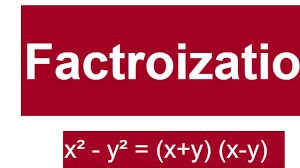
An expression in the form a² - b² which factorizes into (a - b)(a + b).
-- Perfect Square Trinomial
An expression that can be written as the square of a binomial.
-- Sum and Difference of Cubes
Factoring formulas for expressions of the forms a³ ± b³.

Additional Learning Materials

Supplementary resources to enhance your learning experience.