
Adjectives & Adverbs: Degrees of Comparison and Placement
Interactive Audio Lesson
Listen to a student-teacher conversation explaining the topic in a relatable way.
Introduction to Adjectives
🔒 Unlock Audio Lesson
Sign up and enroll to listen to this audio lesson

Today, we're exploring adjectives, which are words that describe nouns. Can anyone give me an example of an adjective?

How about 'beautiful'?
Great! 'Beautiful' is a descriptive adjective. Adjectives can tell us more about a noun's quality. Let's list some types of adjectives together. What are some other types?

There's quantitative and possessive adjectives!
Exactly! Quantitative adjectives tell us about quantity, like 'few' or 'many'. Possessive adjectives, like 'my' or 'your', show ownership.

So, adjectives can tell us a lot about nouns!
Yes! Remember, adjectives often go before the nouns they modify. That’s called their attributive position, such as in 'a red apple'.

What if the adjective is used after a linking verb?
Good question! When they follow linking verbs, we call that the predicative position, like 'The apple is red'.
To summarize, adjectives enrich our sentences by giving more information about nouns.
Degrees of Comparison for Adjectives
🔒 Unlock Audio Lesson
Sign up and enroll to listen to this audio lesson

Now, let’s discuss how adjectives can compare things using degrees of comparison. Can anyone tell me what the positive degree is?
That’s the basic form, right? Like 'tall'.
That's right! Now what about the comparative degree?
It compares two nouns, like 'taller'.
And the superlative compares three or more, like 'tallest'!
Exactly! Remember, we usually form comparative adjectives by adding '-er' or using 'more', and superlatives with '-est' or 'most'.
What about irregular adjectives?
Great point! Some adjectives have unique forms like 'good', 'better', 'best'. Keep those in mind!
In conclusion, comparing things using degrees can help us express ideas more clearly.
Introduction to Adverbs
🔒 Unlock Audio Lesson
Sign up and enroll to listen to this audio lesson
Now we shift focus to adverbs! Who can tell me what adverbs do?
They modify verbs or other adjectives, right?
Correct! Adverbs can tell us how, when, where, or to what extent something happens. Can you give examples of adverbs of manner?
How about 'quickly' and 'carefully'?
Excellent examples! Now when comparing adverbs, do they also have degrees?
Yes! There’s positive, comparative, and superlative just like adjectives.
Exactly! We can say 'runs fast' for positive, 'runs faster' for comparative, and 'runs the fastest' for superlative. Remember the placement varies too, especially for adverbs of frequency!
When should we put adverbs in a sentence?
Great question! Adverb placement can vary. Manner adverbs usually come after the verb, while frequency adverbs often come before the main verb. So important for clarity!
To summarize, adverbs enhance our sentences by providing additional details about how actions are performed.
Degrees of Comparison for Adverbs
🔒 Unlock Audio Lesson
Sign up and enroll to listen to this audio lesson
Let’s talk about how we compare adverbs! Does anyone know how?
We use the positive degree for one action!
Right! Now, what’s the comparative form?
It’s when we compare two actions, like 'sings beautifully' versus 'sings more beautifully'.
And for superlative, we say 'sings the most beautifully'!
Exactly! Just like with adjectives, we can use 'more' or 'most' to form comparisons for adverbs.
Are there any irregular adverbs?
Yes! Some adverbs do have irregular forms, like 'well' which becomes 'better' and 'best'. Keep those in mind!
To wrap up, understanding degrees helps you express comparisons of actions clearly.
Recap of Adjectives and Adverbs
🔒 Unlock Audio Lesson
Sign up and enroll to listen to this audio lesson
It's time to summarize what we've learned about adjectives and adverbs! What are adjectives?
They are words that modify nouns!
Correct! And what types of adjectives can you name?
Descriptive, quantitative, demonstrative, and possessive!
Excellent! Now, how do we form degrees of comparison for adjectives?
We use positive, comparative, and superlative forms!
Great! Now let’s review adverbs – what do they do?
They modify verbs and adjectives!
Correct! And what are the types of adverbs we discussed?
Manner, place, time, frequency, and degree.
Fantastic job! Remember to also consider degrees of comparison for adverbs!
In conclusion, adjectives and adverbs are essential for enhancing our writing and speaking skills.
Introduction & Overview
Read summaries of the section's main ideas at different levels of detail.
Quick Overview
Standard
In this section, we explore adjectives and adverbs as parts of speech that modify nouns and verbs, respectively. We discuss the various types of adjectives and adverbs, how to form degrees of comparison, and the rules for placing these modifiers within sentences.
Detailed
Adjectives
Adjectives are words that describe or modify nouns and pronouns, enriching the information conveyed. They fall into several categories:
1. Descriptive Adjectives: Describe qualities (e.g., beautiful, tall).
2. Quantitative Adjectives: Indicate quantity (e.g., some, many).
3. Demonstrative Adjectives: Point to specific nouns (e.g., this, that).
4. Interrogative Adjectives: Pose questions (e.g., which, what).
5. Possessive Adjectives: Show ownership (e.g., my, your).
6. Distributive Adjectives: Refer to individuals in a group (e.g., each, every).
Degrees of Comparison
Adjectives can change form based on their degree of comparison:
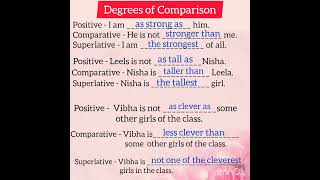
- Positive Degree: For one noun (e.g., a tall tree).
- Comparative Degree: For comparing two (e.g., taller).
- Superlative Degree: For comparing three or more (e.g., tallest).
Placement of Adjectives
Adjectives generally appear before the noun (attributive) or after linking verbs (predicative).
Adverbs
Adverbs modify verbs and adjectives, providing information on how, when, where, or to what extent an action occurs. They also have various types:
1. Adverbs of Manner: Describe how actions are performed (e.g., quickly).
2. Adverbs of Place: Indicate where actions happen (e.g., here).
3. Adverbs of Time: Tell when actions occur (e.g., today).
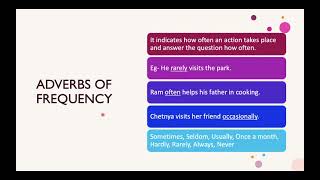
4. Adverbs of Frequency: Describe how often actions occur (e.g., often).
5. Adverbs of Degree: Indicate intensity (e.g., very).
Degrees of Comparison for Adverbs
Like adjectives, adverbs can show comparison:
- Positive Degree: Describing a single action.
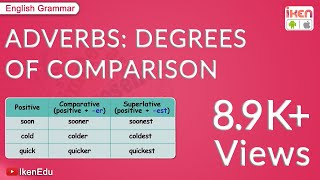
- Comparative Degree: Compares two actions (e.g., faster).
- Superlative Degree: Compares three or more actions (e.g., fastest).
Placement of Adverbs
The placement of adverbs varies based on their type, affecting sentence clarity.
Youtube Videos




Audio Book
Dive deep into the subject with an immersive audiobook experience.
Adjectives: Describing Nouns and Pronouns
Chapter 1 of 8
🔒 Unlock Audio Chapter
Sign up and enroll to access the full audio experience
Chapter Content
Adjectives are words that describe or modify nouns and pronouns, providing more information about their qualities.
Detailed Explanation
Adjectives are essential parts of speech that help add detail to nouns and pronouns. For example, if I say 'the car', it tells you about something, but if I say 'the red car', I provide more information about its color. Adjectives enhance sentences by giving specific information such as size, color, shape, or amount.
Examples & Analogies
Think of adjectives as decorations on a cake. Just like how decorations make a cake look more appealing and give us an idea of its flavor (like chocolate icing or vanilla sprinkles), adjectives make sentences more interesting and descriptive, helping readers visualize and understand the words better.
Types of Adjectives
Chapter 2 of 8
🔒 Unlock Audio Chapter
Sign up and enroll to access the full audio experience
Chapter Content
- Descriptive Adjectives: Describe the quality or characteristic of a noun/pronoun.
Examples: beautiful, tall, happy, red, old
Example: a beautiful flower, a tall tree - Quantitative Adjectives: Indicate the quantity or amount of a noun.
Examples: much, many, few, little, some, no, all
Example: Many students attended. There is little water left. - Demonstrative Adjectives: Point out specific nouns (used before a noun).
Examples: this, that, these, those
Example: This book, those houses - Interrogative Adjectives: Used with nouns to ask questions.
Examples: which, what, whose
Example: Which colour do you prefer? - Possessive Adjectives: Show ownership or possession (used before a noun).
Examples: my, your, his, her, its, our, their
Example: Her dog is playful. - Distributive Adjectives: Refer to each individual member of a group.
Examples: each, every, either, neither
Example: Each student received a prize.
Detailed Explanation
There are several types of adjectives that help convey different aspects of nouns. Descriptive adjectives provide traits (like 'happy' or 'tall'), while quantitative adjectives express amounts (like 'many' or 'few'). Demonstrative adjectives point out specific things (like 'this' or 'that'), and interrogative adjectives help form questions (like 'which' or 'what'). Possessive adjectives indicate belonging (like 'my' or 'their'), and distributive adjectives focus on individual members within a group (like 'each' or 'every'). This variety allows us to express nuances in our writing and speech.
Examples & Analogies
Imagine you are at a pet store. If you say 'I want a dog', it’s vague. But if you say 'I want a big, fluffy dog', you specify what kind of dog you want. By using different types of adjectives, like describing the dog’s size and fur, you create a clearer picture of what you imagine in your mind.
Degrees of Comparison for Adjectives
Chapter 3 of 8
🔒 Unlock Audio Chapter
Sign up and enroll to access the full audio experience
Chapter Content
Adjectives change form to show degrees of comparison when comparing two or more things.
1. Positive Degree: Describes a single noun without comparison.
Example: She is a tall girl.
2. Comparative Degree: Compares two nouns. Usually formed by adding '-er' or using 'more' before the adjective.
Example: She is taller than her brother.
Example: This puzzle is more difficult than the last one.
3. Superlative Degree: Compares three or more nouns and indicates the highest degree. Usually formed by adding '-est' or using 'most' before the adjective.
Example: She is the tallest girl in the class.
Example: This is the most difficult puzzle I have ever seen.
Detailed Explanation
Adjectives can express different levels of comparison. The positive degree describes one noun (like 'tall' for one person). The comparative degree compares two, often using '-er' or the word 'more' (like 'taller'). The superlative degree describes the highest quality among three or more nouns, often using '-est' or 'most' (like 'tallest'). This system helps us explain similarities and differences effectively.
Examples & Analogies
Picture you are comparing fruits. If you have one apple, you might say it's 'big' (positive). If you have two apples and one is bigger, you might say 'This apple is bigger than the other' (comparative). If you have a basket of apples, and you want to say one is the biggest of them all, you would say 'This is the biggest apple' (superlative). Using degrees of comparison allows us to discuss qualities and sizes effectively.
Placement of Adjectives
Chapter 4 of 8
🔒 Unlock Audio Chapter
Sign up and enroll to access the full audio experience
Chapter Content
Adjectives typically come before the noun they describe (attributive position) or after a linking verb (predicative position).
- Attributive: a red car, a clever student
- Predicative: The car is red. The student is clever.
Detailed Explanation
The placement of adjectives can alter their meaning in a sentence. When adjectives come before the noun, they are in the attributive position, such as 'a tall building.' When they come after a linking verb, they are in the predicative position, as in 'The building is tall.' Understanding where to place adjectives in a sentence helps clarify which noun they are describing.
Examples & Analogies
Imagine you're describing a beautiful painting. If you say, 'I saw an amazing painting,' you’re using the adjective ‘amazing’ before the noun. But if you say, ‘The painting was amazing,’ the adjective still describes the painting, just in a different spot. This is similar to how we might rearrange words in a song to fit a melody while keeping the meaning.
Adverbs: Modifying Verbs, Adjectives, and Other Adverbs
Chapter 5 of 8
🔒 Unlock Audio Chapter
Sign up and enroll to access the full audio experience
Chapter Content
Adverbs are words that modify or describe verbs, adjectives, or other adverbs, providing information about how, when, where, or to what extent an action or quality is present. Many adverbs end in '-ly'.
Detailed Explanation
Adverbs play a crucial role in enhancing sentences by modifying verbs, adjectives, or other adverbs. They can tell us how an action is done (quickly), when it happens (tomorrow), where it happens (outside), or the extent of a quality (very). This information contributes to a sentence's clarity and detail, creating a fuller picture for the reader.
Examples & Analogies
Think of an adverb as a movie director giving additional directions to an actor. Instead of just saying 'The actor runs,' a director might say, 'The actor runs quickly to the finish line.' This extra information makes the action clearer and more vivid, much like how adverbs enrich a sentence.
Types of Adverbs
Chapter 6 of 8
🔒 Unlock Audio Chapter
Sign up and enroll to access the full audio experience
Chapter Content
- Adverbs of Manner: Tell how an action is performed.
Examples: quickly, slowly, carefully, well, politely
Example: He walks slowly. - Adverbs of Place: Tell where an action occurs.
Examples: here, there, outside, upstairs, everywhere
Example: The children are playing outside. - Adverbs of Time: Tell when an action occurs.
Examples: today, yesterday, now, soon, often, always, rarely
Example: She arrived late. - Adverbs of Frequency: Tell how often an action occurs.
Examples: always, usually, often, sometimes, rarely, never
Example: I always brush my teeth. - Adverbs of Degree/Quantity: Tell to what extent or how much.
Examples: very, too, quite, almost, nearly, enough, extremely
Example: She is very happy. He ran too fast.
Detailed Explanation
Different types of adverbs provide specific information about actions or qualities. Adverbs of manner describe how something is done (like 'slowly'), while adverbs of place tell where it occurs (like 'outside'). Adverbs of time give details about when actions happen (like 'today'), frequency adverbs indicate how often (like 'always'), and degree adverbs express intensity (like 'very'). Each category contributes uniquely to sentence clarity.
Examples & Analogies
Imagine you are giving directions to a friend. Instead of just saying 'Go there,' you could say 'Go quickly to the café over there and order a coffee now.' Each type of adverb provides necessary context and detail, much like how specific instructions make for a clearer and more helpful set of directions.
Degrees of Comparison for Adverbs
Chapter 7 of 8
🔒 Unlock Audio Chapter
Sign up and enroll to access the full audio experience
Chapter Content
Similar to adjectives, adverbs also have degrees of comparison.
1. Positive Degree: Describes a single action or quality without comparison.
Example: He runs fast.
2. Comparative Degree: Compares two actions. Usually formed using 'more' or 'less' before the adverb, or '-er' for some.
Example: He runs faster than his brother.
Example: She sings more beautifully than him.
3. Superlative Degree: Compares three or more actions and indicates the highest degree. Usually formed using 'most' or 'least' before the adverb, or '-est' for some.
Example: He runs the fastest in the team.
Example: She sings the most beautifully of all.
Detailed Explanation
Just like adjectives, adverbs can show different levels of comparison. The positive degree describes an action without comparing (like 'runs fast'). The comparative degree compares two actions (using 'faster' or 'more quickly'), while the superlative degree highlights the highest degree among multiple actions (using 'fastest' or 'most beautifully'). This helps convey clearer differences in how actions are performed.
Examples & Analogies
Think of a race between three friends. If you say, 'Tom runs fast,' that’s positive. If you compare and say, 'Tom runs faster than Sam,' that’s comparative. Finally, if you say, 'Tom runs the fastest of all,' that’s superlative. This progression helps highlight who's performing best in different contexts, showing the importance of comparing performances.
Placement of Adverbs
Chapter 8 of 8
🔒 Unlock Audio Chapter
Sign up and enroll to access the full audio experience
Chapter Content
The placement of adverbs can vary depending on the type and what they are modifying.
- Adverbs of Manner: Often placed after the verb or after the object if there is one.
Example: He spoke softly. She sang the song beautifully.
- Adverbs of Place and Time: Usually placed at the end of the sentence or at the beginning for emphasis.
Example: They live here. I will meet you tomorrow.
- Adverbs of Frequency: Often placed before the main verb, but after auxiliary verbs.
Example: I always wake up early. I am always happy.
- Adverbs of Degree: Placed before the adjective or adverb they modify.
Example: She is very intelligent. He drives too quickly.
Detailed Explanation
Adverbs can be placed in different positions depending on their type and what they modify. Manner adverbs often follow the verb (like 'spoke softly'), while place and time adverbs usually go at the end of the sentence for clarity (like 'I will meet you tomorrow'). Frequency adverbs typically precede main verbs (like 'I always wake up'), and degree adverbs usually come before the adjectives or adverbs they modify (like 'very happy').
Examples & Analogies
Imagine you're a chef giving instructions to your team. Instead of saying, 'The chef quickly chops the vegetables,' you might say, 'Quickly, chop the vegetables.' The position changes the focus of the action. Similarly, placing adverbs correctly in a sentence influences how the message and meaning come across, guiding your audience to accurately understand the intended action.
Key Concepts
-
Adjectives enhance nouns by providing descriptive details.
-
Adjective comparatives and superlatives are formed by specific rules.
-
Adverbs modify verbs and other modifiers, adding depth to sentences.
-
Adverbs also have degrees of comparison similar to adjectives.
Examples & Applications
The tall building (adjective describing the noun).
She runs fast (adverb modifying the verb).
He is the fastest runner (superlative degree example).
She answered more quickly than before (comparative degree example).
Memory Aids
Interactive tools to help you remember key concepts
Rhymes
Adjectives describe, adverbs do too, they make the meaning brighter, for me and for you!
Stories
Once a word named 'fast' raced against 'faster', but 'fastest' won the contest, becoming the champion of all!
Memory Tools
Remember: 'A' is for Adjective, which describes. 'Ad' is for Adverb, modifying things that thrive!
Acronyms
A.D.D. - Adjective Describes Nouns, Adverb Describes Verbs!
Flash Cards
Glossary
- Adjective
A word that describes or modifies a noun or pronoun.
- Adverb
A word that modifies a verb, adjective, or another adverb.
- Positive Degree
The form of an adjective or adverb that describes one item without comparison.
- Comparative Degree
The form of an adjective or adverb used to compare two items.
- Superlative Degree
The form of an adjective or adverb used to compare three or more items.
- Attributive Position
When an adjective comes before the noun it modifies.
- Predicative Position
When an adjective comes after a linking verb.
Reference links
Supplementary resources to enhance your learning experience.