
Verbs & Tenses: Mastering Present, Past, and Future Tenses (Simple, Continuous, Perfect)
Interactive Audio Lesson
Listen to a student-teacher conversation explaining the topic in a relatable way.
Introduction to Verbs
🔒 Unlock Audio Lesson
Sign up and enroll to listen to this audio lesson

Today, we're diving into one of the fundamental building blocks of English: verbs! Can anyone tell me what verbs do in a sentence?

Verbs show action or state of being.
Correct! Verbs express actions, occurrences, or states of being. Now, let’s categorize verbs. What types can we identify?

Main verbs and auxiliary verbs!
Excellent! Main verbs carry the primary meaning while auxiliary verbs help to form tenses. Can anyone give me an example of an auxiliary verb?

Is 'am' an auxiliary verb?
Yes! 'Am' is part of the verb 'to be'. Remember: Auxiliary verbs help us convey more complex sentences. Let's keep that in mind!
Present Tenses
🔒 Unlock Audio Lesson
Sign up and enroll to listen to this audio lesson

Who can define what Simple Present tense is?

It’s the base form of the verb and it usually expresses routines or general truths.
Exactly! For example, 'She walks to school every day.' What about the Present Continuous?
That uses 'is/am/are' + verb-ing.
Right! An example could be 'They are studying right now.' Lastly, can someone explain Present Perfect?
Oh! That’s 'has/have' + past participle, like 'I have finished my homework.'
Great job, everyone! Let's review—Simple Present indicates routine, Present Continuous shows ongoing actions, and Present Perfect indicates a connection to the present. Remember this triad!
Past Tenses
🔒 Unlock Audio Lesson
Sign up and enroll to listen to this audio lesson
Moving on to past tenses, what do we understand about the Simple Past?
It describes completed actions at a specific time.
Yes! For instance, 'I finished my homework yesterday.' Now, tell me about the Past Continuous.
It’s 'was/were' + verb-ing, like 'She was reading when I called her.'
Exactly! This tense shows an ongoing action interrupted by another action. What about Past Perfect?
That’s 'had' + past participle, right? Like 'I had left before the rain started.'
Absolutely correct! Reviewing these helps us understand timelines in our narratives.
Future Tenses
🔒 Unlock Audio Lesson
Sign up and enroll to listen to this audio lesson
Now, we’re looking at future tenses. What is the format for Simple Future?
It's 'will' + base form, like 'I will go to the store tomorrow.'
Correct! And what does Future Continuous illustrate?
That's going to express actions ongoing in the future, 'will be' + verb-ing, like 'I will be studying at 8 PM.'
Great explanation! What about Future Perfect?
It’s 'will have' + past participle, like 'By next year, I will have graduated.'
Well done! Understanding future tenses allows us to make predictions and plans clearly.
Introduction & Overview
Read summaries of the section's main ideas at different levels of detail.
Quick Overview
Standard
The section delves into verbs as action words, categorizing them into main and auxiliary verbs. It explores the three primary tenses—present, past, and future—each with simple, continuous, and perfect forms. Understanding these concepts is crucial for conveying time accurately in both spoken and written communication.
Detailed
Detailed Summary
In this section, we explore the integral role of verbs within the English language as action words. Verbs can be classified into various types: main (lexical) verbs which carry primary meaning, auxiliary (helping) verbs that assist in forming tenses, and modal verbs that express necessity or possibility.
The section details the three primary tenses: **
1. Present Tenses:
- Simple Present (habitual actions, current facts, and narratives),
- Present Continuous (actions happening now, temporary actions, or planned future events), and
- Present Perfect** (actions that started in the past and continue or have relevance now).
- Past Tenses:**
- Simple Past (completed actions),
- Past Continuous (ongoing actions at a past time or interrupted actions), and
- Past Perfect (actions completed before another past action).
- Future Tenses:
- Simple Future (future actions or spontaneous decisions),
- Future Continuous (ongoing actions at a future time), and
- Future Perfect (actions completed before a future time).
By understanding these forms and their uses, students can articulate actions and states across various time frames accurately.
Youtube Videos




Audio Book
Dive deep into the subject with an immersive audiobook experience.
What Are Verbs?
Chapter 1 of 6
🔒 Unlock Audio Chapter
Sign up and enroll to access the full audio experience
Chapter Content
Verbs are words that express an action, an occurrence, or a state of being. They are the core of any sentence.
Detailed Explanation
Verbs act as the main action or state descriptor in a sentence. They tell us what the subject is doing or in what state it exists. For example, in the sentence "She runs," 'runs' is the verb that indicates the action performed by the subject, 'She'. Understanding verbs is essential because they form the backbone of our sentences.
Examples & Analogies
Think of verbs as the engine of a car. Just as the engine drives the car forward, verbs drive the action of a sentence forward.
Types of Verbs
Chapter 2 of 6
🔒 Unlock Audio Chapter
Sign up and enroll to access the full audio experience
Chapter Content
-
Main Verbs (Lexical Verbs): These carry the primary meaning of the action or state.
Examples: run, eat, sleep, think, believe, exist -
Auxiliary Verbs (Helping Verbs): These help the main verb to form tenses, moods, or voices.
Examples: be (am, is, are, was, were), do (do, does, did), have (has, have, had)
Modal Verbs: A special type of auxiliary verb that expresses possibility, necessity, permission, etc.
Examples: can, could, may, might, must, shall, should, will, would
-
Transitive Verbs: Verbs that require a direct object to complete their meaning. The action passes from the subject to the object.
Example: She writes a letter. (writes what? a letter) -
Intransitive Verbs: Verbs that do not require a direct object to complete their meaning. The action does not pass to an object.
Example: He slept soundly. (slept what? No object needed)
Detailed Explanation
There are several types of verbs each serving a different purpose in a sentence. Main verbs express the central action or state (e.g., 'run'). Auxiliary verbs help form different tenses and moods (e.g., 'is' in 'She is running'). Transitive verbs need a direct object to complete their meaning, while intransitive verbs do not need one, as seen in the examples provided.
Examples & Analogies
Consider main verbs as the stars of a show; they take the spotlight and perform the key actions, while auxiliary verbs are like the stage crew that supports the performance, helping to set the scene and context.
Understanding Tenses
Chapter 3 of 6
🔒 Unlock Audio Chapter
Sign up and enroll to access the full audio experience
Chapter Content
Tenses indicate the time an action or state occurs. We will focus on the Present, Past, and Future tenses, each with Simple, Continuous, and Perfect forms.
Detailed Explanation
Tenses are grammatical markers that tell us when an action takes place: in the present, past, or future. Each of these times has three forms: simple (e.g., 'walk'), continuous (e.g., 'is walking'), and perfect (e.g., 'has walked'). Understanding how to use these tenses correctly helps convey the timing and nature of actions accurately in our speech and writing.
Examples & Analogies
Imagine planning a timeline for a project. The present tense explains what you're currently doing, the past tense describes what you have completed, and the future tense outlines the steps you still need to take, much like marking tasks on a calendar.
Present Tenses
Chapter 4 of 6
🔒 Unlock Audio Chapter
Sign up and enroll to access the full audio experience
Chapter Content
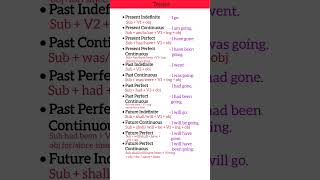
- Simple Present Tense: Form: Base form of the verb (add -s/-es for third person singular).
Uses: - To express habitual actions or routines. (e.g., I walk to school every day.)
- To state general truths or facts. (e.g., The sun rises in the east.)
- To describe events in a narrative or instructions. (e.g., First, you take the flour...)
-
Present Continuous Tense: Form: is/am/are + verb-ing
Uses: - To describe actions happening at the moment of speaking. (e.g., She is reading a book now.)
- To describe temporary actions. (e.g., He is studying for his exams this week.)
- To describe planned future events. (e.g., We are visiting grandparents tomorrow.)
-
Present Perfect Tense: Form: has/have + past participle (V3)
Uses: - To describe an action that started in the past and continues to the present. (e.g., I have lived here for five years.)
- To describe an action completed in the recent past with a result in the present. (e.g., She has finished her homework, so she can play now.)
- To describe experiences without specifying a time. (e.g., I have visited Paris.)
Detailed Explanation
Present tenses help express actions happening now or those that are ongoing. The simple present is used for habitual actions and facts. The present continuous describes actions occurring at this very moment, and the present perfect connects past actions to the present, highlighting their ongoing relevance or results. Knowing how to use them helps convey when and how actions occur.
Examples & Analogies
Think of present tenses as the news; the simple present gives you headlines (facts), the present continuous reports on live events, and the present perfect provides updates on past stories that still matter today.
Past Tenses
Chapter 5 of 6
🔒 Unlock Audio Chapter
Sign up and enroll to access the full audio experience
Chapter Content
- Simple Past Tense: Form: Past form of the verb (V2).
Uses: - To describe actions completed at a specific time in the past. (e.g., He went to the park yesterday.)
- To describe a series of completed actions in the past. (e.g., She woke up, ate breakfast, and left for school.)
-
Past Continuous Tense: Form: was/were + verb-ing
Uses: - To describe an action that was ongoing at a particular time in the past. (e.g., At 8 PM, I was watching TV.)
- To describe an ongoing action interrupted by another past action. (e.g., While I was sleeping, the phone rang.)
-
Past Perfect Tense: Form: had + past participle (V3)
Uses: - To describe an action that was completed before another action in the past. This is used to show the sequence of two past events.
Example: By the time he arrived, I had already eaten dinner. (Eating dinner happened before he arrived.)
Detailed Explanation
Past tenses express actions that have already happened. The simple past denotes actions completed at a specific time, while the past continuous indicates actions that were in progress at a given time or interrupted by another event. The past perfect reveals the sequence of events, showing what happened before something else in the past.
Examples & Analogies
Consider past tenses like a family photo album; the simple past captures snapshots of specific events, the past continuous showcases moments in action, and the past perfect narrates stories—what happened before others in the timeline of memories.
Future Tenses
Chapter 6 of 6
🔒 Unlock Audio Chapter
Sign up and enroll to access the full audio experience
Chapter Content
- Simple Future Tense: Form: will/shall + base form of the verb (shall is mostly used with I/we in formal contexts)
Uses: - To express future actions or predictions. (e.g., I will go to the market tomorrow. It will rain soon.)
- To express spontaneous decisions. (e.g., Oh, I will help you with that.)
-
Future Continuous Tense: Form: will be + verb-ing
Uses: - To describe an action that will be ongoing at a specific time in the future. (e.g., Tomorrow at 10 AM, I will be studying.)
- To describe an action that will be in progress over a period in the future. (e.g., They will be travelling all next week.)
-
Future Perfect Tense: Form: will have + past participle (V3)
Uses: - To describe an action that will be completed before a specific time or another action in the future.
Example: By next year, I will have completed my project. (The project will be finished before next year.)
Detailed Explanation
Future tenses indicate planned actions or predictions. The simple future states what will happen, while the future continuous illustrates actions that will be in progress at a certain time. The future perfect demonstrates tasks that will be completed before a certain point in the future, creating a connection between future actions and timelines.
Examples & Analogies
Think of future tenses like planning a road trip; the simple future is your destination (what you'll do), the future continuous is the journey (ongoing activities along the way), and the future perfect marks when you'll arrive (complete one stage of your journey before moving on to the next).
Key Concepts
-
Verbs express actions or states.
-
Main verbs carry the core meaning.
-
Auxiliary verbs help in forming tenses.
-
Present tense denotes current actions.
-
Past tense denotes completed actions.
-
Future tense denotes upcoming actions.
Examples & Applications
She eats (Simple Present).
He is eating (Present Continuous).
They have eaten (Present Perfect).
I wrote a letter (Simple Past).
They were eating (Past Continuous).
I had written a letter (Past Perfect).
I will write a letter (Simple Future).
They will be writing (Future Continuous).
I will have written a letter (Future Perfect).
Memory Aids
Interactive tools to help you remember key concepts
Rhymes
Verbs can run, sit, or lay,
Stories
Once, Timmy wanted to run fast (Simple Present).
Memory Tools
PVT stands for Present, Past, and Future: The three tenses to remember!
Acronyms
SCPF for tenses
Simple
Continuous
Perfect
Future.
Flash Cards
Glossary
- Verb
A word that expresses an action, occurrence, or state of being.
- Main Verb
A verb that carries the core meaning of the action or state.
- Auxiliary Verb
A verb that helps to form tenses, moods, or voices.
- Present Tense
A tense that describes actions happening now.
- Past Tense
A tense that describes actions completed at a specific time in the past.
- Future Tense
A tense that expresses actions that will happen.
- Simple Tense
A tense that shows a single, complete action.
- Continuous Tense
A tense that shows ongoing action.
- Perfect Tense
A tense that shows completed action and often involves a connection to the present.
Reference links
Supplementary resources to enhance your learning experience.