
Simple, Compound, and Complex Sentences: Building Variety in Writing
Interactive Audio Lesson
Listen to a student-teacher conversation explaining the topic in a relatable way.
Understanding Simple Sentences
🔒 Unlock Audio Lesson
Sign up and enroll to listen to this audio lesson

Today, we're going to discuss simple sentences. A simple sentence contains just one independent clause.

Does that mean it has to be a short sentence?
Not necessarily! Simple sentences can be lengthy, but they're still structured with one subject and one verb that expresses a complete idea. For example, 'The sun shines brightly every morning.' Any questions?

Can we find simple sentences in complex texts?
Absolutely! Simple sentences can appear within complex texts to provide clarity. Let’s move on to the next type.
Exploring Compound Sentences
🔒 Unlock Audio Lesson
Sign up and enroll to listen to this audio lesson

Now, let’s explore compound sentences. They join two independent clauses. Can anyone tell me how we connect them?

Using coordinating conjunctions like 'and' or 'but'?
Exactly! We can also use semicolons. For instance, 'It was raining; the game was canceled.' Let’s try creating one together: invent a compound sentence using 'but.'

I wanted to play outside, but it started to rain.
Great example! You connected two thoughts effectively. Always remember: **FANBOYS** helps us remember those conjunctions!
Delving into Complex Sentences
🔒 Unlock Audio Lesson
Sign up and enroll to listen to this audio lesson
Lastly, let's talk about complex sentences, which contain one independent clause and at least one dependent clause. Who can define a dependent clause?
It's a clause that needs an independent clause to make sense!
Correct! An example is 'Although it was late, we continued studying.' Here, 'Although it was late' cannot stand alone. Let's create our own complex sentences.
Because I was tired, I went to bed early.
Perfect! The dependent clause adds context to the main idea.
Review of Sentence Types
🔒 Unlock Audio Lesson
Sign up and enroll to listen to this audio lesson
Let's summarize. What are the three types of sentences we've learned?
Simple, compound, and complex sentences!
Exactly! Each serves a unique purpose. How do simple sentences differ from compound sentences?
Simple sentences have one main idea, while compound sentences connect two independent ideas.
Great! And complex sentences build on that with dependent clauses. Keep practicing, and you'll find your writing improving!
Introduction & Overview
Read summaries of the section's main ideas at different levels of detail.
Quick Overview
Standard
Understanding sentence types—simple, compound, and complex—enables writers to create more engaging and varied content. Each sentence type offers different ways to express ideas, with simple sentences containing one independent clause, compound sentences joining multiple independent clauses, and complex sentences adding dependent clauses for depth.
Detailed
Simple, Compound, and Complex Sentences: Building Variety in Writing
This section covers the three main types of sentences that shape effective and varied writing: simple, compound, and complex sentences. Each type serves distinct purposes in conveying meaning and provides various levels of detail and relationships between ideas.
Simple Sentences
- A simple sentence consists of a single independent clause, which means it has a subject and a verb and expresses a complete thought. This is fundamental for clear communication.
- Examples:
- The birds sang.
- My brother is tall.
- The sun shines brightly every morning.
Compound Sentences
- Compound sentences combine two or more independent clauses using coordinating conjunctions (FANBOYS: For, And, Nor, But, Or, Yet, So) or semicolons. This structure allows for connecting related thoughts.
- Examples:
- I finished my homework, and then I watched television.
- She wanted to go to the beach, but it started raining.
Complex Sentences
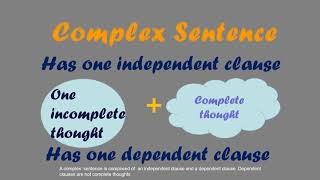
- A complex sentence contains one independent clause and at least one dependent clause, adding depth and detail. Dependent clauses provide additional information but cannot stand alone.
- Examples:
- Because it was raining, we decided to stay indoors.
- The girl who wore the red dress won the competition.
By incorporating a variety of sentence structures, writers can create more engaging and sophisticated texts.
Youtube Videos


Audio Book
Dive deep into the subject with an immersive audiobook experience.
Understanding Simple Sentences
Chapter 1 of 3
🔒 Unlock Audio Chapter
Sign up and enroll to access the full audio experience
Chapter Content
A simple sentence contains one independent clause. An independent clause is a group of words that has a subject and a verb and expresses a complete thought. It can stand alone as a complete sentence.
- Key Feature: One main idea.
- Examples:
- The birds sang. (Subject: birds, Verb: sang)
- My brother is tall. (Subject: brother, Verb: is)
- The sun shines brightly every morning. (Subject: sun, Verb: shines)
- He and his friend played football in the park. (Compound Subject: He and his friend, Verb: played)
Detailed Explanation
A simple sentence is the most basic form of a sentence. It consists of only one independent clause, meaning it has a single subject and verb and expresses a complete thought. For example, 'The birds sang' is a simple sentence because it tells you exactly what the subject 'birds' did. Another example is 'My brother is tall,' where 'brother' is the subject and 'is' is the verb. Simple sentences are used in writing to convey straightforward ideas without complexity.
Examples & Analogies
Think of a simple sentence like a single note played on a musical instrument. It has a clear sound and stands alone. Just like one note can create a melody, a simple sentence conveys one clear idea, making it easy for listeners to understand.
Exploring Compound Sentences
Chapter 2 of 3
🔒 Unlock Audio Chapter
Sign up and enroll to access the full audio experience
Chapter Content
A compound sentence consists of two or more independent clauses joined together. These independent clauses are usually connected by:
- A coordinating conjunction (FANBOYS: For, And, Nor, But, Or, Yet, So). A comma typically precedes the conjunction.
- A semicolon (;) if the clauses are closely related in meaning and you don't want to use a conjunction.
- Key Feature: Two or more main ideas of equal importance.
- Examples (with coordinating conjunctions):
- I finished my homework, and then I watched television.
- She wanted to go to the beach, but it started raining.
- You can eat your dinner now, or you can wait until later.
- Examples (with semicolon):
- The storm raged all night; the power went out for hours.
- He loves to read; his bookshelf is full of books.
Detailed Explanation
A compound sentence combines two or more independent clauses, allowing you to connect related ideas in writing. For instance, in the sentence 'I finished my homework, and then I watched television,' both 'I finished my homework' and 'I watched television' can stand alone as sentences. When they are joined by the conjunction 'and,' it shows the relationship between completing homework and then relaxing. Using semicolons can also connect closely related independent clauses without using conjunctions.
Examples & Analogies
Imagine a train that has several cars linked together, with each car representing an independent clause. Just like the train can move forward smoothly when all the cars are connected, a compound sentence flows well when the independent clauses are linked. Each car (or clause) adds to the story without losing its individual identity.
Diving into Complex Sentences
Chapter 3 of 3
🔒 Unlock Audio Chapter
Sign up and enroll to access the full audio experience
Chapter Content
A complex sentence contains one independent clause and at least one dependent (or subordinate) clause. A dependent clause has a subject and a verb but cannot stand alone as a complete thought; it relies on the independent clause to make sense. Dependent clauses are introduced by subordinating conjunctions (e.g., after, although, as, because, before, if, since, though, unless, until, when, where, while) or relative pronouns (e.g., who, whom, whose, which, that).
- Key Feature: One main idea and one or more supporting ideas. The dependent clause adds more information to the independent clause.
- Examples (with subordinating conjunctions):
- Because it was raining, we decided to stay indoors.
- I will wait here until you arrive.
- Although he was tired, he continued to work.
- Examples (with relative pronouns):
- The girl who wore the red dress won the competition.
- This is the house that Jack built.
- Punctuation Note: If the dependent clause comes before the independent clause, a comma is usually used to separate them. If the independent clause comes first, a comma is often not needed.
Detailed Explanation
Complex sentences enrich your writing by combining one independent clause with at least one dependent clause. The dependent clause provides additional context or detail, clarifying or expanding upon the main idea in the independent clause. For example, 'Because it was raining, we decided to stay indoors' shows why the decision was made. The dependent clause 'because it was raining' cannot stand alone; it relies on the independent clause to complete the thought.
Examples & Analogies
Consider a complex sentence like a conversation between friends where one person gives context before expressing an idea. For example, 'Because it was late, she decided to go home' is like saying, 'I returned home for a reason.' The context (the dependent clause) adds depth to the action (the independent clause) just like a backstory enriches a character's action in a movie.
Key Concepts
-
Simple Sentences: Contain one independent clause, expressing a complete thought.
-
Compound Sentences: Join two independent clauses using conjunctions or semicolons.
-
Complex Sentences: Include one independent clause plus at least one dependent clause.
Examples & Applications
The cat slept soundly on the sofa. (Simple Sentence)
I wanted to go to the park, but it started to rain. (Compound Sentence)
Because it was snowing, we stayed indoors. (Complex Sentence)
Memory Aids
Interactive tools to help you remember key concepts
Rhymes
Simple is single, compound is more; complex brings clauses, opening the door.
Stories
Imagine a busy cafe where customers share stories. One speaks simply, others connect thoughts, while some sprinkle details; that’s how sentences build variety in conversation!
Memory Tools
SCC: Simple, Compound, Complex - identify your sentence's structure!
Acronyms
Remember FANBOYS to link sentences
For
And
Nor
But
Or
Yet
So.
Flash Cards
Glossary
- Simple Sentence
A sentence that contains one independent clause and expresses a complete thought.
- Compound Sentence
A sentence that combines two or more independent clauses, usually connected by a coordinating conjunction or a semicolon.
- Complex Sentence
A sentence that contains one independent clause and at least one dependent clause.
- Independent Clause
A group of words that has a subject and a verb and expresses a complete thought.
- Dependent Clause
A group of words that has a subject and a verb but cannot stand alone as a complete thought.
- Coordinating Conjunctions
Words that connect clauses of equal importance, commonly remembered by the acronym FANBOYS.
Reference links
Supplementary resources to enhance your learning experience.