
Types of Sentences: Declarative, Imperative, Interrogative, Exclamatory
Interactive Audio Lesson
Listen to a student-teacher conversation explaining the topic in a relatable way.
Declarative Sentences
🔒 Unlock Audio Lesson
Sign up and enroll to listen to this audio lesson

Today, we're starting with declarative sentences, which are used to make statements or express facts and opinions. Can anyone tell me what a declarative sentence does?

It tells you something!
Exactly! For example, 'The Earth revolves around the sun.' This sentence expresses a fact. It always ends with a full stop.

Can you give us more examples?
Sure! How about, 'My favorite subject is English.' That shows an opinion. Remember, declarative sentences simply tell us something!
To recap, declarative sentences provide information or opinions, usually ending with a full stop.
Imperative Sentences
🔒 Unlock Audio Lesson
Sign up and enroll to listen to this audio lesson

Next, let's look at imperative sentences. These are used to give commands or requests. What have you noticed about these sentences?

They tell someone to do something.
That's right! For example, if I say, 'Please close the door gently,' I'm requesting an action to be taken.

Can they end with an exclamation mark?
Yes, they can, especially in the case of strong commands. For instance, 'Be careful!' is an imperative sentence with an exclamatory tone.
To summarize, imperative sentences issue commands or requests, often with an implied subject 'you.'
Interrogative Sentences
🔒 Unlock Audio Lesson
Sign up and enroll to listen to this audio lesson
Now, let's discuss interrogative sentences. Who can tell me what they do?
They ask questions!
Yes! They begin with question words or auxiliary verbs and always end with a question mark. For example, 'What is your name?'
What about 'Can you help me?' Is that an interrogative sentence too?
Absolutely! It seeks information. To recap, interrogative sentences ask questions and seek knowledge.
Exclamatory Sentences
🔒 Unlock Audio Lesson
Sign up and enroll to listen to this audio lesson
Finally, we have exclamatory sentences, which express strong emotions. Can anyone give an example?
What a beautiful sunset!
Exactly! Exclamatory sentences often start with exclamatory phrases or words like 'What' or 'How.' They convey excitement, urgency, or strong feelings.
Do they all end with exclamation points?
Yes, they typically do. To summarize, exclamatory sentences express strong emotions and always end with an exclamation mark.
Introduction & Overview
Read summaries of the section's main ideas at different levels of detail.
Quick Overview
Standard
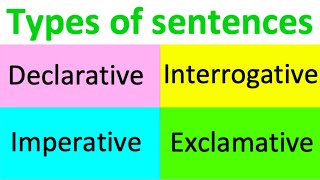
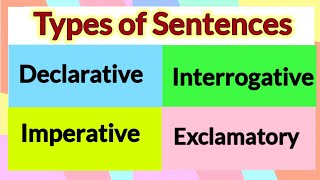
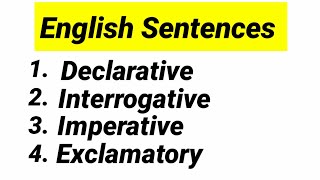
In this section, we learn about the four fundamental types of sentences in English: declarative sentences make statements; imperative sentences issue commands or requests; interrogative sentences ask questions; and exclamatory sentences convey strong emotion. Understanding these types enhances effective communication.
Detailed
Detailed Summary of Sentence Types
This section focuses on the four primary types of sentences in the English language, emphasizing their unique characteristics and functions.
1. Declarative Sentences
- Function: These sentences make statements, share facts, or express opinions.
- Structure: They typically end with a full stop (.).
- Examples:
- The Earth revolves around the sun. (fact)
- My favorite subject is English. (opinion)
- Key Characteristic: They tell you something.
2. Imperative Sentences
- Function: Used to give commands, make requests, or offer advice.
- Structure: The subject (you) is often implied and can end with a full stop or an exclamation mark (!).
- Examples:
- Please close the door gently. (request)
- Be careful! (warning)
- Key Characteristic: They tell you to do something.
3. Interrogative Sentences
- Function: These sentences ask questions and seek information.
- Structure: They start with question words (who, what, where, etc.) or auxiliary verbs and always end with a question mark (?).
- Examples:
- What is your name?
- Can you help me with this problem?
- Key Characteristic: They seek information.
4. Exclamatory Sentences
- Function: Used to express strong emotion or urgency.
- Structure: They often start with
Youtube Videos


Audio Book
Dive deep into the subject with an immersive audiobook experience.
Declarative Sentences
Chapter 1 of 4
🔒 Unlock Audio Chapter
Sign up and enroll to access the full audio experience
Chapter Content
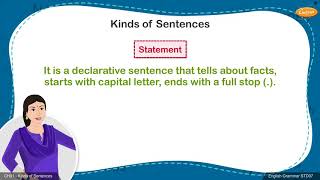
These are the most common type of sentence. Their primary function is to make a statement, provide information, or express a fact or an opinion. They typically end with a full stop (.).
Examples:
- The Earth revolves around the sun. (Stating a fact)
- My favourite subject is English. (Expressing an opinion)
- The bus arrived late this morning. (Providing information)
- Birds build nests in trees. (Making a general statement)
Key Characteristic: They tell you something.
Detailed Explanation
Declarative sentences are the most prevalent type of sentence you'll encounter. Their main purpose is simply to convey information or express opinions. They end with a full stop, which indicates that the reader or listener should pause. For instance, saying 'The Earth revolves around the sun' makes a factual statement about our solar system. This type of sentence helps in sharing knowledge or personal views clearly and directly.
Examples & Analogies
Think of a declarative sentence like a news headline. When you read, 'Local park gets a new playground,' it's informing you about an event without asking anything or giving a command – it’s just stating a fact.
Imperative Sentences
Chapter 2 of 4
🔒 Unlock Audio Chapter
Sign up and enroll to access the full audio experience
Chapter Content
These sentences are used to give a command, make a request, offer advice, or issue an instruction. The subject of an imperative sentence, 'you,' is usually not explicitly stated but is understood. They can end with a full stop or, if the command is forceful or urgent, an exclamation mark (!).
Examples:
- Please close the door gently. (Request)
- Study hard for your upcoming exams. (Advice)
- Turn off the lights before you leave. (Command/Instruction)
- Be careful! (Warning)
- Don't talk during the movie. (Prohibition)
Key Characteristic: They tell you to do something.
Detailed Explanation
Imperative sentences are crucial for giving directions or making requests. They often start with the verb, telling the listener what to do. The subject 'you' is understood, which means you don't always have to say it. For example, when someone says, 'Please pass the salt,' they are indirectly telling you (the listener) to hand them the salt. The tone can also change the impact; a command like 'Stop!' might be much more urgent and requires quick action.
Examples & Analogies
Picture a coach during a game shouting, 'Run faster!' They are not just making a statement; they are giving a command to the players to act immediately. This is similar to how imperative sentences work.
Interrogative Sentences
Chapter 3 of 4
🔒 Unlock Audio Chapter
Sign up and enroll to access the full audio experience
Chapter Content
These sentences are used to ask a question. They always begin with a question word (who, what, where, when, why, how) or an auxiliary verb (is, are, do, does, did, have, has, had, can, could, will, would, etc.) and always end with a question mark (?).
Examples:
- What is your name?
- Are you feeling well today?
- Where did you put the keys?
- Can you help me with this problem?
- Did they finish their project on time?
Key Characteristic: They seek information.
Detailed Explanation
Interrogative sentences are designed to gather information. They can begin with question words such as 'who' or 'what,' signaling to the listener that an answer is expected. For instance, the question 'Where did you put the keys?' is seeking a specific piece of information. These sentences always end with a question mark, indicating an inquiry rather than a statement.
Examples & Analogies
Imagine a detective at a crime scene asking, 'Who was last seen here?' This is like how interrogative sentences function – they're searching for specific answers to advance understanding.
Exclamatory Sentences
Chapter 4 of 4
🔒 Unlock Audio Chapter
Sign up and enroll to access the full audio experience
Chapter Content
These sentences are used to express strong emotion, surprise, excitement, anger, or urgency. They often begin with 'What' or 'How' but can also be simple statements delivered with strong feeling. They always end with an exclamation mark (!).
Examples:
- What a fantastic goal! (Excitement)
- How beautiful the sunset is! (Admiration)
- I can't believe we won! (Surprise/Joy)
- Oh no, I lost my wallet! (Distress)
- Fire! (Urgency/Warning)
Key Characteristic: They show strong feeling.
Detailed Explanation
Exclamatory sentences are powerful because they convey strong emotions. They can express joy, surprise, anger, or urgency, making them highly effective for emphasizing feelings. For example, exclaiming 'What a fantastic goal!' shows excitement and admiration, while 'Oh no, I lost my wallet!' communicates distress. These sentences always end with an exclamation mark, marking the intense emotion involved.
Examples & Analogies
Consider the excitement when a child sees a rainbow, shouting, 'Look at that beautiful rainbow!' This reaction encapsulates the essence of exclamatory sentences; they capture and communicate intense feelings in moments of joy or surprise.
Key Concepts
-
Declarative Sentences: Sentences that state facts or opinions, ending with a period.
-
Imperative Sentences: Sentences that command, request, or instruct, ending with a period or exclamation mark.
-
Interrogative Sentences: Sentences that ask questions, ending with a question mark.
-
Exclamatory Sentences: Sentences that express strong emotions, ending with an exclamation mark.
Examples & Applications
Example of Declarative: 'The bus arrived late this morning.'
Example of Imperative: 'Close the window, please.'
Example of Interrogative: 'Where did you put my keys?'
Example of Exclamatory: 'What a great day it is!'
Memory Aids
Interactive tools to help you remember key concepts
Rhymes
When you want to make a statement, full stop will be your treatment.
Stories
Think of a teacher giving a command to a class: 'Clean your desks!' This shows an imperative sentence, guiding students to action.
Memory Tools
Remember the types of sentences with 'D-I-E-E': 'D' for Declarative, 'I' for Imperative, 'E' for Exclamatory, 'E' for Interrogative.
Acronyms
Use the acronym 'DIEE' to recall the sentence types
Declarative
Interrogative
Exclamatory
Imperative.
Flash Cards
Glossary
- Declarative Sentence
A sentence that makes a statement or expresses an opinion and often ends in a period.
- Imperative Sentence
A sentence that gives a command, request, or instruction, which may end with a period or an exclamation mark.
- Interrogative Sentence
A sentence that asks a question and always ends with a question mark.
- Exclamatory Sentence
A sentence that expresses strong emotion and always ends with an exclamation mark.
Reference links
Supplementary resources to enhance your learning experience.