
Control Signals: Signals that Open/Close Gates, Initiate ALU Operations, etc.
Interactive Audio Lesson
Listen to a student-teacher conversation explaining the topic in a relatable way.
Understanding Control Signals
🔒 Unlock Audio Lesson
Sign up and enroll to listen to this audio lesson

Today, we are delving into control signals, the little electrical impulses that dictate how the CPU operates. Can anyone tell me what you think control signals do?

I think they help the CPU execute commands?
Exactly! Control signals enable or disable various components of the CPU, making sure that data flows correctly and operations occur at the right time. An easy way to remember this is to think of them as the signals that 'open the gates' for data to travel. Now, can anyone summarize how they enable or disable certain pathways?

They switch on the parts of the CPU that help with processing data or sending it somewhere, like to memory?
Well put! The signals can activate pathways or load data into registers, which is crucial for making computations happen. This is how control signals keep everything flowing smoothly during processing.
Functionality of Control Signals
🔒 Unlock Audio Lesson
Sign up and enroll to listen to this audio lesson

Let’s discuss the functionality of control signals more deeply. What are some main functions of these control signals in the CPU?

They enable and disable parts of the CPU like registers and the ALU?
Right! They can act as enable lines for registers, load commands for ALUs, and even signal memory or I/O operations. For example, if the signal `R1_Output_Enable` is sent, what happens?

The contents of Register R1 would be sent out to the data bus?
Exactly! You're catching on quickly. Control signals also select data routes using multiplexers. Remember the acronym ‘ESSI’ for Enable, Select, Signal, and Initiate which covers the main functionalities.
Physical Transmission of Control Signals
🔒 Unlock Audio Lesson
Sign up and enroll to listen to this audio lesson
Now, we’ll shift our focus to the physical characteristics of control signals. Does anyone know how fast control signals can travel?
I think they travel really fast, close to the speed of light?
You’re correct! Their quick activation is vital because it ensures that operations occur in sync with the CPU's clock. Why do you think precise timing is critical for control signals?
So that the data is ready to be processed when it’s needed and to prevent errors from happening?
Exactly! Timing ensures stability on buses before any registers read it, thus avoiding race conditions. Let's keep this in mind as we consider the fast-paced operations of a CPU.
Examples of Control Signals
🔒 Unlock Audio Lesson
Sign up and enroll to listen to this audio lesson
Let's discuss specific control signals and their applications in our earlier examples. Can anyone give me an example of a control signal and its role?
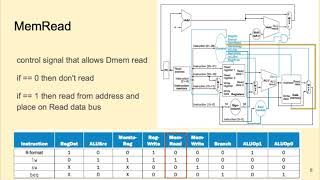
Maybe `MEM_Read`? It signals the CPU to read data from memory.
Spot on! The `MEM_Read` signal is crucial for data retrieval from memory, while `ALU_OpCode` specifies what operation the ALU should perform. Why do you think having these specific command signals is advantageous?
They allow the CPU to perform different tasks like calculations or data manipulation efficiently!
Exactly! The organization of these control signals keeps the CPU efficient. Always think of how these signals help the CPU communicate effectively.
Review and Recap of Control Signals
🔒 Unlock Audio Lesson
Sign up and enroll to listen to this audio lesson
Now that we've covered control signals in depth, can anyone summarize what we discussed today?
Control signals are electrical impulses that help manage CPU operations by enabling or disabling components.
They also help route data using multiplexers and initiate operations in the ALU!
Great recollections! And remember their quick transmission allows the CPU to function smoothly and efficiently. Control signals are integral to the internal choreography of the CPU.
Introduction & Overview
Read summaries of the section's main ideas at different levels of detail.
Quick Overview
Standard
This section elaborates on control signals as the output of the Control Unit (CU), emphasizing their role in enabling or disabling functions across the CPU, routing data correctly, and initiating ALU operations. Key aspects include functionality, physical transmission characteristics, and examples of specific types of signals.
Detailed
Control Signals: The Heart of CPU Communication
Control signals are fundamental electrical impulses produced by the Control Unit (CU) in a CPU, crucial for orchestrating the myriad operations within the processor. At their core, these signals enable or disable operations, route data through various pathways, and initiate arithmetic and logical unit (ALU) functions.
Functionality of Control Signals
Control signals serve multiple purposes:
1. Enable/Disable: Many controls act as loaders or enablers for registers or functional units. For instance, when a signal like R1_Output_Enable is activated, data from Register R1 can be sent onto the data bus.
2. Select/Route: Certain signals control multiplexers, determining from where data will come for ALU inputs.
3. Initiate Operations: ALUs depend on control commands to know the specific task they must execute.
4. Memory and I/O Commands: Control signals like MEM_Read and IO_Write are essential for managing data transfer with memory and peripheral devices.
Transmission Characteristics
Control signals travel at speeds approaching that of light and are designed to manage timing precisely. The CU must activate the right combination of signals within each clock cycle to seamlessly execute operations.
This section encapsulates the complex inner workings of control signals, underscoring their role as the lifeblood of CPU functionality, ensuring synchronized operations across all components.
Youtube Videos
![COA [Module 03 - Lecture 03]: Control Signals for Complete Instruction Execution](https://img.youtube.com/vi/KvjmIpOYn4o/mqdefault.jpg)
Audio Book
Dive deep into the subject with an immersive audiobook experience.
Functionality of Control Signals
Chapter 1 of 3
🔒 Unlock Audio Chapter
Sign up and enroll to access the full audio experience
Chapter Content
Control signals are the physical electrical voltages (typically high/low, or 1/0 logic levels) generated directly by the Control Unit. They are the tangible output of the CU, acting as the switches and selectors that direct the flow of data and trigger operations throughout the entire CPU and its interfaces.
Detailed Explanation
Control signals are like electrical impulses that serve as instructions to various parts of the CPU. These signals function as on/off switches or as selectors for directing the flow of data through the system. The generation of control signals is the responsibility of the Control Unit, which determines when and how these signals should be activated based on the current operation being executed by the CPU.
Examples & Analogies
Imagine a traffic light system directing cars at an intersection. The traffic lights (control signals) turn red or green to tell cars when to stop or go. In the CPU, these control signals operate similarly by letting different components know when to perform their tasks, ensuring everything runs smoothly.
Types of Control Signal Functions
Chapter 2 of 3
🔒 Unlock Audio Chapter
Sign up and enroll to access the full audio experience
Chapter Content
- Enable/Disable: Many control signals act as 'enable' or 'load' lines for registers, buffers, or functional units. For example, R1_Output_Enable might be a signal that, when active, allows the contents of Register R1 to be placed onto an internal data bus. MAR_Load_Enable might be a signal that, when active, causes the MAR to capture the data currently present on the address bus.
- Select/Route (Multiplexer Control): Other control signals are used to select specific inputs for multiplexers (MUXes) or to route data from one path to another. For instance, ALU_Input_Source_Select might be a 2-bit signal where 00 selects input from R1, 01 from R2, etc. This directs which data actually reaches the ALU.
- Initiate Operation: For functional units like the ALU, control signals specify the exact operation to perform. A set of specific bits, like ALU_OpCode = 0101, might tell the ALU to perform a bitwise AND operation.
- Memory/I/O Commands: Signals like MEM_Read, MEM_Write, IO_Read, IO_Write are sent over the external control bus to coordinate data transfers with main memory or peripheral devices.
Detailed Explanation
Control signals perform various critical tasks in a CPU. They enable or disable specific registers and buffers, allowing data movements when needed. Some control signals determine which data inputs are selected by multiplexer circuits, directing the flow of information correctly. Others initiate operations within functional units like the ALU by specifying the exact calculations to perform, while additional signals manage interactions with memory or input/output devices to coordinate data exchanges.
Examples & Analogies
Think of a music producer in a recording studio. The producer uses control signals to tell musicians when to play (Enable), which instruments to feature (Select/Route), what songs to record (Initiate Operation), and when to stop recording (Memory/I/O Commands). In the CPU, the Control Unit works similarly to guide all operations, ensuring everything is done in the right order.
Physical Transmission of Control Signals
Chapter 3 of 3
🔒 Unlock Audio Chapter
Sign up and enroll to access the full audio experience
Chapter Content
These signals are physical wires or traces on the circuit board or within the silicon chip. Their activation (voltage change) travels at near the speed of light, ensuring rapid propagation and precise timing. The CU's design ensures that the correct combination of these signals is active during each clock cycle to perform the intended micro-operation.
Detailed Explanation
Control signals are transmitted through physical pathways such as wires on circuit boards or connections within the CPU's chip. When the Control Unit activates a signal, it sends a voltage change through these pathways. This transmission occurs extremely quickly, almost as fast as light, making it possible for the CPU to execute operations at high speeds. The design of these pathways and the timing of signal activation ensure the correct signals are in place during each clock cycle, making operations efficient and synchronized.
Examples & Analogies
Consider how a fast-food restaurant operates. Customers place their order through a drive-thru speaker, and the order is relayed to the kitchen via a system – much like control signals passing through wires. The orders are expected to arrive quickly and accurately so the kitchen can prepare meals efficiently within a limited time frame, similar to how the CPU works with control signals to complete operations in clock cycles.
Key Concepts
-
Control Signals: The essential impulses controlling CPU operations.
-
Functionality: They enable/disallow actions, establish data routes, and initiate ALU actions.
-
Physical Transmission: They travel nearly light speed and require precise timing.
-
Examples: Signals like
MEM_Read,ALU_OpCode, andR1_Output_Enable
Examples & Applications
The MEM_Read signal directs the memory interface to fetch data from a designated address.
The R1_Output_Enable signal enables the data from Register R1 to flow to the data bus.
Memory Aids
Interactive tools to help you remember key concepts
Rhymes
Control signals act like gates, opening paths that data creates.
Stories
Imagine a traffic controller (the CU) directing traffic (data) through various roads (CPU components) using signals (control signals) to ensure smooth transit.
Memory Tools
E-S-S-I: Enable, Select, Signal, Initiate, the key functions of control signals.
Acronyms
C-E-S
Control signals Enable and Select data pathways.
Flash Cards
Glossary
- Control Signal
Electrial impulses generated by the Control Unit to manage CPU operations by enabling/disabling components and routing data.
- ALU (Arithmetic Logic Unit)
A component of the CPU that performs arithmetic and logical operations.
- Multiplexer (MUX)
A device that selects one of several input signals and forwards the selected input into a single line.
- Memory Read Signal
A control signal that instructs the memory to read data from a specified address.
- Enable Signal
A signal that allows data or operations to be activated in registers or functional units.
Reference links
Supplementary resources to enhance your learning experience.