
Embedded Systems: Week 4 - Verilog Hardware Description Language (Verilog HDL)
Interactive Audio Lesson
Listen to a student-teacher conversation explaining the topic in a relatable way.
Introduction to Hardware Description Languages (HDLs)
🔒 Unlock Audio Lesson
Sign up and enroll to listen to this audio lesson

Good morning class! Today, we will discuss Hardware Description Languages, or HDLs. Can anyone tell me what an HDL might be?

Is it like programming languages but for hardware?
Exactly! HDLs, like Verilog, are specialized languages to describe electronic circuits' structure and behavior. They help us manage the complexity of modern circuits.

But why do we need HDLs if we can draw schematics?
Great question! As circuits become more complex, manual schematics are impractical. HDLs provide a higher level of abstraction, making verification and synthesis easier.

I see, so they can help ensure we catch design flaws before fabrication.
Exactly! Simulation allows for rigorous testing of designs, which is crucial. Remember: 'Design before you fabricate!' Let’s summarize our key points.
"1. HDLs simplify circuit descriptions.
Verilog Basics: Data Types and Operators
🔒 Unlock Audio Lesson
Sign up and enroll to listen to this audio lesson

Now, let's dive into Verilog basics! What do we know about data types in Verilog?
Aren't there nets and registers?
Correct! Nets represent connections and don’t store values, while registers hold values. Can anyone give me an example of a net?

How about using 'wire' for a signal?
Very good! Now let’s talk about operators. What types of operators does Verilog provide?
Arithmetic operators, like addition and subtraction!
"Yes! And also logical and bitwise operators. Remember, we can manipulate data in various forms using these operators. Let’s recap:
Modeling Techniques in Verilog
🔒 Unlock Audio Lesson
Sign up and enroll to listen to this audio lesson
Today, we'll discuss modeling techniques in Verilog. First, who can tell me what gate-level modeling means?
It involves using basic logic gates to represent circuits directly.
Yes! It gives us a low-level abstraction. What about dataflow modeling?
It's about showing how data flows continuously through the circuit!
Excellent observation! Finally, we have behavioral modeling. What sets it apart?
It focuses on what the circuit does, not how it’s constructed with gates.
"Exactly! Each technique has its strengths. To summarize, we have:
Testbenches and Their Importance
🔒 Unlock Audio Lesson
Sign up and enroll to listen to this audio lesson
What do you think is the purpose of testbenches in Verilog?
To test if our designs work correctly!
Precisely! They generate input signals for our design under test. Can anyone mention one characteristic of testbenches?
They don’t get synthesized; they’re just used for simulation.
"Exactly! This makes them more flexible in using constructs like delays and initial blocks. Quick recap:
Logic Synthesis and Synthesizable Constructs
🔒 Unlock Audio Lesson
Sign up and enroll to listen to this audio lesson
Let's talk about logic synthesis. Who can tell me what it is?
It converts high-level descriptions into a gate-level representation.
Correct! It’s pivotal for actual hardware implementation. What does it mean for a construct to be synthesizable?
It means it can be turned into real hardware components.
Yes! Constructs like `if`, `case`, and `always` used correctly are synthesizable. Can anyone give an example of a non-synthesizable construct?
The 'initial' blocks are simulation-only.
"Exactly! Let’s recap:
Introduction & Overview
Read summaries of the section's main ideas at different levels of detail.
Quick Overview
Standard
In this section, students will learn about the significance of Verilog HDL in digital design, including its applications, different modeling styles, and essential constructs. The learning objectives encompass understanding hardware description languages, using various Verilog modeling styles, and building basic testbenches for simulation.
Detailed
Detailed Summary
Overview
In this section, we delve into the Verilog Hardware Description Language (Verilog HDL), an essential tool for designing and implementing embedded systems. Unlike conventional programming languages, Verilog serves as a specialized language for modeling the structure and behavior of electronic circuits, which can be complex and require high-level abstraction for effective design.
Key Learning Objectives
By the end of this module, students will be able to:
1. Explain HDLs - Understand the purpose of Hardware Description Languages (HDLs) and their role in the digital design flow.
2. Verilog Lexical Conventions - Gain a solid grounding in the lexical conventions of Verilog including data types, operators, and literals.
3. Modeling Styles - Differentiate between and apply various Verilog modeling styles including gate-level, dataflow, and behavioral representations.
4. Logic Design Implementation - Implement combinational and sequential logic circuits in Verilog.
5. Assignments Understanding - Distinguish between blocking and non-blocking assignments and their relevance in hardware inference.
6. Testbenches Development - Create basic testbenches to simulate and validate the functionality of designed hardware modules.
7. Logic Synthesis Principles - Understand the principles of logic synthesis and recognize synthesizable versus non-synthesizable constructs in Verilog.
Significance
Mastering Verilog is a pivotal step in building complex embedded systems that integrate custom hardware efficiently. This section serves as a foundation for students, enabling them to efficiently model, simulate, and synthesize digital hardware using Verilog, ultimately enhancing their capabilities in the realm of embedded systems design.
Youtube Videos




Audio Book
Dive deep into the subject with an immersive audiobook experience.
Introduction to Verilog HDL
Chapter 1 of 6
🔒 Unlock Audio Chapter
Sign up and enroll to access the full audio experience
Chapter Content
In the realm of digital design, Verilog is more than just a programming language; it's a specialized language used to describe the structure and behavior of electronic circuits.
Detailed Explanation
Verilog HDL stands out as a unique tool in the digital design field. Unlike general programming languages that create instructions for computers, Verilog specifically focuses on defining the actual physical electronics. Using Verilog allows designers to outline how circuits operate, enabling the creation of complex systems that are essential in today's technology.
Examples & Analogies
Think of Verilog as the blueprint for building a house. Just as a blueprint provides detailed instructions about where to place walls, doors, and windows, Verilog provides a layout for how electronic components should function and interact.
Key Learning Objectives
Chapter 2 of 6
🔒 Unlock Audio Chapter
Sign up and enroll to access the full audio experience
Chapter Content
Upon successful completion of this module, you will be able to:
- Explain the purpose and significance of Hardware Description Languages (HDLs) in the digital design flow.
- Identify and differentiate fundamental Verilog lexical conventions, including data types, literals, and operators.
Detailed Explanation
This section outlines what you will learn by the end of the course. It emphasizes understanding the importance of Hardware Description Languages (like Verilog) in designing digital systems. You will gain knowledge about important terms and structures used in Verilog, spanning from basic syntax to more nuanced language features.
Examples & Analogies
Imagine you're assembling a complex Lego model. Each step in the guide represents a learning objective. By completing each step, you'll gradually understand not only how to complete the model but also how each Lego piece contributes to the greater structure.
Introduction to Hardware Description Languages (HDLs)
Chapter 3 of 6
🔒 Unlock Audio Chapter
Sign up and enroll to access the full audio experience
Chapter Content
This section introduces the foundational concept of HDLs, explaining why they are indispensable tools in modern digital design and how they differ from conventional software programming languages.
Detailed Explanation
HDLs like Verilog enable engineers to define the electrical behavior and structural schema of systems. They overcome the limitations of traditional design methods — with HDLs, designers can efficiently create complex circuits that would be daunting to represent with standard diagrams or code.
Examples & Analogies
Consider how each recipe in a cookbook serves different culinary purposes. An HDL functions similarly; just as you use recipes to create various dishes, you use HDLs to design varied electronic systems.
Purpose and Significance of HDLs
Chapter 4 of 6
🔒 Unlock Audio Chapter
Sign up and enroll to access the full audio experience
Chapter Content
- Complexity Management: HDLs allow designers to describe hardware at a higher level of abstraction.
- Verification: HDLs enable simulation to test hardware before fabrication, catching flaws early.
Detailed Explanation
HDLs help streamline the design process by simplifying how designers represent hardware. They allow for simulations which can reveal design errors before physical implementation, saving time and resources. This is especially vital for projects containing numerous components due to their complexity.
Examples & Analogies
If you've ever tested drive-through orders for accuracy before presenting them to the customer, that’s akin to using an HDL for hardware verification. Just as checking orders reduces errors in the kitchen, using HDLs helps catch mistakes in circuit designs proactively.
Comparison with Software Programming Languages
Chapter 5 of 6
🔒 Unlock Audio Chapter
Sign up and enroll to access the full audio experience
Chapter Content
While HDLs share syntax similarities with software languages like C, their underlying semantics are fundamentally different due to the nature of hardware.
Detailed Explanation
This chunk highlights how HDLs differ from conventional software languages. While programming languages often execute instructions in a series, HDLs describe systems that operate concurrently. This distinction is crucial for accurately modeling hardware behavior, which operates differently from software run on a CPU.
Examples & Analogies
Imagine a symphony orchestra versus a solo musician. The orchestra (HDL) plays simultaneous parts that blend to create harmony, while the solo musician (software) executes one melody at a time. Understanding this difference is essential for effectively using both forms of expression.
Role of Verilog in the Digital Design Flow
Chapter 6 of 6
🔒 Unlock Audio Chapter
Sign up and enroll to access the full audio experience
Chapter Content
Verilog plays a central role in the modern electronic design automation (EDA) flow:
1. Specification: Initial requirements and desired functionality.
2. Architectural Design: High-level block diagram and data flow.
Detailed Explanation
Verilog is integrated into multiple stages of the design process, guiding everything from the initial idea stage to the final physical layout of the chip. Understanding where Verilog fits into this flow is essential for successfully utilizing it in designing embedded systems.
Examples & Analogies
Think of designing a car. The specification outlines what features the car should have, similar to how Verilog specifies functionalities allowed in a circuit. Each step, from high-level designs to final testing, parallels how engineers develop a car from initial concept to detailed build.
Key Concepts
-
Hardware Description Language (HDL): A specialized language for modeling digital systems.
-
Verilog: A widely used HDL for designing electronic circuits.
-
Nets vs. Registers: Nets represent connections, while registers store values.
-
Synthesis: The process of converting HDL descriptions to hardware implementations.
-
Testbenches: Structures for testing and verifying hardware designs through simulation.
Examples & Applications
Verilog code for a simple XOR gate using gate-level modeling.
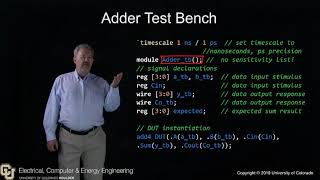
Example of a testbench to verify a basic adder design.
Memory Aids
Interactive tools to help you remember key concepts
Rhymes
If you want to code your gate, an HDL will help you create!
Stories
Once, in a land of circuits, an engineer needed to tell how his design would behave. He spoke the language of Verilog, which transformed his thoughts into a blueprint of reality, avoiding the dragons of complexity.
Memory Tools
HDL: High-level, Design, Language - remember the role of HDL!
Acronyms
VHDL
Verilog
Hardware
Design
Language - describing hardware candy!
Flash Cards
Glossary
- HDL
Hardware Description Language; a specialized programming language used to describe the structure and behavior of electronic circuits.
- Verilog
A specific HDL used for modeling electronic systems, widely adopted in industry.
- Nets
Verilog data types that represent physical connections between hardware elements, which do not store values.
- Registers
Verilog data types that represent storage elements in hardware, which hold values until explicitly changed.
- Behavioral Modeling
A high-level abstraction technique in Verilog that describes how a circuit functions rather than how it is constructed.
- Testbench
A simulation structure, often without inputs/outputs, used to verify and test the functionality of hardware designs.
- Synthesis
The process of translating HDL code into a technology-specific gate-level netlist for implementation.
Reference links
Supplementary resources to enhance your learning experience.