
Blood Composition
Interactive Audio Lesson
Listen to a student-teacher conversation explaining the topic in a relatable way.
Introduction to Blood Components
🔒 Unlock Audio Lesson
Sign up and enroll to listen to this audio lesson

Today, we're going to talk about the composition of blood. Can anyone tell me the main components of blood?

I think it has plasma, red blood cells, white blood cells, and platelets.
Exactly! Plasma, erythrocytes, leukocytes, and platelets are the four key components. Let's break each one down. What do you think plasma does?

Isn't it just the liquid part that carries everything?
Correct! Plasma is indeed the liquid matrix. It makes up about 55% of blood volume and transports nutrients, hormones, and waste. Remember: Plasma is like the delivery system of the blood!
Erythrocytes and Their Function
🔒 Unlock Audio Lesson
Sign up and enroll to listen to this audio lesson

Now, let’s dive into erythrocytes, or red blood cells. What’s their primary role in our body?

To carry oxygen?
Absolutely! They transport oxygen from the lungs to other tissues using hemoglobin. Does anyone remember how many oxygen molecules one hemoglobin can carry?

Four molecules!
Right! That’s crucial for respiratory function. Think of erythrocytes as tiny delivery trucks that ensure every part of your body gets the oxygen it needs.
Leukocytes in Immune Defense
🔒 Unlock Audio Lesson
Sign up and enroll to listen to this audio lesson
Let’s talk about leukocytes, or white blood cells. What do they do?
They fight infections!
Exactly! They play a significant role in the immune system. There are different types of leukocytes, like lymphocytes and neutrophils. Who can tell me what lymphocytes do?
Are they responsible for creating antibodies?
Spot on! Lymphocytes help recognize and respond to pathogens by producing antibodies, while neutrophils engulf bacteria. Remember: 'White helps fight!'
Platelets and Clotting
🔒 Unlock Audio Lesson
Sign up and enroll to listen to this audio lesson
Our final component is platelets. Who knows why they are important?
They help with blood clotting!
Yes! Platelets form a plug when a blood vessel is injured. They are crucial for preventing excessive bleeding. Think of them as the body's band-aids!
So, all these components work together like a team?
Exactly! Each part of blood plays a role in maintaining overall health. Remember: Blood is a 'team of lifesavers!'
Introduction & Overview
Read summaries of the section's main ideas at different levels of detail.
Quick Overview
Standard
The composition of blood includes various components that serve crucial functions. Plasma acts as a transport medium, erythrocytes carry oxygen, leukocytes defend against pathogens, and platelets are essential for clotting. Understanding these elements is vital for grasping how the circulatory system supports overall physiology.
Detailed
Blood Composition
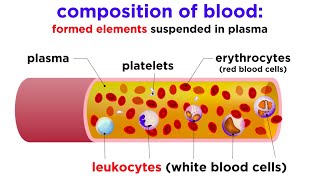
Blood is a specialized bodily fluid that plays essential roles in transportation, regulation, and protection. Its composition can be categorized into four primary components:
- Plasma: The liquid matrix of blood, making up about 55% of total blood volume. Plasma consists of water, electrolytes, nutrients, hormones, and waste products, facilitating the transport of these substances throughout the body.
- Erythrocytes (Red Blood Cells): These cells lack a nucleus and contain hemoglobin, which is crucial for oxygen transport from the lungs to body tissues. Each erythrocyte can carry up to four molecules of oxygen, highlighting its critical function in respiration.
- Leukocytes (White Blood Cells): Unlike erythrocytes, leukocytes are involved in the immune response. They protect the body from infections and foreign substances and can be classified into several types, including lymphocytes, neutrophils, and monocytes, each with specific roles in immunity.
- Platelets: These cell fragments are vital for hemostasis (blood clotting). When a blood vessel is injured, platelets aggregate to form a plug, alongside proteins in plasma that orchestrate the clotting process.
In summary, the composition of blood is not only crucial for transportation and homeostasis but also for immune defense and wound healing. Understanding blood composition enables insights into how these components work together to maintain health.
Youtube Videos

Audio Book
Dive deep into the subject with an immersive audiobook experience.
Plasma
Chapter 1 of 4
🔒 Unlock Audio Chapter
Sign up and enroll to access the full audio experience
Chapter Content
● Plasma: Liquid matrix transporting nutrients, hormones, and waste.
Detailed Explanation
Plasma is the liquid part of blood and makes up about 55% of its overall volume. It is primarily made of water but also contains proteins, electrolytes, nutrients, hormones, and waste products. Plasma's main functions include transporting these substances throughout the body, maintaining blood pressure, and regulating body temperature.
Examples & Analogies
Think of plasma like a river that carries everything it collects from its surroundings (like nutrients and waste) to different cities (body organs). Just as a river is essential for transportation and sustenance for towns along its banks, plasma is vital for the distribution of essential substances in our body.
Erythrocytes (Red Blood Cells)
Chapter 2 of 4
🔒 Unlock Audio Chapter
Sign up and enroll to access the full audio experience
Chapter Content
● Erythrocytes (Red Blood Cells): Carry oxygen via hemoglobin.
Detailed Explanation
Erythrocytes, or red blood cells (RBCs), are responsible for carrying oxygen from the lungs to the rest of the body and returning carbon dioxide from the body back to the lungs. They contain hemoglobin, a protein that binds to oxygen and carbon dioxide. The unique shape of RBCs (biconcave) increases their surface area for gas exchange and allows them to easily flow through blood vessels.
Examples & Analogies
You can think of red blood cells like delivery trucks. Their job is to collect oxygen from a delivery point (the lungs) and transport it to various stores (body tissues). Just like these trucks also take away returns (carbon dioxide), red blood cells drop off oxygen and pick up carbon dioxide to take back to the lungs.
Leukocytes (White Blood Cells)
Chapter 3 of 4
🔒 Unlock Audio Chapter
Sign up and enroll to access the full audio experience
Chapter Content
● Leukocytes (White Blood Cells): Defend against pathogens.
Detailed Explanation
Leukocytes, or white blood cells (WBCs), are crucial components of the immune system. They help the body fight infection and disease by identifying and destroying bacteria, viruses, and other harmful invaders. There are several types of WBCs, including lymphocytes, neutrophils, and macrophages, each playing a different role in immune response.
Examples & Analogies
Imagine your body as a fortress and white blood cells as the guards. They patrol the castle and are always on the lookout for intruders (pathogens). When they find an enemy, they spring into action to eliminate the threat, just like guards would defend against attacks.
Platelets
Chapter 4 of 4
🔒 Unlock Audio Chapter
Sign up and enroll to access the full audio experience
Chapter Content
● Platelets: Involved in blood clotting.
Detailed Explanation
Platelets are small cell fragments that play a vital role in blood clotting. When a blood vessel is injured, platelets adhere to the site of injury and start to gather, eventually forming a plug to prevent blood loss. They contain proteins that are essential for the clotting process and facilitate healing.
Examples & Analogies
You can think of platelets like the construction crew that quickly arrives at a building site after damage has occurred. They seal up the broken areas (wounds) by filling in gaps so that the structure (your body) can heal without losing resources (blood) in the meantime.
Key Concepts
-
Plasma: The transport medium for nutrients and waste in blood.
-
Erythrocytes: Cells carrying oxygen due to hemoglobin.
-
Leukocytes: Immune system cells defending against pathogens.
-
Platelets: Key components in the blood clotting process.
Examples & Applications
The process of oxygen transport by erythrocytes can be visualized as a delivery service where oxygen is picked up in the lungs and delivered to tissues.
During an infection, leukocytes increase in number to combat pathogens, akin to deploying reinforcements in a battle.
Memory Aids
Interactive tools to help you remember key concepts
Rhymes
Plasma is like water clear, transporting things far and near.
Stories
Imagine a city where delivery trucks (erythrocytes) take oxygen from a warehouse (lungs) to all the homes (tissues) while police (leukocytes) protect the city from invaders. If there's an accident, repair teams (platelets) rush in to fix the damage.
Memory Tools
Remember 'E-PLP' for blood components: Erythrocytes, Plasma, Leukocytes, Platelets.
Acronyms
Use the acronym 'BEP' - Blood's Essential Players (for Erythrocytes, Leukocytes, and Platelets).
Flash Cards
Glossary
- Plasma
The liquid component of blood that transports nutrients, hormones, and waste.
- Erythrocytes
Red blood cells responsible for carrying oxygen to body tissues.
- Leukocytes
White blood cells involved in immune response and defense against pathogens.
- Platelets
Cell fragments that play a crucial role in blood clotting.
Reference links
Supplementary resources to enhance your learning experience.