
Embedded Systems: Week 2 - Designing Single Purpose Processors and Optimization
Interactive Audio Lesson
Listen to a student-teacher conversation explaining the topic in a relatable way.
Introduction to Processors
🔒 Unlock Audio Lesson
Sign up and enroll to listen to this audio lesson

Today, we will explore the clear distinctions between General Purpose Processors (GPPs) and Single-Purpose Processors (SPPs). Can anyone remind me what a GPP is?

A GPP is a microprocessor that can run various software programs, making it very versatile.
Exactly! They are designed to be programmable. Now, what about SPPs? Any thoughts?

SPPs are designed to perform one specific task efficiently, like an ASIC.
Great answer! To help remember, think of GPPs as 'General Works' while SPPs are 'Specialists'. Both have distinct roles in embedded systems. Can anyone tell me one advantage of an SPP?

They have better performance for specific tasks since they are optimized for them.
Exactly! Let’s recap - GPPs are flexible, while SPPs offer high efficiency at the expense of being less adaptable.
Design Flow of SPPs
🔒 Unlock Audio Lesson
Sign up and enroll to listen to this audio lesson

Next, we delve into the design flow of SPPs. Can someone explain how we start the design process?

We begin by defining the problem and specifying the inputs and outputs.
Great point! This clarity helps us visualize the required functionality. What comes next?
Then we represent the algorithm at a high level, perhaps using pseudocode or flowcharts!
Correct! Visual representations maximize clarity. Lastly, how do we approach creating an FSMD?
We break down the algorithm into control steps and data operations!
Well done, everyone! Remember, starting with clear specifications is crucial for successful SPP design.
Optimization Techniques
🔒 Unlock Audio Lesson
Sign up and enroll to listen to this audio lesson
Finally, let’s tackle optimization techniques for SPPs. Who can share a common optimization goal?
A primary goal is to minimize power consumption.
Absolutely right! And what about performance? How do we achieve that?
We can reduce the clock cycle time or increase the clock frequency!
Exactly! Remember to consider the critical path in your designs. Let’s summarize: minimizing power and maximizing performance are pivotal.
Introduction & Overview
Read summaries of the section's main ideas at different levels of detail.
Quick Overview
Standard
In this section, we compare General Purpose Processors (GPPs) and SPPs, detailing the architectural distinctions and emphasizing the importance of SPPs in specialized tasks. The design flow for creating an SPP is outlined, along with various optimization techniques that enhance performance, minimize power consumption, and optimize design space.
Detailed
Detailed Summary
This section delves into the critical aspects of designing Single Purpose Processors (SPPs) and optimization strategies tailored for embedded systems. It begins by contrasting General Purpose Processors (GPPs) and SPPs, elaborating on their distinct architectures, advantages, and drawbacks. GPPs are flexible and capable of executing various tasks but suffer from performance inefficiencies in specialized computing. On the other hand, SPPs are optimized for specific operations, leading to improved performance, reduced power consumption, and more compact designs.
Key Components of SPP Design
Designing an SPP follows a systematic flow beginning with high-level algorithms, translating them into Finite State Machines with Datapath (FSMD) representations, and constructing controllers and datapaths using combinational and sequential logic principles.
Optimization Techniques
Numerous strategies for optimization are discussed, focusing on maximizing performance and efficiency while considering design constraints such as power usage and physical area. This includes techniques applicable at various abstraction levels, from the choice of algorithms to fine-tuning gate-level implementations.
Conclusion
The understanding of SPP design principles and optimization techniques is essential for developing efficient hardware solutions for embedded systems demanding high performance and energy efficiency.
Youtube Videos
Audio Book
Dive deep into the subject with an immersive audiobook experience.
Course Overview
Chapter 1 of 6
🔒 Unlock Audio Chapter
Sign up and enroll to access the full audio experience
Chapter Content
Welcome to Week 2 of our "Embedded Systems" course, where we delve into the intricate art and science of Designing Single Purpose Processors (SPPs) and their Optimization. This module is meticulously crafted to transform your understanding of digital hardware design, guiding you from high-level algorithmic concepts to low-level gate-level implementations. You will gain a profound appreciation for why SPPs are indispensable in modern embedded systems, offering unparalleled efficiency for specialized tasks. We will systematically explore the entire design flow, from translating algorithms into the powerful Finite State Machine with Datapath (FSMD) model, to meticulously crafting the controller and datapath, and finally, applying sophisticated optimization techniques to achieve peak performance, minimal power consumption, and compact physical size. Prepare for an immersive journey into the heart of custom hardware acceleration.
Detailed Explanation
This overview introduces the major themes of Week 2 of the Embedded Systems course. It emphasizes the goal of learning how to design single-purpose processors that are optimized for specific tasks. The course will guide you through the process from algorithms (which represent high-level logic) down to the detailed workings of circuits at the gate level. By the end of this module, you should appreciate the practical advantages of single-purpose processors over general-purpose ones in terms of performance and power efficiency.
Examples & Analogies
Think of designing an SPP like crafting a custom kitchen for a specific recipe. If you're always cooking pasta, a custom kitchen with specialized tools for boiling water, draining noodles, and storing pasta will be much more efficient than a generic kitchen that has multi-purpose tools but lacks the specific tools for pasta.
Learning Objectives
Chapter 2 of 6
🔒 Unlock Audio Chapter
Sign up and enroll to access the full audio experience
Chapter Content
Upon successful completion of this rigorous module, you will possess the ability to:
● Critically evaluate the architectural paradigms of General Purpose Processors (GPPs) versus Single-Purpose Processors (SPPs), discerning their respective strengths, weaknesses, and optimal application domains within embedded systems.
● Proficiently translate complex algorithms into a structured Finite State Machine with Datapath (FSMD) representation, capturing both the control flow and data manipulation aspects of computational tasks.
● Architect and implement the distinct yet interconnected components of an SPP: the controller (sequencing and decision-making unit) and the datapath (data processing and storage unit), using sound digital design principles.
● Demonstrate mastery in applying both combinational and sequential logic design methodologies to realize efficient and correct hardware for processor implementation.
● Strategically identify and apply a diverse array of optimization techniques at various levels of design abstraction – from algorithmic enhancements to gate-level refinements – targeting critical metrics such as speed, area, and power.
● Conduct insightful trade-off analyses among competing design metrics (e.g., performance vs. power vs. area vs. NRE cost), enabling judicious decision-making for real-world embedded system design challenges.
● Develop a foundational understanding of low-power design principles essential for energy-efficient embedded solutions.
Detailed Explanation
In this section, the module sets clear learning objectives. The students will learn to discern the differences between General Purpose Processors (GPPs) and Single-Purpose Processors (SPPs), translating algorithms to hardware representations, designing the components of an SPP, and applying both logic methodologies and optimization techniques. Understanding trade-offs like performance vs. power consumption will prepare students for real-world embedded system design. Additionally, they will gain insights into low-power design concepts crucial for energy-sensitive applications.
Examples & Analogies
Consider a student learning to compare different vehicles for a project. Similar to how a student evaluates the advantages of a sports car (fast but less fuel-efficient) against a hybrid car (efficient but slower), the objectives help students evaluate SPPs versus GPPs, encouraging them to make informed design decisions.
Module 2.1: Introduction to Single-Purpose Processors
Chapter 3 of 6
🔒 Unlock Audio Chapter
Sign up and enroll to access the full audio experience
Chapter Content
This foundational section establishes the necessity and unique value proposition of single-purpose processors in the embedded landscape. We will meticulously compare them with general-purpose processors, highlighting the architectural philosophies and performance characteristics that differentiate these two fundamental computing paradigms.
Detailed Explanation
This section provides the foundational understanding of why single-purpose processors are important in embedded systems. By comparing SPPs and GPPs, students learn the distinct advantages of SPPs in terms of performance and efficiency. It establishes a context for deeper exploration of these two types of processors, helping students appreciate their specific uses.
Examples & Analogies
Imagine a toolset where you have a versatile Swiss Army knife (like a GPP) that can do many tasks but isn't the best at any one task, versus a dedicated lawnmower (like an SPP) that is specifically designed for mowing grass efficiently. This analogy highlights how SPPs can outperform GPPs in specific applications.
Comparative Analysis of GPPs and SPPs
Chapter 4 of 6
🔒 Unlock Audio Chapter
Sign up and enroll to access the full audio experience
Chapter Content
General Purpose Processors (GPPs): The Programmable Workhorses
Definition and Architecture: A GPP is a microprocessor designed to execute a broad range of instructions, allowing it to perform diverse tasks merely by loading different software programs. Its architecture typically includes:
● Central Processing Unit (CPU): Comprising an Arithmetic Logic Unit (ALU) for computations, control unit for instruction decoding and execution sequencing, and registers for temporary data storage.
● Memory Hierarchy: Cache memory (L1, L2, L3) for speed, main memory (RAM) for active programs and data, and secondary storage (SSD/HDD) for persistent data.
● Input/Output (I/O) Interfaces: For communication with peripherals.
● Bus Structures: Data bus, address bus, control bus for internal communication.
Key Characteristics:
● Programmability/Flexibility: Its primary strength. A single hardware unit can perform countless functions, from word processing to complex simulations, by changing its software.
● Instruction Set Architecture (ISA): Defines the set of instructions (e.g., ADD, SUB, MOV, JUMP) that the processor understands and can execute. GPPs have rich and often complex ISAs (RISC like ARM, MIPS; CISC like x86).
● Fetch-Decode-Execute Cycle: The fundamental operational loop. Instructions are fetched from memory, decoded, operands are fetched, the operation is executed, and results are written back. This cycle introduces inherent overhead.
● Typical Applications: Desktop computers, laptops, smartphones, servers, embedded systems requiring high flexibility (e.g., infotainment systems, advanced robotics controllers).
● Advantages of GPPs: High flexibility, relatively low NRE cost (as the hardware is off-the-shelf), faster time-to-market for many applications (just write software).
● Disadvantages of GPPs: Lower performance for highly specialized tasks compared to custom hardware, higher power consumption for the same task (due to general-purpose overhead), larger physical footprint.
Detailed Explanation
This segment outlines the architecture and characteristics of General Purpose Processors (GPPs). It explains the essential components of GPPs, emphasizing their versatility and programmability. While they can execute a variety of tasks, they often do so at the expense of efficiency and performance compared to a specialized solution. The typical applications for GPPs highlight their common uses in various computing devices, while distinguishing features discuss both strengths and weaknesses.
Examples & Analogies
Think of a GPP as a multifunctional printer that can print, scan, and fax documents. While it can perform all these functions, it may not print as quickly or as well as a specialized printer dedicated solely to printing. The multifunctional printer is great for diverse tasks, just as GPPs cater to wide-ranging computing needs.
Characteristics of Single-Purpose Processors
Chapter 5 of 6
🔒 Unlock Audio Chapter
Sign up and enroll to access the full audio experience
Chapter Content
Single-Purpose Processors (SPPs): The Dedicated Specialists
Definition and Architecture: An SPP (also known as a custom logic circuit, ASIC - Application-Specific Integrated Circuit, or dedicated hardware accelerator) is a digital circuit meticulously designed and optimized to perform one specific computational task or algorithm very efficiently. Its architecture is "hardwired" directly to the problem.
Key Characteristics:
● Fixed Functionality: Its logic gates are arranged to directly implement a particular algorithm. No instruction set or program memory is typically involved in the same way as a GPP.
● Parallelism: Can exploit inherent parallelism in an algorithm by performing multiple operations simultaneously, leading to higher throughput and lower latency.
● Optimized Data Flow: Data paths are designed precisely for the required operations, minimizing unnecessary routing or multiplexing.
● No Instruction Overhead: Lacks the fetch, decode, and instruction pipeline overhead of GPPs, leading to fewer clock cycles per operation.
● Typical Applications: Video encoding/decoding (H.264, H.265 codecs), audio processing (MP3, AAC codecs), digital signal processing (DSP) filters, image processing units (GPUs, dedicated image signal processors), encryption/decryption accelerators, motor controllers, specialized industrial control systems, neural network accelerators (NPUs).
● Advantages of SPPs: Highest possible performance for the specific task, smallest physical size, lowest power consumption for the specific task.
● Disadvantages of SPPs: Very high NRE cost, long time-to-market, absolutely no flexibility (modifying function requires hardware redesign).
Detailed Explanation
This chunk focuses on Single-Purpose Processors (SPPs), emphasizing their distinct characteristics and architectures. By being hardwired for specific tasks, SPPs provide advantages like exceptional performance, minimal power usage, and compact design. However, this specialization comes with drawbacks, including high development costs and inflexibility. Understanding these characteristics is crucial for recognizing when to employ SPPs effectively.
Examples & Analogies
Imagine a single-purpose toaster that only toasts bread perfectly every time. While it can't be used for other tasks like baking or grilling (unlike a multifunction oven), its specialized design ensures it toasts bread more efficiently and with better results than a general kitchen appliance trying to do many tasks.
Trade-offs Between GPPs and SPPs
Chapter 6 of 6
🔒 Unlock Audio Chapter
Sign up and enroll to access the full audio experience
Chapter Content
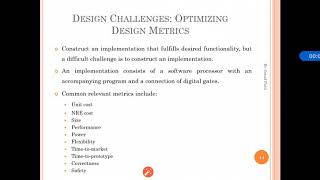
The decision between GPPs and SPPs (or hybrids like FPGAs, which offer reconfigurability) hinges on a careful evaluation of the following critical design metrics:
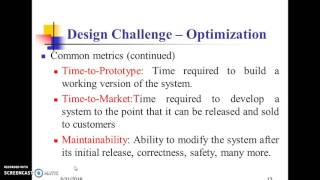
● Performance: SPPs usually win for specific, compute-intensive tasks (lower latency, higher throughput).
● Size (Area): SPPs can be significantly smaller as they include only necessary logic.
● Power Consumption: SPPs are typically more power-efficient for their dedicated task due to highly optimized circuits and lack of general-purpose overhead.
● Non-Recurring Engineering (NRE) Cost: SPPs demand much higher upfront design, verification, and mask costs. Economically viable only for very high production volumes where NRE is amortized per unit.
● Unit Cost: For extremely high volumes, the unit cost of an SPP can be lower than a GPP solution due to simpler final silicon.
● Time-to-Market: Generally longer for SPPs due to complex hardware design and verification cycles.
● Flexibility/Re-programmability: Extremely low for SPPs; high for GPPs.
● Risk: Higher design risk for SPPs; bugs in hardware are costly to fix.
Detailed Explanation
This chunk delves into the critical trade-offs one must consider when choosing between GPPs and SPPs. It highlights that while SPPs tend to outperform GPPs in specific tasks, they come with increased design costs and risk. The understanding of performance, size, power consumption, and cost implications is vital for making informed hardware design decisions.
Examples & Analogies
Imagine deciding between buying a custom motorcycle designed for racing or a standard bicycle that can be used for various activities. The motorcycle is faster and more efficient for racing but comes with higher costs and lacks versatility for casual riding. Similarly, SPPs are tailored for high performance but at a greater initial investment and loss of flexibility.
Key Concepts
-
GPP vs. SPP: GPPs are versatile while SPPs are task-specific processors designed for optimized performance.
-
Design Flow: The systematic process for creating SPPs from problem definition to FSMD implementation.
-
Optimization: Techniques to enhance performance, reduce power consumption, and efficiently utilize design space.
Examples & Applications
In designing a video encoder, an SPP can process data more quickly than a GPP by directly handling specific algorithms.
An FIR filter can be efficiently implemented on an SPP, allowing rapid execution of its dedicated tasks.
Memory Aids
Interactive tools to help you remember key concepts
Rhymes
GPP, flexible indeed, for tasks of every need. SPPs specialize, quick and precise, in efficiency they take the prize.
Stories
Imagine you have a great chef (GPP) who can make any meal perfectly, but a special pizza maker (SPP) who can only make pizza faster than anyone else!
Memory Tools
Remember GSS - GPP stands for General tasks, SPP specializes in Specific tasks.
Acronyms
GPP = General Programmable Processor; SPP = Specialized Processing Power.
Flash Cards
Glossary
- General Purpose Processor (GPP)
A type of microprocessor designed to execute a broad range of instructions, facilitating a variety of tasks.
- SinglePurpose Processor (SPP)
A custom-designed digital circuit optimized for executing a specific computational task efficiently.
- Finite State Machine with Datapath (FSMD)
A model that separates control logic and data processing aspects in digital system design.
- Power Consumption
The amount of electrical power used by a processor during operation, crucial for energy efficiency in embedded systems.
- Optimization Techniques
Strategies implemented to improve performance, power efficiency, and area utilization in design.
Reference links
Supplementary resources to enhance your learning experience.