
Module 2.4: Optimization Issues for Single-Purpose Processors
Interactive Audio Lesson
Listen to a student-teacher conversation explaining the topic in a relatable way.
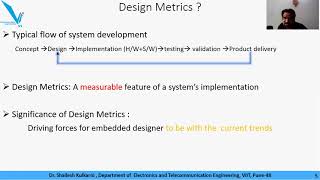
Design Metrics for Embedded Systems
🔒 Unlock Audio Lesson
Sign up and enroll to listen to this audio lesson

Today, we're going to discuss the metrics that are crucial for evaluating and optimizing single-purpose processors. Can anyone tell me what they think ‘unit cost’ refers to?

I think it has to do with how much it costs to produce each processor.
Exactly! The unit cost refers to the manufacturing cost per piece of the embedded system. It's influenced by factors like silicon area and assembly costs. The goal is to reduce this cost, especially as SPPs are often used in high-volume productions.

How does reducing the NRE costs help?
Great question! Non-Recurring Engineering costs are one-time expenses related to design and prototyping. By reducing these costs, such as through shorter design cycles and reusable intellectual property or IP, we can make SPP production more economically sustainable.
Now, who can explain why size or area is important?

Smaller size might be necessary for devices that have limited space, like wearables.
Correct! Minimizing the logic gates and optimizing layout begins to be crucial for compact, efficient devices. Any other metrics we've discussed that are significant?

What about performance? That seems really important too!
Indeed, performance relates to how quickly the system can execute tasks. By optimizing for execution time and throughput, we can create better systems. Remember: PEPTAL — where P stands for Performance, E for Efficiency, P for Power, T for Time-to-Market, A for Area, and L for Cost. This acronym can help you remember the critical metrics!
Summarizing today’s key points, we discussed unit costs, NRE cost, size, and performance metrics and their implications. Understanding these metrics is foundational for making intelligent design decisions in SPP development.
Optimizing the Original Program/Algorithm
🔒 Unlock Audio Lesson
Sign up and enroll to listen to this audio lesson

Now let’s dive into optimization opportunities at different design levels. What do we mean by optimizing the original program or algorithm?
I guess it's about improving the algorithm before we even think about hardware?
Exactly! The right algorithm can significantly impact performance and efficiency. Techniques like establishing more efficient algorithms can lead to better results. Can anyone give me an example?
How about using something like the Fast Fourier Transform instead of a regular Fourier Transform?
Perfect example! Algorithms like the FFT optimize computational complexity. Additionally, reducing redundant computations and minimizing memory accesses can yield critical advantages in design. Can anyone think of a way to leverage parallelism?
We can structure algorithms to run separate tasks at once, right?
Absolutely right! Exposing more inherent parallelism is vital for SPP architectures. Summarizing, we should always seek to refine algorithms for optimized processing capacities before we actualize hardware designs.
Optimizing the FSMD
🔒 Unlock Audio Lesson
Sign up and enroll to listen to this audio lesson
Moving onward, let’s look at the optimization of the FSMD. Who can tell me about state merging or reduction?
Isn't that when we combine states in an FSM that do the same thing?
Correct! Merging equivalent states simplifies the design, resulting in fewer flip-flops and ultimately smaller area utilization. What about re-timing?
I think it’s about moving registers around to reduce the critical path delay.
Exactly right! Re-timing can improve maximum clock frequency, but it requires analysis to ensure we don’t compromise on functionality. Any thoughts on how FSMD optimizations affect timings?
I guess they could delay the output if we aren’t careful!
Absolutely! We have to account for the timing of control signals and data availability during optimization. At the end, remember to focus on reducing complexity and enhancing performance when refining the FSMD.
Datapath Resource Management
🔒 Unlock Audio Lesson
Sign up and enroll to listen to this audio lesson
Now let’s discuss optimizing the datapath, focusing on resource management. What’s meant by resource sharing?
I think it’s when we use one component for multiple operations instead of having many separate units.
Exactly! For instance, using a single adder for different operations conserves area and power. How does register sharing come into play?
We can allocate the same register for variables that aren't needed simultaneously, right?
Right! This can help reduce total register count, thus saving area. Minimizing multiplexer inputs is also critical for reducing delay. Remember the grapevine strategy — if too many branches meet, it complicates the output. How can pipelining affect performance?
It allows multiple operations to be processed at once, which boosts throughput.
Yes! However, it might increase latency and complicate control. Thus, striking a balance is essential while leveraging all available optimization strategies. In summary, optimizing the datapath fosters a more capable and efficient SPP.
Introduction & Overview
Read summaries of the section's main ideas at different levels of detail.
Quick Overview
Standard
The optimization of single-purpose processors (SPPs) is pivotal to the design process, focusing on essential metrics such as performance, power consumption, area, and cost. It explores opportunities for optimization at various design levels, including algorithm selection and architectural refinements.
Detailed
Optimization Issues for Single-Purpose Processors
Optimization is a critical aspect of designing Single-Purpose Processors (SPPs). It involves enhancing the design across various metrics to ensure efficiency and effectiveness. This section elaborates on the following key points:
1. Design Metrics for Embedded Systems
Every design decision in SPPs involves a trade-off guided by specific metrics:
- Unit Cost: It refers to the manufacturing cost per unit of embedded systems, influenced by factors like silicon area and assembly. The goal is to reduce costs through optimized designs.
- Non-Recurring Engineering (NRE) Cost: This is a one-time cost for design and testing, where reducing cycle time and employing reusable IP can significantly benefit SPP design.
- Size (Area): Physical size is essential, as minimizing logic gates and optimizing layout can save space, which is crucial for devices like wearables.
- Performance: Measured by execution time and throughput, optimizing for performance entails leveraging parallelism and reducing clock cycles.
- Power Consumption: This encompasses dynamic and static power, with strategies focusing on voltage reduction and minimizing switching activity being crucial for battery efficiency.
- Flexibility/Re-programmability: Reflects ease of functionality updates, which is very low for SPPs.
- Time-to-Market (TTM): The design complexity and verification effort affect how quickly the product can reach the market.
2. Optimization Opportunities at Different Design Levels
Optimization can be approached on different levels:
- High-Level: Algorithmic refinements can lead to substantial gains in performance and efficiency. Techniques include adopting more efficient algorithms and minimizing redundant calculations.
- FSMD Architectural Refinements: Reducing states in an FSMD and optimizing timing paths can enhance performance and area utilization.
- Datapath Resource Management: Techniques like resource sharing, minimizing multiplexer inputs, and pipelining can save area while improving throughput.
- Controller Optimization: Streamlining control logic through state minimization and efficient state encoding can optimize the overall system performance.
3. Power Optimization Techniques
An in-depth exploration of techniques that include reducing switching activity and dynamic voltage scaling, focusing on power-efficient design methodologies.
These strategies are essential for creating SPPs that excel in performance, efficiency, and usability in embedded systems.
Youtube Videos



Key Concepts
-
Unit Cost: The cost associated with manufacturing each embedded system.
-
NRE Cost: The one-time engineering costs for design and production.
-
Size: The area covered by the silicon chip and PCB.
-
Performance: How fast a system can perform its functions.
-
Power Consumption: The amount of power used by the system during operation.
-
Flexibility: The ability to adapt system functionalities post-manufacturing.
-
Time-to-Market: The period it takes for a product to be available for sale.
-
State Merging: Combining identical states in an FSM for efficiency.
-
Resource Sharing: Utilizing the same component for different tasks to save cost.
-
Pipelining: Segmenting tasks for concurrent processing to improve throughput.
Examples & Applications
Using FFT instead of DFT to optimize computational speed while processing signals.
Sharing a single adder circuit for multiple operations in a processor design.
Applying clock gating to disable unused components in an integrated circuit, conserving power.
Memory Aids
Interactive tools to help you remember key concepts
Rhymes
When costs are on your mind, keep unit cost defined, NRE's a one-time fee, lower costs are guaranteed.
Stories
Imagine you're an engineer designing a smartwatch. You think about unit costs as you source smaller components, ensuring you don't overspend on materials while keeping your design's performance high and power low.
Memory Tools
Remember PEPTAL for design metrics: Performance, Efficiency, Power, Time-to-Market, Area, and Cost.
Acronyms
ROAC - Resource Optimization Around Costs
principle guiding how to share resources effectively.
Flash Cards
Glossary
- Unit Cost
The manufacturing cost per individual embedded system.
- NonRecurring Engineering (NRE) Cost
The one-time cost of design, verification, and tooling for initial prototypes.
- Size (Area)
The physical footprint of the silicon chip and the overall PCB area.
- Performance
The speed at which the system accomplishes its task, often measured in latency and throughput.
- Power Consumption
The electrical power dissipation of the system, which includes static and dynamic power.
- Flexibility/Reprogrammability
The capability to alter system functionality after manufacturing.
- TimetoMarket (TTM)
The duration from product conception to its commercial availability.
- State Merging
The process of combining equivalent states in a finite state machine (FSM) to streamline the design.
- Resource Sharing
Utilizing a single component for multiple operations instead of using separate components.
- Pipelining
The technique of breaking an operation into smaller stages to allow concurrent processing of multiple operations.
Reference links
Supplementary resources to enhance your learning experience.