
Homographs: Same Spelling, Different Sound, Different Meaning
Interactive Audio Lesson
Listen to a student-teacher conversation explaining the topic in a relatable way.
Introduction to Homographs
🔒 Unlock Audio Lesson
Sign up and enroll to listen to this audio lesson

Today we're discussing homographs. These are words that have the same spelling but different meanings and pronunciations. Can anyone give me an example?

How about 'lead'?
Great! 'Lead' can mean to guide or to be in charge, but it can also refer to a type of metal. So, we have two meanings and two pronunciations. Let's remember: same spelling, different sound, different meaning!

What about 'wind'?
'Wind' is another excellent example! It can refer to moving air or the action of winding something up. Context helps us distinguish these meanings.
Contextual Understanding of Homographs
🔒 Unlock Audio Lesson
Sign up and enroll to listen to this audio lesson

Now, let’s delve into how context plays a role in understanding homographs. Who can tell me what context means?

It's the situation or the surroundings in which something happens.
Exactly! For instance, if I say, 'I will wind the clock,' you know I'm talking about coiling it up. But if I say, 'The wind was strong today,' it's about air. Both use 'wind,' but the context defines their meaning.

So, it’s really important to pay attention to how a word is used, right?
Absolutely! Always consider the sentence or situation as context gives clues about the intended meaning.
Reviewing More Examples of Homographs
🔒 Unlock Audio Lesson
Sign up and enroll to listen to this audio lesson
Let’s review some more examples. Can someone think of another homograph?
What about 'minute'? It can mean a small amount or a unit of time!
Exactly! One context relates to time, while the other describes something tiny. Remember, understanding homographs enriches your vocabulary!
What about different pronunciations as well?
I see you’re catching on. 'Row' can mean a line of things or the action of rowing a boat. Different sounds, different meanings—same spelling. Context is key!
Introduction & Overview
Read summaries of the section's main ideas at different levels of detail.
Quick Overview
Standard
Homographs are explored in detail, highlighting their unique feature of sharing spelling yet differing in sound and meaning. Various examples illustrate how context determines their usage.
Detailed
Homographs are defined as words that are spelled the same but have different pronunciations and meanings. This section delves into the concept by providing examples such as 'lead' (to guide) and 'lead' (a metal), as well as 'wind' (moving air) and 'wind' (to coil). It emphasizes the importance of context in understanding the intended meaning of the word when spoken or written. The significance of recognizing homographs enhances vocabulary comprehension and spelling skills.
Youtube Videos

Audio Book
Dive deep into the subject with an immersive audiobook experience.
Definition of Homographs
Chapter 1 of 3
🔒 Unlock Audio Chapter
Sign up and enroll to access the full audio experience
Chapter Content
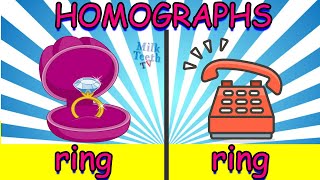
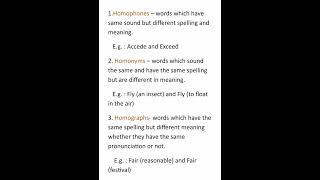
Homographs are words that are spelled the same but have different pronunciations and different meanings.
Detailed Explanation
Homographs are unique because they share the same spelling, which can lead to confusion. However, they are pronounced differently and have distinct meanings. For example, the word 'lead' can refer to guiding someone ('leed') or to a type of metal ('led'). Therefore, understanding the context is crucial for proper interpretation.
Examples & Analogies
Think of homographs like different flavors of ice cream that look the same but taste completely different. Just as you need a spoon to discover the unique taste, you must pay attention to how the word is used in a sentence to grasp its meaning.
Key Feature of Homographs
Chapter 2 of 3
🔒 Unlock Audio Chapter
Sign up and enroll to access the full audio experience
Chapter Content
Key Feature: Same spelling, different sound, different meaning.
Detailed Explanation
The key feature that defines homographs is that although they are written identically, their pronunciations and meanings differ. This characteristic distinguishes them from other word categories, such as homophones or homonyms, where meanings or sounds could overlap.
Examples & Analogies
Imagine two friends named 'Alex.' One is an accomplished musician who 'plays' in a band, while the other 'plays' games on their phone. Even though they share the same name, their activities are profoundly different. Similarly, homographs like 'tear' (to rip) and 'tear' (a drop of water from the eye) require clarity to differentiate.
Common Examples of Homographs
Chapter 3 of 3
🔒 Unlock Audio Chapter
Sign up and enroll to access the full audio experience
Chapter Content
Common Examples:
- Bow (pronounced 'boh' - to bend forward as a greeting; 'bou' - a knot, or an archery weapon)
- She gave a bow after her performance. (boh)
- He tied the ribbon in a bow. (bou)
- Lead (pronounced 'leed' - to guide; 'led' - a metal)
- I will lead the team. (leed)
- Pencils used to contain lead. (led)
- Live (pronounced 'liv' - to reside; 'lyve' - happening in real-time)
- I live in Mumbai. (liv)
- The concert was broadcast live on TV. (lyve)
- Minute (pronounced 'min-it' - 60 seconds; 'my-noot' - extremely small)
- Wait a minute. (min-it)
- There was a minute scratch on the car. (my-noot)
- Wind (pronounced 'wind' - moving air; 'wynd' - to coil or turn)
- The wind blew strongly. (wind)
- She had to wind the clock. (wynd)
Detailed Explanation
This chunk highlights practical examples of homographs, showcasing how context plays a critical role in understanding their meanings. The pronunciation and meaning change dramatically based on how they are used. For instance, 'bow' can signify different actions based on its pronunciation, leading to completely different interpretations.
Examples & Analogies
Consider the word 'lead' in a company. When you say, 'I will lead the way' (leed), it means guiding or directing. But if you mention, 'The pencil contains lead' (led), you're talking about the substance within it. The same concept can apply to a tour guide leading a group to explore fascinating places compared to discussing an element on the periodic table.
Key Concepts
-
Homographs: Defined as words with the same spelling, differing in sound and meaning.
-
Context Matters: The importance of context in determining the meaning of homographs.
Examples & Applications
Bow: to bend forward as a greeting (boh) vs. bow: a tied knot or weapon (bou)
Lead: to guide (leed) vs. lead: a type of metal (led)
Wind: moving air (wind) vs. wind: to coil (wynd)
Memory Aids
Interactive tools to help you remember key concepts
Rhymes
'Read the lead, but don't lead with red!' — Helps remember the two meanings of 'lead'.
Stories
Once a sailor said, 'I can't tell the wind when I wind up the string.' This story illustrates the action and the air context of 'wind'.
Memory Tools
For homographs: 'Same Spelling, Different Sound, Different Meaning' simplifies the understanding.
Acronyms
HSD
Homographs Share Different meanings.
Flash Cards
Glossary
- Homograph
A word that is spelled the same as another word but has a different meaning and often a different pronunciation.
- Context
The situation or setting in which a word or phrase is used, which helps to determine its meaning.
Reference links
Supplementary resources to enhance your learning experience.