
Homonyms: Same Spelling AND Sound, Different Meaning
Interactive Audio Lesson
Listen to a student-teacher conversation explaining the topic in a relatable way.
Introduction to Homonyms
🔒 Unlock Audio Lesson
Sign up and enroll to listen to this audio lesson

Good morning, class! Today we're going to dive into the world of homonyms. Can anyone tell me what a homonym is?

Is it a type of word that sounds the same as another but has a different meaning?
That's correct! Homonyms are words that have the same spelling and pronunciation but different meanings. For example, the word 'bat' can refer to a flying mammal or a piece of sports equipment. Does anyone have another example?

What about 'bank'? It can mean a place where we keep money, or the side of a river!
Excellent example! The context of a sentence is key to understanding which meaning is intended. Remember, homonyms rely heavily on how they're used.

So, if I say 'He went to the bank,' it could mean he's going to the financial institution or the river bank?
Exactly! That's why context is so important in language.

Can you give us more examples of homonyms?
Of course! Words like 'right'—which can mean correct or a direction—are homonyms too. To sum up, understanding homonyms helps avoid confusion in communication and enhances our vocabulary.
Examples of Homonyms
🔒 Unlock Audio Lesson
Sign up and enroll to listen to this audio lesson

Now, let’s discuss some homonyms in detail. Who can tell me what 'right' means?
It can mean correct, but it can also refer to a direction!
Exactly! 'Right' has at least three meanings: correctness, direction, and even a moral entitlement. The context will tell us what it means. Let’s take another example, 'date.' What are its meanings?
It can be a day on the calendar or the fruit!
Right! If I say, 'Let’s meet on that date,' you know I’m referring to a specific time. But if I say, 'I love eating dates,' we’re talking about the fruit. Great work!
Can we try using some homonyms in sentences to practice?
Certainly! Can anyone create a sentence using the word 'bat'?
Sure! 'The bat flew over my head while I was playing baseball.'
Nicely done! Always consider the context!
Understanding Context in Homonyms
🔒 Unlock Audio Lesson
Sign up and enroll to listen to this audio lesson
Context is essential in understanding homonyms. Can anyone explain how context helps us?
It tells us which meaning to choose based on other words in the sentence!
Exactly! For example, 'I need to bank on this investment.' Here, 'bank' refers to relying on something rather than a financial institution. Let’s try another example—'I can't right the ship.' What does 'right' mean here?
I think it means to correct or fix it?
Perfect! Remember that our choice of words can change meaning dramatically. Can anyone give a sentence using the word 'fair' to illustrate its various meanings?
How about ‘The fair was held in the park this weekend.’ And of course, 'it’s fair to share.'
Fantastic! Context ensures clarity in communication, especially with homonyms.
Introduction & Overview
Read summaries of the section's main ideas at different levels of detail.
Quick Overview
Standard
This section covers the concept of homonyms, emphasizing the importance of understanding context to determine their meanings. Examples illustrate how the same spelling and sound can lead to different meanings in communication.
Detailed
Homonyms: Same Spelling AND Sound, Different Meaning
Homonyms are a fascinating aspect of the English language. They are words that share the same spelling and pronunciation but possess different meanings based on their context in sentences. This section explores this concept, emphasizing its significance in effective communication. Some critical features of homonyms include:
- Key Feature: Same spelling, same sound, different meaning.
- Importance: Understanding homonyms can prevent miscommunication and enhance comprehension in writing and speaking.
Common Examples of Homonyms:
- Bat:
- (a flying mammal) A bat flies at night.
- (a piece of sports equipment) He hit the ball with a bat.
- Bank:
- (financial institution) I deposited money in the bank.
- (edge of a river) We sat on the river bank.
- Right:
- (correct) You got the answer right.
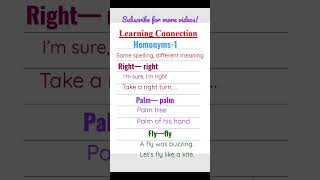
- (direction) Turn right at the corner.
- (a legal or moral entitlement) Everyone has a right to education.
- Date:
- (a specific day/time) What is today’s date?
- (a type of fruit) I like to eat dates.
- Fair:
- (just, equitable) That’s a fair decision.
- (an exhibition or market) We went to the village fair.
- (light in colour) She has fair hair.
Recognizing the context in which these words are used is crucial for understanding their meanings during communication.
Youtube Videos



Audio Book
Dive deep into the subject with an immersive audiobook experience.
Definition of Homonyms
Chapter 1 of 2
🔒 Unlock Audio Chapter
Sign up and enroll to access the full audio experience
Chapter Content
Homonyms are words that are spelled the same and sound the same, but have different meanings. The meaning depends entirely on the context of the sentence.
Detailed Explanation
Homonyms are a unique category of words in English. They are characterized by having the same spelling and pronunciation, which can sometimes create confusion. The difference in meaning is determined by the context in which the word is used. For instance, the word 'bat' can refer to a flying mammal or a piece of sports equipment, depending on the sentence's context.
Examples & Analogies
Think of homonyms like a shadow of a person. Just as a shadow can look like a person but is not the same, homonyms can sound and look identical to one another while carrying different meanings based on the situation. If you say, 'I saw a bat flying at night,' you visualized a mammal, but when you say, 'He hit the ball with a bat,' you're talking about sports equipment.
Examples of Homonyms
Chapter 2 of 2
🔒 Unlock Audio Chapter
Sign up and enroll to access the full audio experience
Chapter Content
Common Examples:
- Bat:
- a flying mammal: A bat flies at night.
- a piece of sports equipment: He hit the ball with a bat.
- Bank:
- financial institution: I deposited money in the bank.
- edge of a river: We sat on the river bank.
- Right:
- correct: You got the answer right.
- direction: Turn right at the corner.
- a legal or moral entitlement: Everyone has a right to education.
- Date:
- a specific day/time: What is today's date?
- a type of fruit: I like to eat dates.
- Fair:
- just, equitable: That's a fair decision.
- an exhibition or market: We went to the village fair.
- light in colour, complexion: She has fair hair.
Detailed Explanation
Examples help illustrate the definition of homonyms further. For the word 'bat,' it can mean the creature seen at night or the equipment used in games like baseball. Similarly, 'bank' can refer to where we keep our money or where a river meets the land. The word 'right' can pertain to something correct, a direction one might take, or an entitlement everyone possesses, like the right to an education. Understanding these examples is crucial because it showcases how the same word can fit into various categories and meanings depending on context.
Examples & Analogies
Imagine you're at a party. If someone says, 'That's not fair!' they might be discussing an unjust decision. If they say, 'I went to the fair,' they mean a fun event with rides and games. Context is everything! It's like a chameleon that alters its colors based on its environment—a word can shift its meaning just as a chameleon changes its appearance based on its surroundings.
Key Concepts
-
Homonyms: Words with the same spelling and pronunciation but different meanings.
-
Context: The situation in which a word is used, essential for understanding the correct meaning.
Examples & Applications
Bank: financial institution vs. river bank.
Right: correct vs. right turn.
Date: a day of the month vs. a sweet fruit.
Memory Aids
Interactive tools to help you remember key concepts
Rhymes
To understand a homonym’s fame, check the context to make sense of the name.
Stories
Once, a bat flew over a river bank where a boy sat in confusion, not knowing if 'bank' meant the place to keep money or the edge of the river.
Memory Tools
Think of 'H-O-M-O' in 'homonym' to remind you of 'same spelling, same sound, different meanings.'
Acronyms
C.S.M. (Context, Sound, Meaning) helps you remember how to identify homonyms.
Flash Cards
Glossary
- Homonym
A word that is spelled the same and sounds the same as another word but has a different meaning.
- Context
The circumstances or situation in which a word or sentence is used, which can help clarify its meaning.
Reference links
Supplementary resources to enhance your learning experience.