
Spelling Rules & Common Misspellings: Mastering Accuracy
Interactive Audio Lesson
Listen to a student-teacher conversation explaining the topic in a relatable way.
General Spelling Rules
🔒 Unlock Audio Lesson
Sign up and enroll to listen to this audio lesson

Today, we will discuss important spelling rules that will help you write more accurately. Let's start with the 'i before e' rule. Can anyone tell me what it means?

It's when 'i' comes before 'e' unless there's a 'c'?
Exactly, and there are exceptions. For example, 'receive' is an exception. Can anyone think of other exceptions?

What about ‘weigh’ and ‘neighbour’?
Great examples! You see, these rules help us remember tricky words. Can someone give me a sentence using 'believe'?

I believe in hard work!
Good job! Remember, rules like 'i before e' can help prevent common mistakes.
Dropping the Silent 'e'
🔒 Unlock Audio Lesson
Sign up and enroll to listen to this audio lesson

Next, let’s talk about dropping the silent 'e'. When do we drop the 'e'?

When we add a vowel suffix like -ing?
Exactly! For example, 'make' becomes 'making'. What about words that end in 'ge' or 'ce'?
They keep the 'e', like 'courageous'?
Spot on! Keeping the 'e' helps maintain the correct sound. Can you remember to apply this when you're writing?
Yes, let's practice by changing 'hope' to 'hopeful'!
Well done! Remembering these rules can enhance your spelling.
Doubling the Final Consonant
🔒 Unlock Audio Lesson
Sign up and enroll to listen to this audio lesson
Now let’s discuss the CVC rule. Who can explain this rule to the class?
If a one-syllable word ends with a consonant-vowel-consonant pattern, we double the last consonant when adding a vowel suffix?
Great! Can someone give me an example?
Like 'run' becomes 'running'?
Correct! Now, how about multi-syllable words?
Only double it if the stress is on the last syllable, right?
Exactly! Stress placement is important, such as in 'begin' becoming 'beginning'.
Changing 'y' to 'i'
🔒 Unlock Audio Lesson
Sign up and enroll to listen to this audio lesson
Let's move on to changing 'y' to 'i'. What do you do when a word ends in a consonant followed by 'y'?
We change 'y' to 'i' before adding a suffix!
Right! Can someone give an example?
Like 'happy' becomes 'happiness'!
Good, but remember, if the suffix starts with 'i', we keep the 'y', like in 'studying'.
So, 'study' stays with 'y'?
Exactly! Let’s review this rule in our exercises.
Common Misspellings
🔒 Unlock Audio Lesson
Sign up and enroll to listen to this audio lesson
Lastly, let's focus on common misspellings. Can anyone share a word they often find confusing?
I always mix up 'definitely'!
Ah! A common one. Think of 'finite' inside it. Can you try to spell it out loud?
De-finite-ly!
Excellent! What other commonly misspelled words can we discuss?
I struggle with 'separate'.
Remember 'a rat' in separate! Let's practice spelling these words to ensure we remember them.
Introduction & Overview
Read summaries of the section's main ideas at different levels of detail.
Quick Overview
Standard
In this section, learners will explore key spelling rules, such as the 'i before e' rule, how to handle silent 'e's, consonant doubling, and changing 'y' to 'i'. Additionally, it highlights common misspellings alongside helpful tips to remember the correct spellings.
Detailed
Detailed Summary of Spelling Rules & Common Misspellings
Accurate spelling is crucial for effective written communication. The English language contains several rules that can help learners spell correctly, along with common misspellings that often cause confusion.
General Spelling Rules
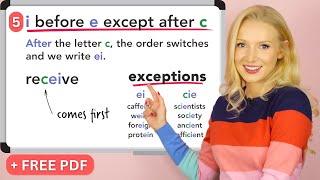
- 'i' before 'e' Rule: Generally, 'i' comes before 'e' except after 'c' or when pronounced like 'a' (e.g., 'neighbour'). Examples are: achieve, belief, field. Key exceptions include receive and weigh.
- Dropping the Silent 'e': When adding a suffix starting with a vowel to a word ending in a silent 'e', the 'e' is dropped (e.g., bake + er = baker). Exceptions apply.
- Keeping the Silent 'e': Maintain 'e' when a suffix starting with a consonant is added (e.g., hope + ful = hopeful).
- Doubling the Last Consonant (CVC Rule): If a one-syllable word ends in CVC and a vowel-initial suffix is added, double the last consonant (e.g., run + ing = running).
- Changing 'y' to 'i': Change 'y' to 'i' before adding a new suffix (e.g., happy + ness = happiness) unless the suffix starts with 'i'.
Common Misspellings
This section lists typical misspellings and mnemonic aids to remember their correct forms, including:
- receive: “I before E except after C.”
- definitely: “Finite is contained within.”
- separate: “A rat in 'separate'.”
- accommodation: “Two C’s and M’s.”
By mastering these rules and common misspellings, one can significantly improve spelling accuracy, leading to clearer and more professional written communication.
Youtube Videos




Audio Book
Dive deep into the subject with an immersive audiobook experience.
General Spelling Rules
Chapter 1 of 3
🔒 Unlock Audio Chapter
Sign up and enroll to access the full audio experience
Chapter Content
- General Spelling Rules:
-
"i" before "e" except after "c" or when sounding like "a" as in "neighbour" or "weigh".
- Examples: achieve, belief, relieve, field.
- Exceptions: receive, deceive, ceiling, conceive.
- Sounding like "a": neighbour, weigh, eight, sleigh.
- Other exceptions: seize, weird, foreign, height, leisure.
-
Dropping the 'e' before a suffix starting with a vowel:
- If a word ends in a silent 'e' and you add a suffix that starts with a vowel (like -ing, -able, -ation), drop the 'e'.
- Examples: come + ing = coming; make + ing = making; bake + er = baker; love + able = lovable.
- Exceptions: words ending in -ce or -ge keep the 'e' before -able or -ous to maintain the soft 'c' or 'g' sound (e.g., noticeable, courageous).
-
Keeping the 'e' before a suffix starting with a consonant:
- If a word ends in a silent 'e' and you add a suffix that starts with a consonant (like -ful, -ment, -ly), keep the 'e'.
- Examples: hope + ful = hopeful; safe + ty = safety; accurate + ly = accurately.
- Exceptions: argument, truly, awful.
-
Doubling the consonant (CVC Rule - Consonant-Vowel-Consonant):
- If a word has one syllable, ends in a single consonant preceded by a single vowel (CVC pattern), and you add a suffix starting with a vowel, double the final consonant.
- Examples: run + ing = running; stop + ed = stopped; big + est = biggest; swim + er = swimmer.
- For words with more than one syllable, double the consonant only if the stress is on the last syllable:
- begin + ing = beginning (stress on 'gin')
- refer + ed = referred (stress on 'fer')
- but: visit + ing = visiting (stress on 'vis').
-
Changing 'y' to 'i':
- If a word ends in a consonant + 'y', change the 'y' to 'i' before adding a suffix (unless the suffix starts with 'i', like -ing).
- Examples: happy + ness = happiness; study + ed = studied; busy + er = busier.
- But: study + ing = studying (because suffix starts with 'i').
Detailed Explanation
This chunk outlines the basic rules for spelling in English. The first rule, which states 'i' should generally come before 'e' unless it follows 'c', is important for many common words. Next is a rule about dropping a silent 'e' before adding a suffix starting with a vowel, and conversely, we learn to keep the 'e' if the suffix starts with a consonant. There's also a rule concerning doubling the final consonant when a word has one syllable and follows a specific structure (CVC). Lastly, we look at changing 'y' to 'i' before adding certain suffixes, with exceptions provided for clarity.
Examples & Analogies
Think of spelling rules as traffic signs guiding you through a writing journey. Just like you wouldn’t ignore a stop sign when driving, you should take note of these spelling rules to avoid potential pitfalls that could lead to confusion or errors in communication.
Common Misspellings and Tips
Chapter 2 of 3
🔒 Unlock Audio Chapter
Sign up and enroll to access the full audio experience
Chapter Content
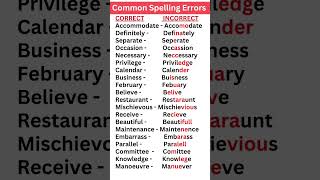
- Common Misspellings and How to Remember Them:
- receive: Remember "I before E except after C".
- believe: Remember "I before E".
- separate: A rat in separate.
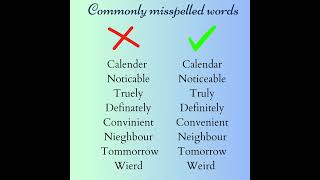
- definitely: Think of the word finite (limited) within it. De-finite-ly.
- embarrass: Two 'r's, two 's's: emba-rr-a-ss.
- occurrence: Two 'c's, two 'r's: occu-rr-ence.
- accommodation: Two 'c's, two 'm's: acco-mm-odation.
- tomorrow: One 'm', two 'r's: tomo-rr-ow.
- truly: No 'e' before 'ly' (true becomes tru-ly).
- until: Only one 'l' at the end.
- address: Two 'd's, two 's's.
- beautiful: Remember beau-ti-ful.
- calendar: Ends in -ar, not -er.
- conscious: Think of science within it.
- environment: Remember iron is in-vi-ron-ment.
- government: Remember govern-ment.
- independent: Ends in -ent, not -ant.
- knowledge: Remember the know part.
- library: Ends in -ary, not -ery.
- recommend: Two 'm's.
- rhythm: Think of rhy-thm (helps with the 'h').
- surprise: Don't forget the first 'r'.
- through: Ends with ough.
- whether: Contains ether. (Don't confuse with weather).
Detailed Explanation
This chunk focuses on common misspellings and provides memory aids for each one. For example, 'receive' follows the spelling rule 'I before E except after C', while for 'definitely,' you can think of the word 'finite' within it to help remember the structure. The chunk emphasizes creative techniques that assist in recalling the correct spelling of frequently misspelled words.
Examples & Analogies
Imagine you're training for a spelling bee. Just like a coach gives you tips and drills to nail every word, these mnemonic devices act as the coach for remembering spellings. They provide personal connections that make the spelling stick, creating a solid foundation to build upon as you progress.
Strategies for Improving Spelling
Chapter 3 of 3
🔒 Unlock Audio Chapter
Sign up and enroll to access the full audio experience
Chapter Content
- Strategies for Improving Spelling:
- Read widely: Exposure to correctly spelled words helps solidify patterns.
- Proofread carefully: Always check your written work for errors.
- Use a dictionary: Look up words you are unsure about.
- Keep a list of your common errors: Focus on mastering these specific words.
- Break words into syllables: This can help with longer words.
- Practice regularly: Consistent effort leads to improvement.
Detailed Explanation
This chunk provides strategies for enhancing spelling skills. Reading a variety of texts helps internalize correct spellings naturally. Proofreading allows you to catch mistakes before finalizing your writing. Using a dictionary when uncertain about a word can clarify its spelling and meaning. Additionally, keeping track of errors you often make is effective for focused practice, while breaking longer words into syllables simplifies the learning process. Lastly, consistent practice is vital for long-term improvement.
Examples & Analogies
Consider learning to ride a bike. You wouldn’t expect to master it without practice and a few falls along the way, right? Similarly, these strategies are essential training wheels for your spelling journey—guiding you until you can confidently ride smoothly and accurately on your own.
Key Concepts
-
Spelling Rules: Guidelines to help spell words correctly.
-
Common Misspellings: Frequently misspelled words with strategies to memorize.
Examples & Applications
'i' before 'e' except after 'c' is a common spelling rule, e.g., 'believe'.
Dropping the silent 'e' when adding suffixes like in 'make' to form 'making'.
Doubling the consonant in 'run' to become 'running' when adding '-ing'.
Changing 'happy' to 'happiness' by replacing 'y' with 'i'.
Memory Aids
Interactive tools to help you remember key concepts
Rhymes
When spelling 'believe', remember to weave, 'i' before 'e' is how we achieve.
Stories
Once upon a time, a rat made its way to separate the two rivers, showing the correct spelling with its clever trick.
Memory Tools
Remember 'definitely' contains 'finite' – it's not 'definately'!
Acronyms
'D.P.S.' for 'Drop', 'Preserve', 'Switch' to remember how to handle silent e!
Flash Cards
Glossary
- Spelling Rules
Guidelines that dictate how words are correctly written in English.
- Common Misspellings
Frequently incorrectly spelled words that learners struggle with.
- Silent 'e'
An 'e' at the end of a word that is not pronounced but affects the phonetic structure.
- Doubling
The process of writing a consonant twice when adding a vowel suffix in specific conditions.
- CVC Rule
Consonant-Vowel-Consonant rule dictating when to double the last consonant.
Reference links
Supplementary resources to enhance your learning experience.