
Introduction
Interactive Audio Lesson
Listen to a student-teacher conversation explaining the topic in a relatable way.
Understanding the FFT
🔒 Unlock Audio Lesson
Sign up and enroll to listen to this audio lesson

Today, we'll be discussing the Fast Fourier Transform, or FFT. Can anyone tell me why FFT is important in digital signal processing?

Is it because it helps us analyze signals more efficiently?
Exactly! The FFT allows us to compute the Discrete Fourier Transform more efficiently. Instead of requiring O(N²) operations, it cuts this down to O(N log N).

So, we can handle larger datasets more easily with the FFT?
Yes, that's correct! This efficiency is why the FFT is so widely used in applications such as audio processing and communications.

What does 'log N' mean in that context?
Great question! 'log N' refers to the logarithmic nature of the algorithm's complexity. It indicates the number of times you can divide N by 2 before reaching 1, which reflects how the FFT divides the problem into smaller parts.
In summary, the FFT is vital because it efficiently computes the DFT for large datasets, making it applicable in many areas.
Complexity of DFT vs FFT
🔒 Unlock Audio Lesson
Sign up and enroll to listen to this audio lesson

Let's dive a little deeper into the computational complexities. What would happen if we were to calculate the DFT directly without using FFT?

It would take way longer, since it's O(N²).
Exactly! And this can be very limiting, especially for large values of N. The FFT's O(N log N) complexity makes it much more feasible.
What scenarios benefit from this reduction?
Real-time applications, such as digital audio processing and telecommunications, where quick processing is essential. Reduced complexity means faster analysis and processing times.
So the FFT is really a game changer!
Yes! It's fundamental to the fields of signal processing, image processing, and many more. In conclusion, the FFT provides a practical solution to the computation problems posed by standard DFT methods.
Introduction & Overview
Read summaries of the section's main ideas at different levels of detail.
Quick Overview
Standard
The Fast Fourier Transform (FFT) is a crucial algorithm for efficiently calculating the Discrete Fourier Transform (DFT) in digital signal processing. It significantly reduces computational complexity from O(N²) to O(N log N), making it suitable for large datasets. This section outlines the importance of deriving the Radix-2 FFT algorithm, which is a widely adopted method.
Detailed
Introduction to Fast Fourier Transform
The Fast Fourier Transform (FFT) is a critical algorithm widely utilized in digital signal processing for computing the Discrete Fourier Transform (DFT) efficiently. The standard computation of the DFT requires O(N²) operations, which can become impractical for large datasets. The Radix-2 FFT algorithm improves this by reducing the complexity to O(N log N), making it highly efficient and practical for real-world applications.
In this section, we will discuss the foundation of the Radix-2 FFT, providing insights into its derivation and functionality. It serves as a robust framework for how the FFT optimizes DFT computation, enabling effective analysis and processing of signals in various fields. As we progress through this chapter, we will derive the Radix-2 FFT step-by-step and explore its significance in enhancing the computation of the DFT.
Youtube Videos
![Decimation In Time - Fast Fourier Transform [Lec 2]](https://img.youtube.com/vi/XeJXx-Te1Eo/mqdefault.jpg)
Audio Book
Dive deep into the subject with an immersive audiobook experience.
Understanding FFT
Chapter 1 of 4
🔒 Unlock Audio Chapter
Sign up and enroll to access the full audio experience
Chapter Content
The Fast Fourier Transform (FFT) is one of the most widely used algorithms in digital signal processing for efficiently computing the Discrete Fourier Transform (DFT).
Detailed Explanation
The Fast Fourier Transform, known as FFT, is a key algorithm that allows for the efficient calculation of the Discrete Fourier Transform (DFT). The DFT is a mathematical transformation used to analyze the frequencies present in a discrete signal. Due to the FFT's efficiency, it has become a fundamental tool in digital signal processing, making it essential for various applications in sciences and engineering.
Examples & Analogies
Think of FFT like a fast food drive-thru. Instead of having to cook each item from scratch (which would take a long time, like calculating DFT using O(N²) operations), the drive-thru efficiently organizes and prepares your order (similar to the FFT reducing computation to O(N log N)), so you get your meal much faster!
Cost of Standard DFT
Chapter 2 of 4
🔒 Unlock Audio Chapter
Sign up and enroll to access the full audio experience
Chapter Content
The standard DFT, although conceptually simple, requires O(N²) operations, which becomes computationally expensive for large N.
Detailed Explanation
An important limitation of the standard Discrete Fourier Transform (DFT) is that it scales poorly with larger datasets. The time complexity of O(N²) means that as the size of the input (N) increases, the time it takes to compute the DFT grows quadratically, making it infeasible for large datasets due to excessive computational demand.
Examples & Analogies
Imagine trying to check every item in a large library one by one (O(N²)), versus having a specialized system that quickly organizes and retrieves all the information you need (similar to the FFT). If you have 100 books, it takes much longer to compare each book with every other book than if you can simply index them and find what you need quickly.
Benefits of Radix-2 FFT
Chapter 3 of 4
🔒 Unlock Audio Chapter
Sign up and enroll to access the full audio experience
Chapter Content
The Radix-2 FFT algorithm reduces the complexity of the DFT computation to O(N log N), making it highly efficient for practical applications.
Detailed Explanation
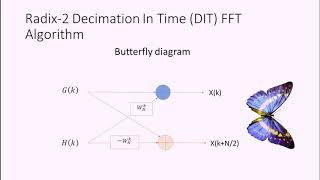
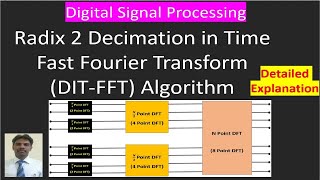
The Radix-2 FFT significantly enhances the efficiency of computing the DFT by employing a 'divide-and-conquer' strategy. This reduction in computational complexity from O(N²) to O(N log N) allows it to handle larger datasets far more efficiently, opening up the potential for real-time signal processing and analysis in various applications, such as audio and image processing.
Examples & Analogies
Consider organizing a massive crowd of people to find specific individuals. Without a plan, you might waste hours, but with a structured approach like forming smaller groups, the task becomes much more manageable and faster, similar to how the Radix-2 FFT organizes data for quicker processing.
Chapter Insight
Chapter 4 of 4
🔒 Unlock Audio Chapter
Sign up and enroll to access the full audio experience
Chapter Content
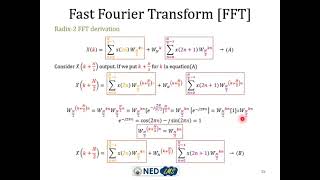
In this chapter, we will derive the Radix-2 FFT algorithm, which is one of the most commonly used FFT algorithms.
Detailed Explanation
The chapter will focus on providing a thorough derivation of the Radix-2 FFT algorithm. The derivation process will break down how this efficient algorithm is constructed step by step, highlighting its importance and foundational principles in digital signal processing for practical applications.
Examples & Analogies
This is akin to a recipe in cookbooks that breaks down individual steps to take a complex dish and makes it simpler to prepare. Each step not only leads toward the final dish, or in this case, the FFT, but also teaches you why each ingredient matters and how they work together.
Key Concepts
-
Fast Fourier Transform (FFT): An efficient algorithm for computing the DFT, reducing complexity.
-
Complexity reduction: The FFT reduces computational time from O(N²) to O(N log N), enhancing performance.
-
Applications: The FFT is applicable in various fields including audio processing, telecommunications, and imaging.
Examples & Applications
The application of FFT in analyzing audio signals allows for real-time sound processing and manipulation.
In telecommunications, FFT facilitates the modulation and demodulation of signals for efficient data transfer.
Memory Aids
Interactive tools to help you remember key concepts
Rhymes
FFT, quick as can be, calculating signals with glee!
Stories
Imagine a chef slicing ingredients efficiently—like how FFT slices the signal into manageable parts for fast processing.
Memory Tools
Remember: F - Fast, F - Fourier, T - Transform. Together they process signals with skill!
Acronyms
FFT might stand for Fabulous Fast Transformation!
Flash Cards
Glossary
- Fast Fourier Transform (FFT)
An algorithm used for efficiently computing the Discrete Fourier Transform (DFT).
- Discrete Fourier Transform (DFT)
Transforms a discrete signal into its frequency components.
- Computational Complexity
A measure of the amount of computational resources that an algorithm requires.
Reference links
Supplementary resources to enhance your learning experience.