
AVR Core
Interactive Audio Lesson
Listen to a student-teacher conversation explaining the topic in a relatable way.
Introduction to AVR Microcontrollers
🔒 Unlock Audio Lesson
Sign up and enroll to listen to this audio lesson

Today, we're diving into AVR microcontrollers. Can anyone tell me what a microcontroller is?

Isn't it like a mini computer on a chip that controls other parts?
Exactly! AVR microcontrollers are specific types of microcontrollers known for their 8-bit RISC architecture. This makes them simple to use and cost-effective. Why do you think simplicity is important for beginners?

It helps them learn without getting overwhelmed!
Well said! Simplicity allows new programmers to grasp concepts without many complexities.
AVR Core Architecture
🔒 Unlock Audio Lesson
Sign up and enroll to listen to this audio lesson

AVR microcontrollers use a Harvard architecture. What do you think that means?

Does it mean the program and data memory are separate?
That's correct! This separation allows faster execution of instructions. Can you think of any advantages of this method?

Maybe it can read instructions while processing data at the same time?
Great insight! This allows for more efficient processing, which is critical in embedded applications!
Instruction Set and Registers
🔒 Unlock Audio Lesson
Sign up and enroll to listen to this audio lesson
Next, let's talk about the AVR instruction set. How many general-purpose registers does the AVR architecture offer?
32 registers!
Exactly! This is significant because it contributes to efficient code execution. Why do you think that matters?
More registers can mean less time accessing memory, right?
Spot on! This efficiency is why many hobbyists choose AVR microcontrollers for their projects.
Popularity in Hobby Projects
🔒 Unlock Audio Lesson
Sign up and enroll to listen to this audio lesson
AVR microcontrollers are especially popular in the Arduino platform. Why is that?
I think it's because Arduino makes it really easy to program them!
Precisely! The user-friendly nature and vast community support help beginners get started quickly.
What are some common AVR microcontrollers used in these projects?
Some common examples include the ATmega series, like the ATmega328, and the smaller ATtiny series known for their low power consumption.
Conclusion and Review
🔒 Unlock Audio Lesson
Sign up and enroll to listen to this audio lesson
To wrap up, can someone summarize the key features of AVR microcontrollers we discussed today?
They have a simple 8-bit RISC architecture, are based on Harvard design, and are popular in projects like Arduino!
And they have a lot of general-purpose registers, which makes them efficient!
Excellent summaries! Remember, understanding these concepts is crucial for embedded systems and programming.
Introduction & Overview
Read summaries of the section's main ideas at different levels of detail.
Quick Overview
Standard
AVR microcontrollers, characterized by an 8-bit RISC architecture, are highly sought after for their simplicity and cost-effectiveness. This section highlights the unique features of the AVR core, its instruction set, and its popularity among hobbyists, especially in the Arduino ecosystem.
Detailed
Detailed Summary of AVR Core
The AVR Core section covers the architecture of AVR microcontrollers, which are based on an 8-bit RISC (Reduced Instruction Set Computing) design. Developed by Atmel, now a part of Microchip Technology, these microcontrollers are known for their simplicity and efficiency, making them particularly suitable for beginners and smaller embedded projects.
Key Features of the AVR Core
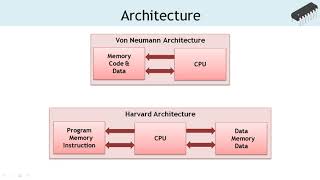
- Harvard Architecture: The AVR microcontroller utilizes a Harvard architecture that features separate program and data memories, allowing for faster execution of instructions compared to other microcontrollers that might use a von Neumann architecture.
- Instruction Set: AVR microcontrollers employ a simple 8-bit instruction set, optimized for efficient code execution with 32 general-purpose registers available, facilitating faster operations and easier programming.
- Popularity in Hobby Projects: AVR microcontrollers have gained significant traction in hobbyist and educational projects, largely due to their integration into platforms like Arduino, which streamline the development process for users.
- Common Examples: Popular models of AVR microcontrollers include the ATmega series (e.g., ATmega328 and ATmega32) and the ATtiny series, which is recognized for its smaller size and lower power consumption.
Understanding the AVR core is vital for those looking to design systems or applications in embedded systems, particularly in educational settings or DIY electronics projects.
Youtube Videos


Key Concepts
-
AVR Microcontrollers: 8-bit microcontrollers known for simple operations and cost efficiency.
-
Harvard Architecture: Allows separation of program and data memory for efficiency.
-
Instruction Set: AVR's instruction set is simple, enhancing speed and usability.
-
General-Purpose Registers: 32 registers are available which help in fast processing.
Examples & Applications
The ATmega328 is used in Arduino boards, making it popular for hobbyists.
The ATtiny series is often employed in smaller, lower-power applications.
Memory Aids
Interactive tools to help you remember key concepts
Rhymes
AVR controllers, simple and neat, with Harvard design, they can't be beat!
Stories
Once in a classroom of microcontrollers, there lived an AVR, who loved quick responses. With its Harvard memory, it could cook up instructions and data at lightning speed, making it the favorite among students.
Memory Tools
A Very Rapid 8-bit microcontroller (AVR) - helps you remember what AVR stands for and its speed!
Acronyms
RISC - Reduce Instructions, Simplify Computing.
Flash Cards
Glossary
- AVR Microcontroller
An 8-bit microcontroller designed by Atmel, known for its simplicity and efficiency.
- RISC
Reduced Instruction Set Computing, an architecture that uses a small set of instructions for operation.
- Harvard Architecture
An architecture that separates program memory and data memory for faster instruction execution.
- Instruction Set
A set of instructions that a microcontroller can execute.
- GeneralPurpose Registers
Registers that are available for any operations and can hold data temporarily during processing.
Reference links
Supplementary resources to enhance your learning experience.