
Overview of Microcontroller Architectures
Interactive Audio Lesson
Listen to a student-teacher conversation explaining the topic in a relatable way.
Introduction to Microcontroller Families
🔒 Unlock Audio Lesson
Sign up and enroll to listen to this audio lesson

Today we're going to explore the three primary microcontroller architectures: ARM, AVR, and PIC. These families differ in design and applications, so let’s start by defining what distinguishes each one.

Why are there so many different types of microcontrollers?
Great question! Variations cater to diverse applications, performance needs, and user skill levels. For example, ARM is great for high-performance tasks, while AVR is more beginner-friendly.

I’ve heard AVR is used in Arduino projects. Is that true?
Yes, that’s correct! AVR microcontrollers are popular in Arduino due to their simplicity and accessibility for hobbyists.

So, what about PIC? Are they more complex?
PIC microcontrollers have a modular architecture, which allows for a range of applications, from simple to complex systems. This versatility makes them widely used in various industries.
In summary, ARM for performance, AVR for beginners, and PIC for versatility.
ARM Microcontroller Architecture
🔒 Unlock Audio Lesson
Sign up and enroll to listen to this audio lesson

Let’s dive deeper into the ARM architecture. Can anyone tell me what RISC stands for?

Reduced Instruction Set Computing!
Exactly! ARM microcontrollers utilize this reduced set to enhance performance and minimize power consumption, making them ideal for IoT applications.
What are some examples of ARM microcontrollers?
Popular models include the STM32 series and NXP LPC series. They offer a great balance of speed, efficiency, and development support.
To help remember: ARM = Advanced efficiency, Reusability, and Multiple applications. ARM makes impactful contributions across industries ranging from automotive to consumer electronics.
AVR Microcontroller Architecture
🔒 Unlock Audio Lesson
Sign up and enroll to listen to this audio lesson
Now, let’s talk about AVR microcontrollers. What’s a significant feature of AVR architecture?
I think it has a Harvard architecture, right?
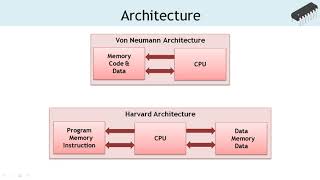
Correct! The separation of program and data memory allows for faster execution of instructions. This setup is especially beneficial for small projects.
And they are 8-bit, making them simpler for beginners?
Exactly! The ATmega series is a great example. By having efficient code execution and many general-purpose registers, they’re perfect for educational purposes and prototyping.
Remember: AVR = Accessible, Versatile, and Reliable for hobbyists. It’s a fantastic entry point into embedded systems!
PIC Microcontroller Architecture
🔒 Unlock Audio Lesson
Sign up and enroll to listen to this audio lesson
Lastly, let’s discuss PIC microcontrollers. Who can explain the CISC architecture?
I believe it stands for Complex Instruction Set Computing?
Correct! CISC allows for more complex instructions, which is beneficial for compact code, especially in smaller applications.
So, what types of applications are PIC microcontrollers used for?
They’re widely used in embedded systems, including everything from medical devices to home automation systems. Their modular nature makes them very flexible.
Quick tip: PIC = Programmable, Integrated, and Comprehensible for various uses. This makes them a staple in the industry.
Comparison of Microcontroller Architectures
🔒 Unlock Audio Lesson
Sign up and enroll to listen to this audio lesson
Now that we have covered each architecture, let’s summarize. What’s the primary advantage of ARM microcontrollers?
High performance and low power consumption!
Exactly! And what about AVR?
They are excellent for beginners and hobbyists!
Spot on! And PIC microcontrollers?
They are versatile and used in various applications!
Right! To wrap up, each architecture serves a unique purpose in the embedded systems ecosystem. Whether it’s efficiency, accessibility, or versatility, there’s a microcontroller for every project!
Introduction & Overview
Read summaries of the section's main ideas at different levels of detail.
Quick Overview
Standard
Microcontrollers come in various architectures, primarily ARM, AVR, and PIC, each characterized by distinct features and suitability for specific applications. This section discusses the fundamental components, instruction sets, and popular models within each architecture.
Detailed
In the section 'Overview of Microcontroller Architectures', we delve into the three major microcontroller families: ARM, AVR, and PIC. Each architecture has unique attributes suited for different applications, ranging from simple hobbyist projects to complex industrial systems.
- ARM Microcontroller Architecture: ARM microcontrollers, based on a RISC architecture, are known for high performance and low power consumption. They utilize Cortex cores and a wide instruction set, making them scalable for various applications.
- AVR Microcontroller Architecture: The Atmel AVR microcontrollers, known for their simplicity and cost-effectiveness, are based on an 8-bit RISC architecture catering to hobbyists and small projects, particularly through platforms like Arduino.
- PIC Microcontroller Architecture: Developed by Microchip, PIC microcontrollers are admired for their modularity and versatility, featuring CISC architecture which allows complex instructions well-suited for a wide range of embedded applications.
This section emphasizes understanding these architectures' distinctions to aid in selecting appropriate microcontrollers based on project requirements.
Youtube Videos



Audio Book
Dive deep into the subject with an immersive audiobook experience.
Introduction to Microcontroller Families
Chapter 1 of 7
🔒 Unlock Audio Chapter
Sign up and enroll to access the full audio experience
Chapter Content
Microcontrollers come in various families, each offering distinct features in terms of performance, peripherals, and application suitability. The three most widely used microcontroller families are ARM, AVR, and PIC.
Detailed Explanation
Microcontrollers are designed to cater to different needs based on their features and capabilities. The mention of families suggests that, like how different car models meet various consumer demands, microcontrollers are tailored for specific applications. ARM, AVR, and PIC microcontrollers represent the major families that provide varied functionalities. Understanding these families allows engineers and developers to choose the right microcontroller for their projects.
Examples & Analogies
If you think of microcontrollers like types of smartphones, ARM would be akin to high-end models suited for heavy applications (like gaming or computational tasks), while AVR may be like basic models ideal for everyday use, and PIC could be compared to versatile models that fit a range of scenarios.
ARM Microcontrollers
Chapter 2 of 7
🔒 Unlock Audio Chapter
Sign up and enroll to access the full audio experience
Chapter Content
ARM (Advanced RISC Machine) microcontrollers are based on a RISC (Reduced Instruction Set Computing) architecture and are known for their high performance, low power consumption, and scalability. ARM-based microcontrollers are widely used in a broad range of applications from consumer electronics to industrial automation and IoT.
Detailed Explanation
ARM microcontrollers utilize a simplified set of instructions to maximize processing speed and energy efficiency. This architecture is advantageous for applications requiring quick computing power without significantly draining the battery, making them suitable for modern devices that rely on mobile or embedded systems.
Examples & Analogies
Consider a running athlete. The ARM architecture is like an athlete trained to perform efficiently without wasting energy. While they are capable of running long distances (scalability), they can also sprint quickly (high performance), making them suitable for various events (applications) from casual fun runs to professional competitions.
Key Features of ARM Microcontrollers
Chapter 3 of 7
🔒 Unlock Audio Chapter
Sign up and enroll to access the full audio experience
Chapter Content
● ARM Core: ARM microcontrollers use the ARM Cortex cores (e.g., Cortex-M0, Cortex-M3, Cortex-M4, Cortex-M7) that are designed to offer a balance between performance, power efficiency, and ease of use. ● Instruction Set: ARM microcontrollers use a 32-bit or 64-bit RISC architecture with a simple instruction set that improves execution speed and reduces power consumption. ● Wide Application Support: ARM-based MCUs are supported by a vast ecosystem of development tools, libraries, and software platforms.
Detailed Explanation
The ARM Core signifies that there are different versions (Cortex-M0 to M7) catering to various performance needs, ensuring there's an option for almost every project requirement. The instruction set being simple enables faster processing as it requires fewer cycles to perform operations. Additionally, the extensive support system for ARM MCUs allows developers access to tools and software, streamlining the development process.
Examples & Analogies
Imagine using different types of machines at a factory. Each machine (Cortex core) is designed to deliver optimal performance based on the task (product) being produced. The easy-to-use instruction set is like a user manual that simplifies operating these machines, while the vast support network is akin to having a team of engineers readily available for technical assistance or upgrades.
AVR Microcontrollers
Chapter 4 of 7
🔒 Unlock Audio Chapter
Sign up and enroll to access the full audio experience
Chapter Content
AVR microcontrollers, developed by Atmel (now part of Microchip), are based on an 8-bit RISC architecture. AVR microcontrollers are popular due to their simplicity, ease of use, and low cost, making them ideal for beginners and small embedded projects.
Detailed Explanation
The AVR architecture is noted for being straightforward, featuring a fast instruction cycle thanks to its Harvard architecture, in which program and data memories are separate. This simplicity and effectiveness make AVR microcontrollers a common choice for educational projects and hobbyists, as they provide easy learning and experimentation opportunities.
Examples & Analogies
Think of AVR microcontrollers like basic cooking recipes. These recipes are simple to follow and yield great results without requiring advanced cooking skills. They suit novices (beginners) or those uninclined to complex techniques who still want to create delicious meals (projects).
Key Features of AVR Microcontrollers
Chapter 5 of 7
🔒 Unlock Audio Chapter
Sign up and enroll to access the full audio experience
Chapter Content
● AVR Core: The AVR microcontroller uses a Harvard architecture, where the program and data memories are separate, allowing for faster execution. ● Instruction Set: AVR microcontrollers use a simple 8-bit instruction set and are known for their efficient code execution. The architecture offers 32 general-purpose registers, making it faster than other microcontrollers in its class. ● Popular in Hobbyist Projects: AVR microcontrollers are particularly popular in platforms like Arduino, which simplifies the development process.
Detailed Explanation
The separation of program and data memories in the Harvard architecture leads to improved execution speeds because instructions can be fetched and executed simultaneously. The efficient instruction set allows programmers to create compact code, enhancing performance. The popularity of AVR microcontrollers in platforms like Arduino speaks to their accessibility and usability for those interested in electronics without extensive technical backgrounds.
Examples & Analogies
Picture a library versus using an encyclopedia. The Harvard architecture is like a library where books (programs) and working documents (data) are in separate rooms, making it easy to grab the necessary materials quickly. Platforms like Arduino are similar to user-friendly guides that help people navigate the library without getting lost, making electronic projects easier to tackle.
PIC Microcontrollers
Chapter 6 of 7
🔒 Unlock Audio Chapter
Sign up and enroll to access the full audio experience
Chapter Content
PIC microcontrollers, developed by Microchip Technology, are among the most widely used 8-bit and 16-bit microcontrollers. PIC microcontrollers have a simple, modular architecture with a variety of configurations for different applications, making them very versatile.
Detailed Explanation
PIC microcontrollers' modular architecture allows designers to choose different components based on specific application needs. The 8-bit and 16-bit options provide flexibility, with 8-bit systems generally favored for basic tasks and 16-bit for more complex applications. This versatility makes them suitable for a wide range of developments in both consumer and industrial electronics.
Examples & Analogies
Think of PIC microcontrollers like a customizable toolbox, where the user can pick different tools depending on their project. For instance, they may choose socket wrenches for simple assembly tasks (8-bit) and drill heads for more complex creations (16-bit). Just as a toolbox can adapt to various building tasks, PIC microcontrollers are designed to suit many applications.
Key Features of PIC Microcontrollers
Chapter 7 of 7
🔒 Unlock Audio Chapter
Sign up and enroll to access the full audio experience
Chapter Content
● PIC Core: PIC microcontrollers use a Harvard architecture, with separate program and data memory, which provides faster data access. ● Instruction Set: PIC microcontrollers are known for their CISC (Complex Instruction Set Computing) architecture. The instructions are more complex but allow for more compact code, which is ideal for smaller applications. ● Popular for Embedded Systems: PIC microcontrollers are commonly used in a range of embedded applications from low-power devices to high-performance systems.
Detailed Explanation
PIC's Harvard architecture also means faster access times due to the separation of memory areas similar to ARM and AVR. The complexity in instructions allows for efficient coding in smaller memory spaces. Consequently, PIC microcontrollers find a broad application range, often appearing in both everyday devices and more specialized equipment.
Examples & Analogies
Consider a school where the complexity of subjects differs. CISC architecture is akin to advanced high school classes offering intricate material (complex instructions) that can teach students much in a short time (compact code), making it advantageous for students focused on specialized knowledge pathways (embedded systems).
Key Concepts
-
Microcontroller Family: Different families like ARM, AVR, and PIC cater to specific applications.
-
RISC vs CISC: ARM uses RISC, while PIC uses CISC for their architectures.
-
Typical Applications: ARM is used in IoT, AVR in hobby projects, and PIC in commercial systems.
Examples & Applications
ARM microcontroller example: STM32 (by STMicroelectronics).
AVR microcontroller example: ATmega328, widely used in Arduino.
PIC microcontroller example: PIC16F877A, used in industrial applications.
Memory Aids
Interactive tools to help you remember key concepts
Rhymes
For ARM that's fast and sleek, energy-efficient, so to speak.
Stories
Imagine an engineer choosing a microcontroller. For a quick appliance fix, they pick an AVR. For a major production line control, they opt for a versatile PIC.
Memory Tools
Remember ARM, AVR, and PIC as A for Advanced, A for Accessible, and P for Programmable.
Acronyms
Use AAP
ARM for Applications
AVR for Accessibility
and PIC for Programming versatility.
Flash Cards
Glossary
- Microcontroller (MCU)
A compact integrated circuit that contains a processor, memory, and I/O peripherals on a single chip.
- ARM Architecture
A RISC-based microcontroller architecture known for high performance and low power consumption.
- AVR Architecture
An 8-bit RISC microcontroller architecture developed by Atmel, popular for its simplicity.
- PIC Architecture
A modular microcontroller architecture designed by Microchip, featuring CISC architecture.
- RISC
Reduced Instruction Set Computing; a type of CPU architecture with a small set of simple instructions.
- CISC
Complex Instruction Set Computing; a type of CPU architecture with a more complex set of instructions that can perform more tasks.
Reference links
Supplementary resources to enhance your learning experience.