
PIC Microcontrollers
Interactive Audio Lesson
Listen to a student-teacher conversation explaining the topic in a relatable way.
Overview of PIC Microcontrollers
🔒 Unlock Audio Lesson
Sign up and enroll to listen to this audio lesson

Today, we’re going to talk about PIC microcontrollers. Can anyone tell me what a microcontroller is?

Is it a tiny computer on a chip?
Exactly! A microcontroller integrates a processor, memory, and I/O peripherals on one chip. Now, specifically, PIC microcontrollers are designed with a Harvard architecture. Who can explain what that means?

It means they have separate memory for programs and data, right?
Correct! This separation allows for quicker access to data. Remember, we can think of it as having two lanes on a highway instead of one, allowing for smoother traffic flow. Now, can anyone name a series of PIC microcontrollers?

The PIC16 series!
Great job! And how about their applications?

They can be used in simple devices like toys, right?
That's right! They are widely used in various fields due to their versatility. To summarize, PIC microcontrollers are modular, support various applications, and are versatile in design.
Instruction Set and Complexity
🔒 Unlock Audio Lesson
Sign up and enroll to listen to this audio lesson

Now, let's dive deeper into the instruction set of PIC microcontrollers. Who can recall what CISC stands for?
It stands for Complex Instruction Set Computing!
Exactly! This means the instructions are more complex but can perform tasks with fewer lines of code. It’s like being able to release an album with fewer songs but still maintaining quality.
So, it saves memory space?
Right! Compact code is essential, especially for smaller applications. Can anyone think of a specific application that could benefit from this?
Maybe in wearables? They need efficiency!
Great example! Wearables indeed benefit from compact coding. That reminds me of our homework on applications of microcontrollers. Let’s not forget, the versatility of PICs lies in their architecture and instruction set.
Real-World Applications
🔒 Unlock Audio Lesson
Sign up and enroll to listen to this audio lesson
Lastly, let’s discuss where we can find PIC microcontrollers in the real world. Who has an idea?
I think they're in home appliances like microwaves and washing machines.
Absolutely! PIC microcontrollers control various features in those devices. They can also be found in toys, automotive systems, and industrial controls. What defines their application?
Their modular design and ease of use!
Exactly! This versatility means they can be adapted to many different tasks. In summary, remember that PIC microcontrollers are useful in a wide array of applications due to their adaptable architecture.
Introduction & Overview
Read summaries of the section's main ideas at different levels of detail.
Quick Overview
Standard
PIC microcontrollers, developed by Microchip Technology, are versatile devices used in a variety of applications. This section highlights their architecture, key features, and specific examples of PIC models, detailing their functionality in embedded systems.
Detailed
PIC Microcontrollers
PIC (Peripheral Interface Controller) microcontrollers are a family of microcontrollers developed by Microchip Technology. They are well-known for their simplicity and versatility, having modular architectures that cater to various applications ranging from simple to complex tasks.
Key Features of PIC Microcontrollers:
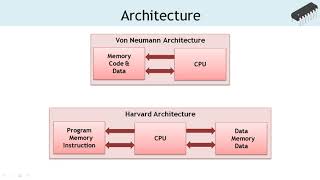
- Architecture: Most PIC microcontrollers utilize a Harvard architecture, distinctly separating program and data memory. This design allows for faster data access, which enhances performance for certain applications.
- Instruction Set: PIC microcontrollers utilize a Complex Instruction Set Computing (CISC) architecture, which provides a rich and versatile instruction set. This allows for compact code, optimizing memory usage, especially in smaller applications.
- Versatility: PIC microcontrollers are applicable in a wide variety of fields, from simple embedded applications like toys and home appliances to more complex industrial systems like automation and control systems.
Examples:
- PIC16 series: 8-bit microcontrollers commonly used in consumer electronics.
- PIC18 series: These provide enhanced features and performance, suitable for more demanding applications.
- PIC32 series: 32-bit microcontrollers used in high-performance applications.
In summary, PIC microcontrollers are a pivotal choice in the embedded systems world due to their modularity, various configurations, and strong community support around development tools.
Youtube Videos


Audio Book
Dive deep into the subject with an immersive audiobook experience.
Overview of PIC Microcontrollers
Chapter 1 of 3
🔒 Unlock Audio Chapter
Sign up and enroll to access the full audio experience
Chapter Content
PIC microcontrollers, developed by Microchip Technology, are among the most widely used 8-bit and 16-bit microcontrollers. PIC microcontrollers have a simple, modular architecture with a variety of configurations for different applications, making them very versatile.
Detailed Explanation
PIC microcontrollers, which stand for 'Peripheral Interface Controllers', are popular devices in the microcontroller family. They are primarily produced by Microchip Technology. These microcontrollers exist in 8-bit and 16-bit configurations, which indicates the size of the data they can process at one time. Their architecture is designed to be modular, meaning that they can be configured in various ways to suit different tasks and applications. This versatility makes them suitable for use in a wide range of projects, from simple sensors to complex systems like robotics.
Examples & Analogies
Imagine a Swiss Army knife—each tool is designed for a specific purpose, yet they can all fit in one compact device. Similarly, PIC microcontrollers can serve different functions, making them adaptable for various applications, like controlling small household appliances or managing industrial processes.
Architecture of PIC Microcontrollers
Chapter 2 of 3
🔒 Unlock Audio Chapter
Sign up and enroll to access the full audio experience
Chapter Content
● PIC Core: PIC microcontrollers use a Harvard architecture, with separate program and data memory, which provides faster data access.
● Instruction Set: PIC microcontrollers are known for their CISC (Complex Instruction Set Computing) architecture. The instructions are more complex but allow for more compact code, which is ideal for smaller applications.
● Popular for Embedded Systems: PIC microcontrollers are commonly used in a range of embedded applications from low-power devices to high-performance systems.
Detailed Explanation
PIC microcontrollers employ what's known as Harvard architecture. This design includes separate memory spaces for instructions (program code) and data, allowing these microcontrollers to access both types of memory simultaneously, leading to faster processing. They use a Complex Instruction Set Computing (CISC) architecture, meaning they can perform tasks with fewer lines of code, which is particularly beneficial for projects with limited memory capacity. This makes PIC microcontrollers ideal for many embedded systems like automating a coffee machine or managing small robots.
Examples & Analogies
Think of a librarian who organizes books by genre (program code) and author (data). By keeping these categories separate, they can quickly find the right book for a patron without mixing things up. Similarly, PIC microcontrollers efficiently manage their tasks because they can quickly access both program and data memory without confusion.
Common Applications of PIC Microcontrollers
Chapter 3 of 3
🔒 Unlock Audio Chapter
Sign up and enroll to access the full audio experience
Chapter Content
● Example PIC Microcontrollers:
● PIC16 series (8-bit)
● PIC18 series (8-bit, more features)
● PIC32 series (32-bit)
Detailed Explanation
PIC microcontrollers are commonly found in a multitude of applications due to their flexibility and reliability. The most well-known examples of PIC microcontrollers include the PIC16 series, which is widely used for simple applications, and the PIC18 series, which offers enhanced features for more complex tasks. The PIC32 series expands the capabilities even further with 32-bit architecture, supporting advanced applications that require more processing power and memory. These microcontrollers can be found in devices ranging from simple toys to sophisticated industrial equipment.
Examples & Analogies
Consider a chef who can make everything from a simple sandwich (PIC16) to a gourmet meal (PIC32). The chef uses different tools and ingredients depending on what they're preparing. Similarly, PIC microcontrollers offer various models that cater to different levels of complexity, whether you're building a basic circuit for an educational project or a comprehensive control system for home automation.
Key Concepts
-
Harvard Architecture: Separates program and data memory for efficiency in microcontrollers.
-
CISC Instruction Set: Allows for complex tasks using fewer lines of code.
-
Modularity: The design allows for various configurations, enhancing application versatility.
Examples & Applications
PIC16 series: Used in consumer electronics for basic functionalities.
PIC32 series: Utilized in deployment for advanced applications requiring higher processing power.
Memory Aids
Interactive tools to help you remember key concepts
Rhymes
PICs are controllers, small and neat, with separate memories to process a treat.
Stories
Imagine a factory where every worker has a unique task that simplifies the process—the workers represent different microcontrollers, and teamwork equals efficiency. This is like PICs operating with separate memories!
Memory Tools
In memory keep PICS: Peripheral Interface Controller Systems.
Acronyms
CISC
Complex Instruction Set Compact.
Flash Cards
Glossary
- PIC Microcontrollers
Microcontrollers developed by Microchip Technology known for their simplicity and versatile applications.
- Harvard Architecture
A computer architecture with physically separate storage and signal pathways for instructions and data.
- CISC
Complex Instruction Set Computing; a type of microcontroller architecture that allows for complex instructions and compact coding.
- Modular Architecture
A design approach where microcontroller components can be arranged in various configurations to suit different applications.
- 8bit Microcontroller
A microcontroller that processes data in 8-bit chunks, commonly used for simpler applications.
Reference links
Supplementary resources to enhance your learning experience.