
PIC Microcontroller Architecture
Interactive Audio Lesson
Listen to a student-teacher conversation explaining the topic in a relatable way.
Overview of PIC Microcontrollers
🔒 Unlock Audio Lesson
Sign up and enroll to listen to this audio lesson

Today, we're going to learn about PIC microcontrollers and what makes their architecture special. Can anyone tell me what they know about microcontrollers?

I know that they are used in devices to perform specific tasks.

And they have various types depending on their architecture, right?
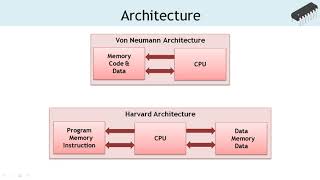
Exactly! PIC microcontrollers, for instance, use a Harvard architecture. This means they have separate memory for programs and data, allowing for faster access to instructions. Does anyone know why that might be beneficial?

It sounds like it would make processing quicker!
That's right! Faster processing helps in real-time applications. So, remember, PIC = Programmable and Integrated Circuit. Let's move to comparing their characteristics.
Understanding CISC and Memory Architecture
🔒 Unlock Audio Lesson
Sign up and enroll to listen to this audio lesson

Now, let's talk about the architecture of PIC microcontrollers in detail. They use a CISC architecture, meaning they have complex instructions. What’s the effect of this on programming?

Does it mean we can achieve more with fewer lines of code?
Exactly! Compact code is crucial in embedded systems. Suppose you have limited memory; using CISC helps pack more functionality in less space. Can anyone name a series of PIC microcontrollers?
The PIC16 series, right?
Perfect! The PIC16 is general-purpose, while the PIC18 introduces more advanced features. Good recall! Remember, CISC can be remembered as 'Complex Instructions, Smaller Code.'
Applications of PIC Microcontrollers
🔒 Unlock Audio Lesson
Sign up and enroll to listen to this audio lesson
Moving on! What are some common applications you think would use PIC microcontrollers?
I think they might be used in toys or gadgets.
Also in industrial applications, right?
Correct! PIC microcontrollers are incredibly versatile. They can be utilized in low-power devices like toys as well as complex systems like automation controls in factories. Just remember: 'PIC = Power, Integration, and Control.'
Introduction & Overview
Read summaries of the section's main ideas at different levels of detail.
Quick Overview
Standard
PIC microcontrollers, developed by Microchip Technology, are known for their simple and modular architecture, featuring Harvard architecture for faster data access. They support complex instructions for compact code and have a wide range of applications in embedded systems, ranging from low-power devices to high-performance systems.
Detailed
PIC Microcontroller Architecture
PIC microcontrollers, developed by Microchip Technology, are a family of widely-used microcontrollers that come in 8-bit and 16-bit architectures. This section delves into the key components of the PIC architecture, emphasizing its modularity and various applications in embedded systems.
Key Features of PIC Microcontrollers:
- Modular Architecture: PIC MCUs are designed to be modular, allowing users to choose configurations that best fit their application needs.
- Harvard Architecture: This architecture differentiates between program memory and data memory, leading to faster data access and improved performance.
- CISC Architecture: PIC microcontrollers utilize a Complex Instruction Set Computing (CISC) architecture, characterized by more complex instructions. This allows for more compact coding—ideal for smaller applications where memory efficiency is critical.
- Versatile Applications: PIC microcontrollers are popular in a myriad of applications, from low-power toys to sophisticated industrial systems.
Common PIC Microcontrollers:
- PIC16 series: 8-bit microcontrollers suitable for simple tasks.
- PIC18 series: 8-bit but with more features compared to the PIC16, suitable for moderately complex applications.
- PIC32 series: 32-bit microcontrollers designed for advanced applications requiring higher performance.
Youtube Videos



Audio Book
Dive deep into the subject with an immersive audiobook experience.
PIC Microcontrollers Overview
Chapter 1 of 5
🔒 Unlock Audio Chapter
Sign up and enroll to access the full audio experience
Chapter Content
PIC microcontrollers, developed by Microchip Technology, are among the most widely used 8-bit and 16-bit microcontrollers. PIC microcontrollers have a simple, modular architecture with a variety of configurations for different applications, making them very versatile.
Detailed Explanation
PIC microcontrollers are integrated circuits developed by Microchip Technology. They are designed to be used in various applications due to their simple yet modular architecture. This means that they can be easily configured to meet different needs, whether for simple tasks or more complex functions. The terms '8-bit' and '16-bit' refer to the data width that the microcontroller can process, with 8-bit devices being simpler and 16-bit devices capable of handling more complex computations.
Examples & Analogies
Think of PIC microcontrollers like Swiss Army knives. Just as a Swiss Army knife has multiple tools for various tasks, PIC microcontrollers come in different configurations and capabilities to serve a wide range of applications, from simple electronics to more advanced systems.
PIC Core Architecture
Chapter 2 of 5
🔒 Unlock Audio Chapter
Sign up and enroll to access the full audio experience
Chapter Content
PIC microcontrollers use a Harvard architecture, with separate program and data memory, which provides faster data access.
Detailed Explanation
The Harvard architecture used in PIC microcontrollers separates the memory for program instructions and data. This means that the microcontroller can read instructions and data at the same time without having to switch back and forth between memory spaces, resulting in faster execution. This is beneficial in applications that require quick response times.
Examples & Analogies
Imagine a chef in a kitchen with two stoves: one for cooking and another for preparing ingredients. Having two stoves allows the chef to work on multiple tasks simultaneously, speeding up the meal's preparation. Similarly, the Harvard architecture allows the PIC microcontroller to handle program and data processing efficiently at the same time.
Instruction Set
Chapter 3 of 5
🔒 Unlock Audio Chapter
Sign up and enroll to access the full audio experience
Chapter Content
PIC microcontrollers are known for their CISC (Complex Instruction Set Computing) architecture. The instructions are more complex but allow for more compact code, which is ideal for smaller applications.
Detailed Explanation
CISC architecture means that the instruction set of PIC microcontrollers contains a wide variety of instructions, many of which can perform complex tasks in a single command. While this may lead to more complicated programming in some contexts, it allows developers to write more compact code, which is advantageous when working with the limited memory available in smaller applications. Essentially, fewer lines of code can accomplish more tasks.
Examples & Analogies
Think of a CISC architecture like a Swiss Army knife with specialized tools. Each tool has multiple functions, so instead of needing several separate tools, you can accomplish many tasks with just one! This compactness is what makes PIC microcontrollers effective for small-scale applications.
Application in Embedded Systems
Chapter 4 of 5
🔒 Unlock Audio Chapter
Sign up and enroll to access the full audio experience
Chapter Content
PIC microcontrollers are commonly used in a range of embedded applications from low-power devices to high-performance systems.
Detailed Explanation
Due to their flexibility and variety of configurations, PIC microcontrollers are applicable in both simple and complex embedded systems. They are used in devices that require battery efficiency and low power consumption, as well as in more powerful systems that might handle complex calculations or processes. Essentially, their adaptability makes them a popular choice for engineers and developers in various industries.
Examples & Analogies
Imagine using a specific type of vehicle for different types of travel: a bike for short errands, a car for daily commuting, and a bus for long trips. PIC microcontrollers serve different applications similarly, adapting to the needs of each project, whether it’s a simple gadget or a complex electronic system.
Example PIC Microcontrollers
Chapter 5 of 5
🔒 Unlock Audio Chapter
Sign up and enroll to access the full audio experience
Chapter Content
Example PIC Microcontrollers: • PIC16 series (8-bit) • PIC18 series (8-bit, more features) • PIC32 series (32-bit)
Detailed Explanation
Microchip Technology has developed several series of PIC microcontrollers that cater to different application needs. The PIC16 series represents a basic level of functionality with 8-bit architecture, making it suitable for simple tasks. The PIC18 series offers enhanced features and is still based on 8-bit architecture but includes more advanced options for developers. Lastly, the PIC32 series represents a significant step up in capability, incorporating 32-bit architecture for more demanding applications.
Examples & Analogies
Think of the different models of smartphones available. A basic model may have essential features suitable for casual users, while higher-end models have advanced functionalities for tech enthusiasts. Similarly, the PIC series caters to varying needs—from simple projects with the PIC16 to more complex applications with the PIC32.
Key Concepts
-
Modular Architecture: The design allows for different configurations tailored to specific applications.
-
Harvard Architecture: A memory structure that separates data and program memory for efficient processing.
-
CISC Architecture: A complex instruction set that facilitates compact code ideal for embedded systems.
-
Versatility: PIC microcontrollers can be used in various applications, from simple to complex systems.
Examples & Applications
Example of a PIC microcontroller in a simple toy that requires basic control over LED functions.
Example of using a PIC microcontroller in an industrial automation system to monitor and control machinery.
Memory Aids
Interactive tools to help you remember key concepts
Rhymes
PIC is neat, modular and fast, Harvard lets it outshine the past.
Stories
Imagine a student named PIC who built a modular robot. The robot could assemble toys using quick instructions that separated its program from the data, making it a master builder!
Memory Tools
Remember 'PIC is Modular, Harvard Quick' to grasp how PIC microcontrollers work efficiently.
Acronyms
M-A-H for Modular Architecture, Harvard architecture, and CISC.
Flash Cards
Glossary
- PIC Microcontroller
A family of microcontrollers developed by Microchip Technology, known for their modular architecture.
- Harvard Architecture
An architecture that separates program memory from data memory for improved processing speed.
- CISC (Complex Instruction Set Computing)
A type of CPU architecture that allows for complex instructions, enabling more functionality with fewer lines of code.
- 8bit and 16bit
Refers to the width of the data bus; 8-bit microcontrollers can handle 8 bits of data, while 16-bit can handle 16 bits.
Reference links
Supplementary resources to enhance your learning experience.