
PIC Core
Interactive Audio Lesson
Listen to a student-teacher conversation explaining the topic in a relatable way.
Introduction to PIC Microcontrollers
🔒 Unlock Audio Lesson
Sign up and enroll to listen to this audio lesson

Today, we're going to delve into PIC microcontrollers. Who can tell me what characterizes their architecture?

Are they based on Harvard architecture?
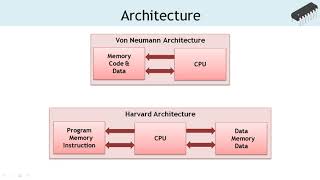
Correct! PIC microcontrollers use Harvard architecture, which separates program and data memory. This separation allows for faster data access. Can anyone explain why faster data access might be important?

It helps in executing instructions more quickly, right?
Exactly! This is essential for performance in embedded applications. Great job!
Instruction Set of PIC Microcontrollers
🔒 Unlock Audio Lesson
Sign up and enroll to listen to this audio lesson

Now let's discuss the instruction set architecture of PIC microcontrollers. Who knows what it means for it to be CISC?

CISC means it has a Complex Instruction Set Computing architecture, which has more complex instructions but can produce smaller code, right?
Exactly right, Student_3! This is advantageous in applications where memory space is limited. How do you think that affects the choice of microcontroller in a design?

It means we can fit more functionality in smaller devices!
Yes! That’s a crucial consideration in embedded systems design. Let's tie that thought back to how specific PIC microcontrollers target different use cases.
Different Series of PIC Microcontrollers
🔒 Unlock Audio Lesson
Sign up and enroll to listen to this audio lesson
Lastly, let's look at the different families of PIC microcontrollers. Can anyone name a few series and their specific uses?
There’s the PIC16 series for simpler applications and PIC18 for more features...
And the PIC32 series for 32-bit tasks!
Correct! The PIC16 series is great for basic tasks, while the PIC32 can handle more advanced projects. What factors might you consider when choosing a microcontroller series for a project?
I think it depends on the required performance, power consumption, and the complexity of the task.
Absolutely! It's essential to match the microcontroller’s capabilities to the project requirements. Well done!
Introduction & Overview
Read summaries of the section's main ideas at different levels of detail.
Quick Overview
Standard
PIC microcontrollers, developed by Microchip Technology, utilize a Harvard architecture that separates program and data memory to allow faster data access. They're predominantly used in embedded systems across different applications due to their 8-bit and 16-bit options, offering adaptability and performance.
Detailed
Detailed Summary
PIC microcontrollers are a key player in the embedded systems landscape due to their simple, modular architecture and versatility in handling various applications. Their design incorporates a Harvard architecture, meaning there are distinct pathways for data and program memory, which enhances data access speeds. The instruction set is based on CISC (Complex Instruction Set Computing), which provides more compact code but at the expense of more intricate instruction complexity. Commonly employed in applications from low-power electronics to high-performance systems, PIC microcontrollers are widely recognized for their adaptability to various use cases. Notable families include the PIC16 series (8-bit), PIC18 series (8-bit with enhanced features), and PIC32 series (32-bit).
Youtube Videos

Key Concepts
-
Harvard Architecture: A model separating program and data storage for efficient processing.
-
CISC Architecture: Allows for complex instructions, optimizing code size.
-
Versatility of PIC Microcontrollers: Applicable in various embedded systems from simple to complex tasks.
-
Different Families: Various series like PIC16, PIC18, and PIC32 suited to different applications and performance needs.
Examples & Applications
PIC16F877A is used widely in industrial applications due to its balance of features and ease of programming.
The PIC32 series is utilized in high-performance tasks like data acquisition and advanced control systems.
Memory Aids
Interactive tools to help you remember key concepts
Rhymes
In PICs we trust, for tasks they adjust, Harvard memory they bust, in electronics they must!
Stories
Imagine a factory where every machine is an assistant. Just like PIC microcontrollers, each has its task, working with separate data and instructions to speedily complete their jobs.
Memory Tools
CISC is 'Compact Instruction Set Code', a reminder that it packs more into less.
Acronyms
PIC
'Programmable Integration Circuit' helps you remember what these microcontrollers essentially are.
Flash Cards
Glossary
- PIC Microcontroller
A family of microcontrollers developed by Microchip Technology, featuring a simple, modular design suitable for various applications.
- Harvard Architecture
A microcontroller architecture that includes separate pathways for data and program memory, allowing faster access.
- CISC
Complex Instruction Set Computing, an architecture that allows for more complex instructions in a compact coding format.
- Embedded Systems
Computer systems integrated within larger systems to perform dedicated functions.
- Instruction Set
The specific commands that a microcontroller can execute, defining its capabilities.
Reference links
Supplementary resources to enhance your learning experience.